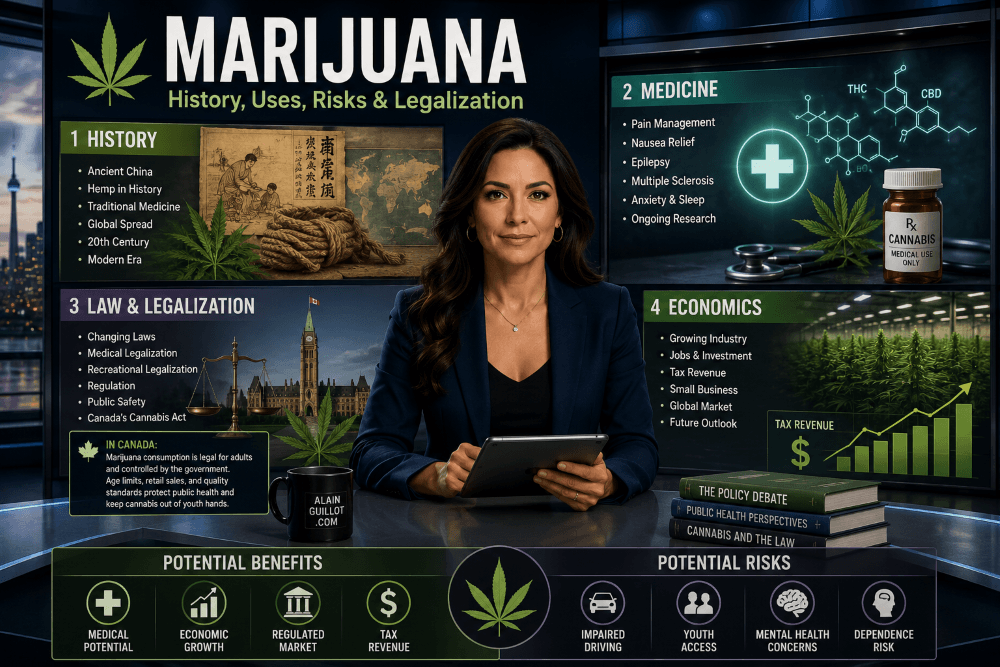
Marijuana has been used by humans for thousands of years for medicine, religious ceremonies, recreation, and the production of hemp. Today, it is one of the most discussed public policy issues in the world. Some countries prohibit it entirely, while others have legalized its medical or recreational use. Understanding marijuana requires examining its history, scientific research, economic impact, and legal status rather than relying on myths or political slogans.
Whether you support legalization or oppose it, marijuana has become an important topic in health care, law enforcement, economics, and public policy.
Marijuana: History, Uses, Risks, and Legalization
The word marijuana generally refers to the dried flowers and leaves of the cannabis plant. The plant contains more than one hundred naturally occurring chemical compounds known as cannabinoids.
The two best-known cannabinoids are:
- THC (tetrahydrocannabinol): the primary psychoactive compound responsible for the “high.”
- CBD (cannabidiol): a non-intoxicating compound that has been studied for potential therapeutic uses.
Humans have cultivated cannabis for thousands of years for different purposes, including fiber, food, medicine, and recreation.
A Brief History of Marijuana
Cannabis has one of the longest recorded histories of any cultivated plant.
Ancient Civilizations
Historical evidence suggests cannabis was used in ancient China more than 4,000 years ago. It was valued for making rope, paper, clothing, and medicinal preparations.
The plant later spread throughout India, the Middle East, Africa, and Europe, where it served both practical and medicinal purposes.
The Twentieth Century

During much of the twentieth century, many countries criminalized marijuana possession and sale.
In the United States, the Marihuana Tax Act of 1937 significantly restricted cannabis, and the “War on Drugs” that followed decades later further increased penalties.
Many nations adopted similar prohibition policies during this period.
The Modern Era
Beginning in the 1990s, several countries started allowing marijuana for medical purposes.
In 2018, Canada became the first G7 nation to legalize recreational marijuana nationwide through the Cannabis Act. Today, adults in Canada may legally purchase cannabis from provincially authorized retailers, subject to federal and provincial rules governing age limits, possession, advertising, and retail distribution. The legal market is regulated by governments with the goals of protecting public health, restricting youth access, and reducing the illegal market.
Several U.S. states and a growing number of countries have also legalized marijuana for medical or recreational use, although laws vary widely.
Medical Uses of Marijuana
Researchers continue to study cannabis for a variety of medical conditions.
Health authorities in some countries permit medical cannabis for certain patients under professional supervision.
Potential medical applications include:
- Chronic pain management
- Nausea related to chemotherapy
- Muscle spasms associated with multiple sclerosis
- Certain forms of epilepsy
- Palliative care
The evidence supporting marijuana differs depending on the condition. For some illnesses, research suggests potential benefits, while for others the evidence remains limited or inconclusive.
Patients should always consult qualified healthcare professionals before using cannabis for medical purposes.
Recreational Use
Many adults use marijuana recreationally because of its psychoactive effects.
People commonly report:
- Relaxation
- Altered perception of time
- Increased appetite
- Enhanced sensory experiences
However, individual responses vary considerably depending on dosage, method of consumption, frequency of use, and personal health.
Health Risks of Marijuana
Like alcohol, tobacco, and many prescription medications, marijuana carries potential risks.
Research has identified several concerns, including:
- Impaired driving ability
- Reduced reaction time
- Short-term memory impairment
- Increased risk of dependence for some users
- Possible mental health effects in susceptible individuals
- Respiratory irritation when smoked
Young people are generally considered at greater risk because the brain continues developing into early adulthood.
Using marijuana responsibly includes understanding both its potential benefits and its possible harms.
The Economics of Marijuana
Legal cannabis has become a significant economic sector.
Governments may collect tax revenue while regulating production and sales.
The legal industry supports employment in:
- Agriculture
- Retail
- Manufacturing
- Scientific research
- Logistics
- Security
- Healthcare
Supporters argue legalization can reduce illegal markets and generate public revenue.
Critics caution that governments must also consider healthcare costs, impaired driving, workplace safety, and public education.
Marijuana Laws Around the World
Cannabis laws vary significantly.
Some examples include:
- Canada: Recreational marijuana is legal and regulated.
- Uruguay: Recreational marijuana is legal.
- Germany: Cannabis laws have become more permissive in recent years.
- United States: Laws differ by state despite federal restrictions.
- Many Asian and Middle Eastern countries: Marijuana possession can carry severe criminal penalties. For example, the penalty for smoking or consuming marijuana in Singapore is up to 10 years in prison, a fine of up to S$20,000, or both.
Anyone traveling internationally should understand the laws of their destination before carrying or consuming cannabis.
Conclusion
Marijuana has evolved from an ancient agricultural crop into one of the most debated public policy issues of the twenty-first century.
Its history spans thousands of years, its medical potential continues to be studied, and its legalization has created new economic opportunities while raising important questions about public health and regulation.
Canada’s decision to legalize and regulate recreational marijuana illustrates one approach to balancing individual freedom, consumer safety, and public health. Whether other countries follow a similar path will depend on their own legal systems, public opinion, and policy priorities.
Understanding marijuana requires looking beyond stereotypes and considering the available evidence, the evolving legal landscape, and the broader social and economic implications.
Frequently Asked Questions
Is marijuana legal in Canada?
Yes. Recreational marijuana is legal for adults in Canada under the Cannabis Act. Production, distribution, and retail sales are regulated by federal and provincial governments.
What is the difference between marijuana and cannabis?
Cannabis is the name of the plant. Marijuana commonly refers to the dried flowers and leaves that are consumed for their psychoactive or medicinal effects.
Is marijuana addictive?
Some people can develop cannabis use disorder. The risk varies depending on factors such as age, frequency of use, genetics, and individual health.
Does marijuana have medical benefits?
Research suggests cannabis may benefit certain medical conditions, including chronic pain, chemotherapy-related nausea, and some forms of epilepsy. However, effectiveness varies by condition, and medical guidance is important.