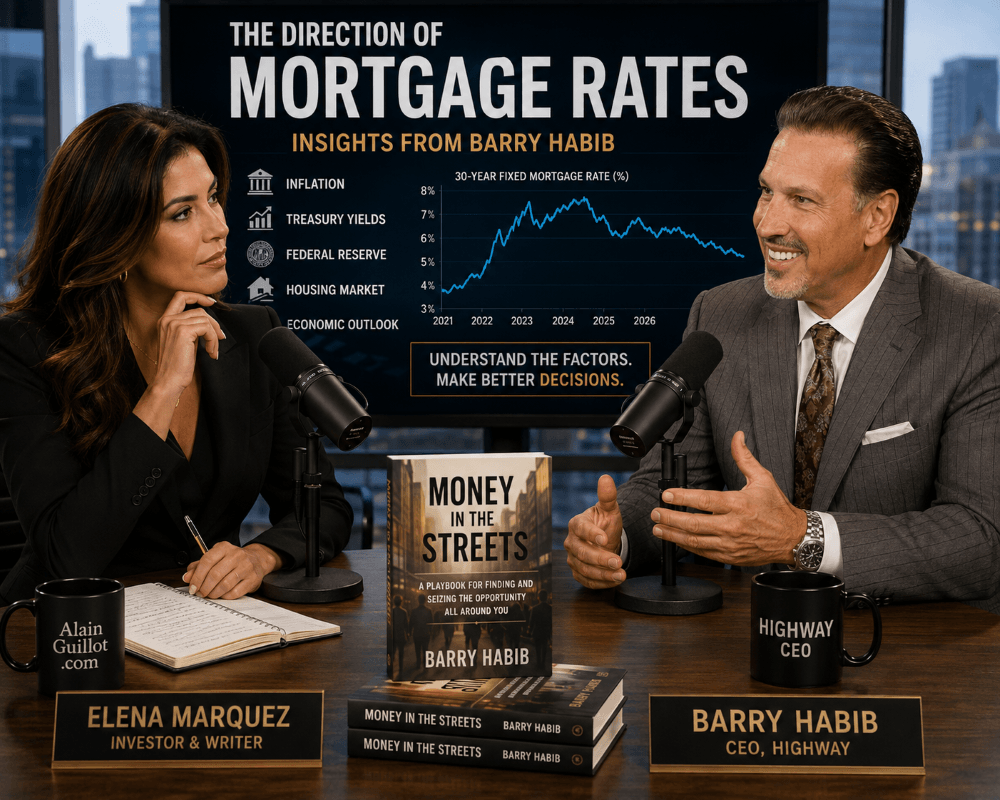
Barry Habib has spent decades studying mortgages, interest rates, housing and financial markets. Understanding his work can also help ordinary investors and homebuyers understand something that is frequently misunderstood: where mortgage rates actually come from.
Turn on the financial news and you might hear that the Federal Reserve raised or lowered interest rates. Many people naturally assume mortgage rates should immediately move by approximately the same amount.
That’s not how it works.
Mortgage rates are influenced by inflation, bond yields, expectations about future Federal Reserve policy, mortgage-backed securities and the risks lenders face.
Understanding those relationships won’t allow you to predict mortgage rates perfectly. But it can make you a much better-informed homebuyer and investor.
Who Is Barry Habib?

He has appeared regularly on Fox Business Network and CNBC Networks, including his Monthly Mortgage Report show, which ran for 13 years on Squawk Box.
Barry Habib is an American entrepreneur, mortgage-market analyst and financial commentator who has spent much of his career studying the housing and mortgage industries.
He is CEO of Highway, a technology and market-intelligence company serving mortgage and real-estate professionals. Habib also serves on the board of directors of Fannie Mae, giving him an interesting perspective on one of the most important institutions in American housing finance.
His career is particularly interesting because it combines entrepreneurship with financial forecasting.
Rather than looking at mortgage rates in isolation, Habib emphasizes the relationships between housing, inflation, employment, bonds and monetary policy.
Those connections are useful even if you never work in the mortgage industry.
Barry Habib and Money in the Streets

Habib is also the author of Money in the Streets: A Playbook for Finding and Seizing the Opportunity All Around You.
The book goes beyond mortgage rates.
Its broader message is about learning to recognize opportunities that other people overlook and having the confidence to act on them. That makes it an interesting inspirational companion to Habib’s more technical work analyzing financial markets.
For entrepreneurs and investors, I think there’s a valuable lesson here.
Opportunities rarely arrive with a sign saying “This is your opportunity.”
We have to develop the knowledge, curiosity and awareness necessary to recognize them.
Habib’s career is itself an example of that philosophy: learn how markets work, pay attention to changing conditions and look for opportunities created by those changes.
Barry Habib: What Determines Mortgage Rates?
The first thing to understand is that there isn’t one person sitting in Washington deciding what your 30-year mortgage should cost.
Mortgage rates emerge from financial markets.
Among the most important influences are:
- Inflation and expectations about future inflation
- U.S. Treasury yields
- Mortgage-backed securities
- Expectations for future Federal Reserve policy
- Economic growth
- Employment conditions
- Investor demand for bonds
- Credit and prepayment risk
- Lender costs and profit margins
These variables interact constantly.
That’s why mortgage rates can sometimes move dramatically even when the Federal Reserve hasn’t changed its policy rate.
Why Doesn’t the Federal Reserve Set Mortgage Rates?
This is probably the biggest misconception about mortgages.
The Federal Reserve influences interest rates, but it does not directly set mortgage rates.
The Fed has much more direct control over very short-term interest rates. Longer-term rates, including fixed mortgage rates, are determined in financial markets and incorporate expectations about where short-term rates, inflation and the economy are heading.
The Federal Reserve itself explains that longer-term mortgage rates depend on the expected path of the federal funds rate, Treasury term premiums and additional risk spreads.
Imagine the Fed cuts its policy rate today.
Mortgage rates could fall.
But suppose investors simultaneously become worried that inflation will remain high for years.
Long-term bond yields could rise.
Mortgage rates could therefore remain high—or potentially even increase—despite the Fed cutting rates.
That surprises many homebuyers.
Why the 10-Year Treasury Yield Matters
If you want to understand American mortgage rates, start paying attention to the 10-year U.S. Treasury yield.
Thirty-year fixed mortgage rates tend to be closely connected to longer-term bond yields rather than simply following the overnight federal funds rate.
Mortgages aren’t identical to Treasury bonds, of course.
Investors demand additional compensation for risks associated with mortgages, including the possibility that homeowners will refinance or repay their mortgages early.
That creates a spread between Treasury yields and mortgage rates.
The Federal Reserve’s July 2026 Monetary Policy Report specifically identifies yields on agency mortgage-backed securities as an important factor in determining home mortgage rates.
A useful simplified relationship is:
Treasury yields + mortgage-market risk/spread = mortgage rates
It’s more complicated in practice, but that’s a much better mental model than assuming:
Fed cuts rates = mortgage rates automatically fall.
How Inflation Affects Mortgage Rates
Inflation is extremely important to bond investors.
Imagine lending someone $300,000 at a fixed interest rate for 30 years.
If inflation unexpectedly becomes much higher, the dollars you receive decades from now will have considerably less purchasing power.
Investors therefore demand higher yields when they expect higher inflation.
Higher bond yields tend to put upward pressure on mortgage rates.
The opposite can happen when inflation falls convincingly.
Lower inflation can give investors greater confidence that future dollars will retain more of their purchasing power. It can also give the Federal Reserve greater flexibility to pursue lower policy rates.
Both forces can help long-term interest rates.
But there’s an important word here:
expectations.
Financial markets don’t wait until inflation reaches a particular number before reacting.
Investors are constantly trying to anticipate what happens next.
What Does Falling Inflation Mean for Mortgage Rates?
Falling inflation is generally favorable for mortgage rates, but it doesn’t guarantee that they will immediately decline.
Markets care about whether lower inflation is sustainable.
Investors also consider:
- Economic growth
- Government borrowing
- Federal Reserve policy
- Employment
- Bond supply and demand
- Global capital flows
- Risk premiums
This helps explain why long-term yields can remain elevated even after the Federal Reserve begins cutting short-term rates.
In February 2026, Federal Reserve researchers noted that the 10-year Treasury yield had remained somewhat above 4% despite 175 basis points of reductions in the federal funds target range over the preceding year and a half.
That’s a wonderful real-world demonstration of why Fed rates and mortgage rates aren’t the same thing.
Can Barry Habib—or Anyone—Predict Mortgage Rates?
Barry Habib has built a reputation partly around analyzing and forecasting interest rates.
But this raises a bigger question:
Can anyone reliably predict mortgage rates?
Not perfectly.
Even the smartest economists, bond traders and Federal Reserve officials are constantly updating their expectations as new information arrives.
An unexpected inflation report can change bond prices within seconds.
So can employment data, economic growth, geopolitical events or an unexpected statement from a Federal Reserve official.
The value of forecasting isn’t necessarily knowing exactly where mortgage rates will be six months from today.
Its greater value is understanding what could cause rates to move.
That’s an important distinction.
Should You Wait for Mortgage Rates to Fall?
Suppose you’re considering buying a home but mortgage rates seem expensive.
Should you wait?
Maybe—but don’t make the decision based solely on a prediction that rates will decline.
If rates fall substantially, something else may happen:
More buyers could enter the market.
More buyers can mean increased competition and potentially higher home prices.
You could therefore save money on your mortgage rate while paying considerably more for the house.
Instead, ask yourself:
- Can I comfortably afford the house at today’s rate?
- Would I still want the house if prices declined temporarily?
- Do I expect to remain there long enough to justify the transaction costs?
- Do I have adequate emergency savings after the purchase?
- Could I refinance later if rates fall significantly?
Trying to perfectly time both home prices and mortgage rates is extraordinarily difficult.
Fixed vs. Adjustable-Rate Mortgages
Another decision involves choosing between fixed and adjustable mortgage rates.
Fixed-rate mortgage
A fixed mortgage provides certainty.
Your interest rate remains unchanged for the specified term, protecting you if market rates rise.
The disadvantage is that you may initially pay more for that certainty.
Adjustable-rate mortgage
An adjustable-rate mortgage can offer a lower initial rate, but your borrowing cost can change.
That can work in your favor when rates decline.
It can become painful when rates rise.
Neither choice is automatically better.
The appropriate mortgage depends on your finances, risk tolerance, how long you expect to own the property and how much uncertainty you can comfortably absorb.
Is Buying a Home Still a Good Investment?
I don’t think a primary residence should be evaluated purely as an investment. A primary home is also a consumption item. Not designed to make a profit. In fact, when considering the opportunity cost of investing in the stock market, buying a home might be a poor investment.
A home provides shelter, stability and personal enjoyment in addition to its financial characteristics.
Financially, homeownership can help people build equity over long periods. But houses also have significant expenses:
- Mortgage interest
- Property taxes
- Insurance
- Maintenance
- Repairs
- Transaction costs
- Opportunity cost of the down payment
Home prices don’t automatically rise every year.
And even when your house appreciates, your actual investment return can be much lower after accounting for all the costs.
The better question may therefore be:
Is this a good home for me at a price I can comfortably afford?
If it also becomes a successful long-term investment, that’s an excellent additional benefit.
In my opinion, people should only buy homes when they are maxed out in their registered investment and have disposable liquidity that they don’t have to optimize.
What Homebuyers Should Watch in the Bond Market
You don’t have to become a bond trader to understand mortgage rates.
I would watch five things:
- The 10-year Treasury yield: One of the most useful indicators of long-term borrowing conditions.
- Inflation: Particularly whether inflation is trending upward or downward.
- Federal Reserve expectations: Not simply what the Fed did yesterday, but what markets expect it to do over the coming years.
- Employment and economic growth: A surprisingly strong economy can keep longer-term rates elevated.
- Mortgage-backed securities: These securities play a direct role in mortgage financing and pricing.
Following these indicators won’t tell you exactly what next month’s mortgage rate will be.
But you’ll understand why rates are moving.
The Bigger Lesson From Barry Habib
What I find most useful about Barry Habib isn’t any individual mortgage-rate prediction.
It’s the habit of looking beneath the headline.
When the Federal Reserve cuts rates, don’t automatically assume mortgage rates must fall.
Ask what is happening to inflation.
Look at Treasury yields.
Think about what bond investors expect five or ten years into the future.
And when everyone around you sees uncertainty, remember the message behind Money in the Streets: uncertainty can also create opportunity for people willing to study what’s happening and act intelligently.
Financial literacy doesn’t allow us to predict the future.
It does something more useful.
It helps us make better decisions when the future is uncertain.
Frequently Asked Questions
Does the Federal Reserve directly set mortgage rates?
No. The Federal Reserve sets a target range for the federal funds rate and influences broader financial conditions. Longer-term mortgage rates are determined by financial markets and are affected by Treasury yields, expected future Fed policy, inflation and mortgage-specific risk premiums.
Why can mortgage rates rise when the Fed cuts rates?
Mortgage rates reflect expectations about the future rather than only today’s federal funds rate. If investors become more concerned about inflation, government borrowing or other long-term risks, Treasury and mortgage yields can rise even while the Fed lowers short-term rates.
What is the relationship between the 10-year Treasury and mortgage rates?
Thirty-year fixed mortgage rates tend to move with longer-term bond yields, including the 10-year Treasury. Mortgage rates normally trade above Treasury yields because mortgage securities carry additional risks and costs.
Should I wait for mortgage rates to fall before buying a house?
Not necessarily. Rates could decline, but lower rates can also bring additional buyers into the housing market and potentially increase home prices. Affordability, your financial situation and how long you plan to own the home are generally more important than trying to perfectly time interest rates.
Other Podcast Posts