Wednesday | Wall Street, the Federal Reserve, and the bond market
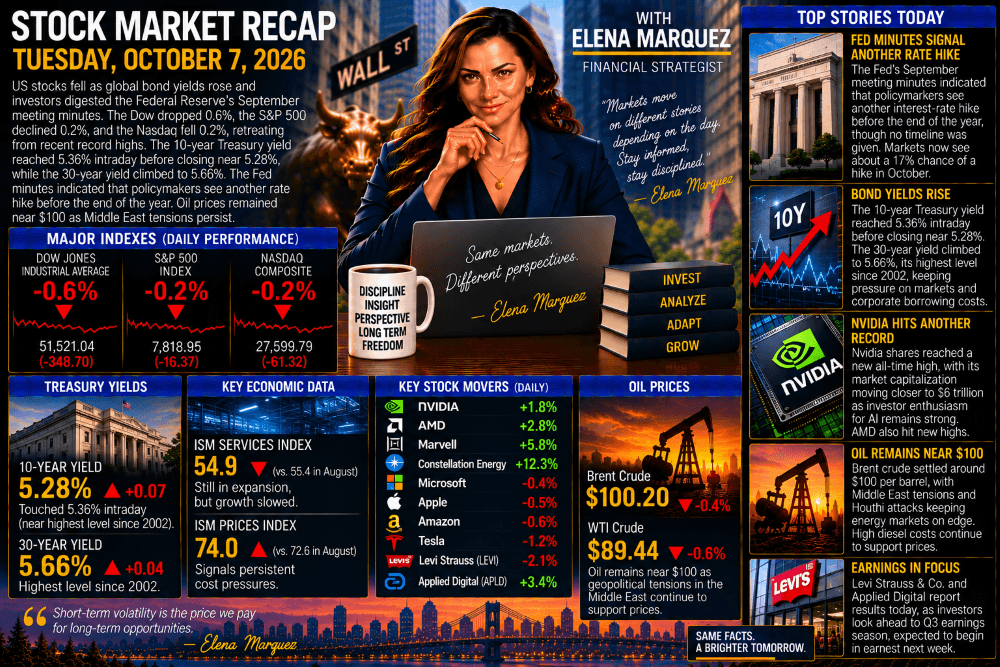
Wall Street’s record-breaking rally hit another obstacle Wednesday: rising Treasury yields.
After two consecutive days of record highs, stocks retreated as investors confronted an uncomfortable reality. The Federal Reserve may be approaching the end of its rate-hiking cycle, but the bond market isn’t necessarily finished pushing borrowing costs higher.
The minutes from September’s Federal Reserve meeting reinforced expectations that another interest-rate increase remains possible before year-end.
Meanwhile, oil prices remained near $100 per barrel, and investors were reminded just how dependent the S&P 500 has become on a handful of technology giants.
The central question: Can the AI boom continue supporting record stock valuations when money remains this expensive?
Wednesday’s closing results
Dow Jones
−0.7%
−348 points
S&P 500
−0.3%
Below record
Nasdaq
−0.3%
Tech retreats
Rounded closing moves, reported by AP.
AP News
The Bond Market Is Back in Control
Wednesday’s most important development wasn’t the decline in stock prices. It was another violent move in government bonds.
The 10-year Treasury yield reached approximately 5.36% intraday, while the 30-year yield climbed above 5.7%, levels not seen since 2002. Both subsequently retreated, with the 10-year near 5.28% and the 30-year around 5.66%.
The Wall Street Journal
+1
Why does this matter?
Because Treasury yields influence borrowing costs throughout the economy.
Higher yields mean more expensive mortgages, business loans, corporate bonds and government financing.
They also make stocks less attractive by offering investors a higher return on relatively low-risk government securities.
For technology companies, the consequences can be especially significant. Much of their valuation depends on profits expected years into the future.
The higher the discount rate, the less those future profits are worth today.
That’s why the bond market can undermine even the most enthusiastic AI rally.
Federal Reserve Minutes: Another Hike Is Possible
The Federal Reserve released minutes from its September meeting Wednesday afternoon.
The central bank had raised its benchmark interest rate by 0.25 percentage points in September, its first increase in three years.
The minutes indicated that most policymakers anticipated another increase before the end of 2026, although they remained divided over the appropriate response to persistent inflation.
Inflation is still running above the Fed’s 2% target, and high energy prices continue complicating the outlook.
AP News
Yet investors aren’t convinced that the next increase will arrive immediately.
Market-implied odds of an October hike were only about 17% Wednesday.
That suggests investors expect the Fed to pause at its upcoming meeting and possibly reconsider tightening later in the year.
There is an important distinction here:
The Fed may stop raising short-term rates temporarily, while long-term Treasury yields continue climbing.
The central bank controls its policy rate. Investors determine long-term bond yields through the prices they’re willing to pay.
And right now, those investors are demanding substantial compensation.
Are Three Companies Holding Up the S&P 500?
Another concern is becoming increasingly difficult to ignore.
The S&P 500 recently reached a record high.
But a significant portion of its performance depends on just three companies:
- Nvidia
- Apple
- Microsoft
Together, they represent roughly one-fifth of the index’s market capitalization.
That concentration has two implications.
First, investors who own an S&P 500 index fund may have more exposure to a few technology giants than they realize.
Second, weakness in those companies can disproportionately affect the entire index.
The S&P 500 includes 500 leading companies, but they don’t all have equal influence.
A company worth several trillion dollars matters much more to a capitalization-weighted index than a smaller constituent.
This isn’t necessarily a reason to avoid index investing.
But it is a reason to understand what investors actually own.
AI Optimism Meets Expensive Capital
For months, artificial intelligence has provided the market with an extraordinary source of optimism.
Nvidia continues benefiting from demand for AI chips.
AMD is expanding manufacturing capacity.
Marvell is forecasting stronger data-center revenue.
Utilities and power companies are signing enormous electricity agreements with technology giants.
Yet all that infrastructure requires capital.
Enormous amounts of capital.
Data centers must be built.
Chips must be manufactured.
Electricity generation must expand.
Transmission networks must be upgraded.
And much of that investment is financed directly or indirectly through capital markets.
When Treasury yields climb above 5%, the financial calculations become more demanding.
The AI industry needs to generate enough future profits to justify both enormous investment costs and increasingly expensive financing.
That’s the central contradiction facing the technology sector.
Oil Remains Near $100
Energy markets provided another source of uncertainty.
Brent crude settled around $100.20 per barrel as investors monitored Middle Eastern supply disruptions, the conflict involving Iran and concerns about diesel supplies.
AP News
Oil matters because higher energy prices can feed directly into inflation.
Transportation becomes more expensive.
Manufacturing becomes more expensive.
Agricultural production becomes more expensive.
Eventually, businesses may pass those costs on to consumers.
This is particularly troublesome when the Fed is trying to bring inflation back toward 2%.
A cooling labor market might reduce wage pressures.
But higher oil prices can push inflation in the opposite direction.
Global Debt Is Becoming a Bigger Story
The Treasury selloff isn’t happening in isolation.
European government bonds have also faced pressure, particularly in France, where fiscal concerns and political uncertainty have unsettled investors.
Meanwhile, IMF Managing Director Kristalina Georgieva highlighted record government debt as a major challenge for the global economy.
Reuters
+1
Governments need to borrow money.
Corporations need to borrow money.
AI companies need to finance infrastructure.
And investors have limited capital to allocate among competing opportunities.
When demand for financing increases, lenders may require higher yields.
This is one reason long-term interest rates can remain elevated even when investors expect the Fed to pause.
Earnings Season Is Almost Here
The next major test for Wall Street will be third-quarter corporate earnings.
Analysts are forecasting approximately 30.6% year-over-year earnings growth for the S&P 500.
Reuters
That’s an extraordinary expectation.
And it helps explain why stocks have remained resilient despite the bond market’s turmoil.
Investors are betting that corporate profits will grow fast enough to justify today’s valuations.
But high expectations create their own risk.
A company can report excellent earnings and still see its stock decline if investors were expecting something even better.
This will be particularly important for AI companies, where optimism is already embedded in stock prices.
Today’s Corporate Developments
Constellation Brands gained about 1.9% after reporting better-than-expected results, although management offered a cautious annual outlook.
Worthington Steel declined approximately 6.5% after disappointing earnings.
Investors are also watching results from Levi Strauss & Co. and Applied Digital as earnings season begins gathering momentum.
AP News
The contrast is revealing.
Strong earnings can still attract buyers, but investors are becoming more selective about which companies deserve premium valuations.
The Bottom Line
| Dow Jones | −0.7% |
| S&P 500 | −0.3% |
| Nasdaq Composite | −0.3% |
| 10-year Treasury | ~5.28% |
| 30-year Treasury | ~5.66% |
| Brent crude | $100.20 |
| October Fed hike probability | ~17% |
Today’s decline wasn’t a dramatic stock-market collapse.
It was a reminder that the forces supporting this rally remain in conflict.
The AI boom promises extraordinary future profits.
The bond market is making those future profits more expensive to finance.
The Federal Reserve is trying to control inflation without damaging employment.
And high oil prices are making that balancing act more difficult.
The Nasdaq and S&P 500 reached records yesterday.
Today, both retreated.
That doesn’t necessarily mean the rally is over.
But it does mean investors should pay attention to something beyond Nvidia’s next record high.
Watch the bond market.
Because when the cost of money changes, the value of almost everything else changes with it.
Other Stock Market blog posts
Leave a Reply