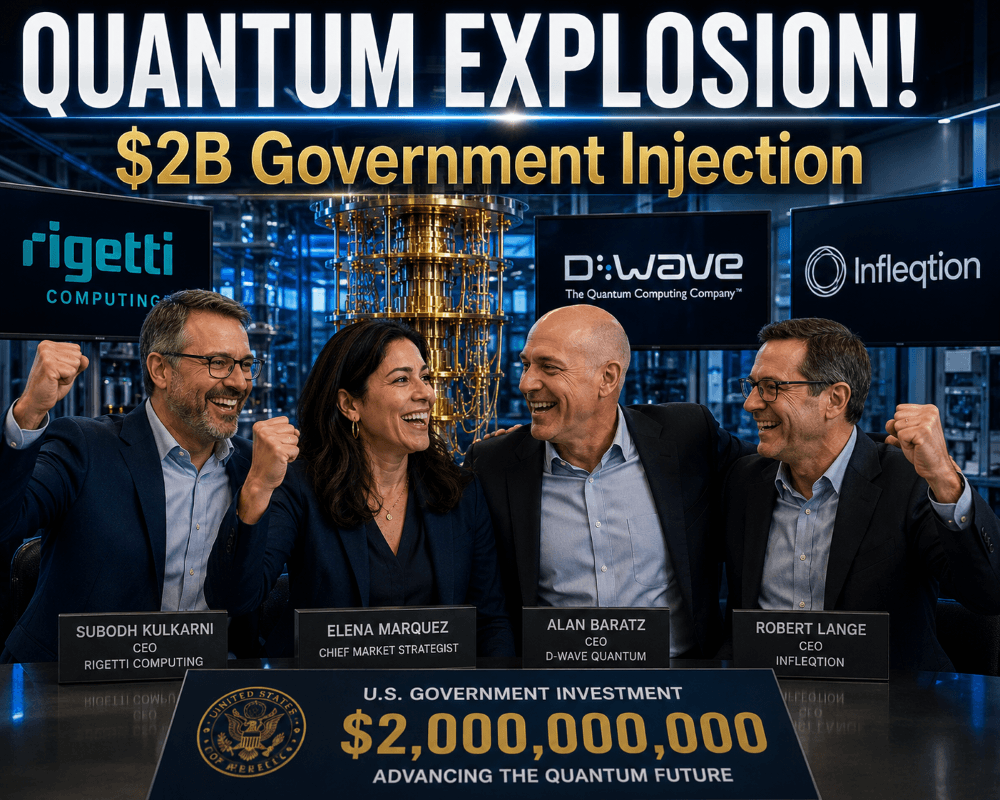
The next technology revolution arrived with a vengeance on Thursday. Quantum computing stocks experienced a massive breakout as several industry players announced landmark agreements with the U.S. Department of Commerce. International Business Machines (IBM) surged more than 7%, while smaller, “pure-play” quantum innovators like D-Wave Quantum (QBTS), Rigetti Computing (RGTI), and Infleqtion (INFQ) skyrocketed about 30%. The explosive rally follows a major shift in Washington’s tech strategy: a $2 billion federal injection distributed across nine quantum-related firms in exchange for minority equity stakes. This is a new way of investing for the Department of Commerce. In the past, they have give grants, just giving the money away, now the government wants a piece of the action.
The $2 Billion Sovereign Wealth Strategy
The Department of Commerce is deploying capital from the CHIPS and Science Act with a distinct twist. Rather than relying solely on traditional subsidies, the government is executing a strategy of funding critical technology companies in exchange for partial ownership interests.
This sovereign-wealth approach has been championed for high-priority industries like semiconductor manufacturing and critical minerals supply chains. Last year, the government took a massive 10% equity position in Intel (INTC), which re-established commercial confidence in domestic chip manufacturing. So far the government has made a few billion dollars in that trade; the stock surged after the government decided to put its thumb on the scale. Now, federal officials are applying the exact same playbook to safeguard America’s edge in the race for next-generation computing power.
Breaking Down the Billion-Dollar Quantum Deals
The $2 billion federal capital pool is distributed among industry giants and agile startups, though the structural allocations vary wildly:
- IBM ($1 Billion): Legacy tech heavyweight IBM signed a Letter of Intent to launch Anderon, a standalone, pure-play quantum foundry in Albany, New York. Backed by $1 billion in CHIPS incentives and $1 billion of IBM’s own cash, Anderon will operate as a state-of-the-art 300mm quantum wafer fabrication facility.
- Rigetti Computing ($100 Million): Rigetti is secured to receive $100 million in federal funding over three years to accelerate its superconducting quantum R&D, in exchange for an equity stake.
- D-Wave Quantum & Infleqtion ($100 Million each): Both companies announced identical $100 million capital injections tied directly to government ownership interests.
The Debate Over Industrial Policy: Winners vs. Losers
In principle, government intervention that attempts to pick winners and losers in a free-market economy can be deeply problematic. However, ignoring the aggressive state-backed industrial successes of international players is impossible.
State-Backed Economic Models: A Global Comparison
Success Case Economies
- Taiwan: Heavily subsidized TSMC creating a global tech moat.
- China: Coordinated national resources backing EV and solar supply chains.
Underperforming Diversification
- Saudi Arabia: Massive state capital deployed via Vision 2030, though mixed non-oil growth results persist.
The U.S. government’s recent stake in Intel has paid off handsomely, generating strong financial returns while injecting fresh stability into a vital domestic market. The multi-billion dollar bet on quantum technology signals an understanding that global tech dominance requires aggressive capital alignment.
Why Investors are Ignoring IBM to Chase Pure Plays
Despite a strong single-day rally, IBM’s stock remains down roughly 6% for the year. Many retail traders view the tech giant as an overly rigid, bureaucratic entity. This structural drag evokes memories of the early computing era, when a nimble and young Bill Gates, founder of Microsoft, outmaneuvered IBM’s internal friction to dominate the personal computer market. The little guy beat the multimillion dolar corporation.
Conversely, smaller enterprises like D-Wave, Rigetti, and Infleqtion represent highly focused “pure plays.” Because these companies are entirely dedicated to quantum development without the structural overhead of legacy mainframe businesses, their equity values respond far more violently to fundamental catalysts. This agility explains why their quantum computing stocks exploded by more than 30% on Thursday, despite receiving smaller absolute funding totals than IBM.
For speculative investors looking to gain early exposure to the impending technology paradigm shift, bypassing IBM to accumulate positions in volatile, high-growth alternatives like QBTS, RGTI, and INFQ offers significantly higher upside potential.
Frequently Asked Questions
Which quantum computing stocks surged from the CHIPS Act funding?
IBM (IBM) rose over 7%, while specialized pure-play stocks like D-Wave Quantum (QBTS), Rigetti Computing (RGTI), and Infleqtion (INFQ) all rallied by more than 20% following the federal announcement.
What is Anderon in Albany, New York?
Anderon is a new, standalone company launched by IBM and backed by a $1 billion Department of Commerce CHIPS award alongside $1 billion in cash from IBM. It will operate as America’s first dedicated 300mm pure-play quantum chip manufacturing foundry.
Why is the U.S. government taking equity stakes in private companies?
The administration uses equity-based funding structures to protect domestic supply chains, maximize taxpayer returns, and counter heavily state-subsidized technology sectors in competing countries like China.
Disclaimer: The information provided in this newsletter is for informational and educational purposes only. It does not constitute investment, financial, or legal advice. I am not a registered investment advisor. All “Buy,” “Hold,” or “Sell” ratings are expressions of personal opinion and should not be construed as recommendations to purchase or sell any security.
Other Stock Market blog posts