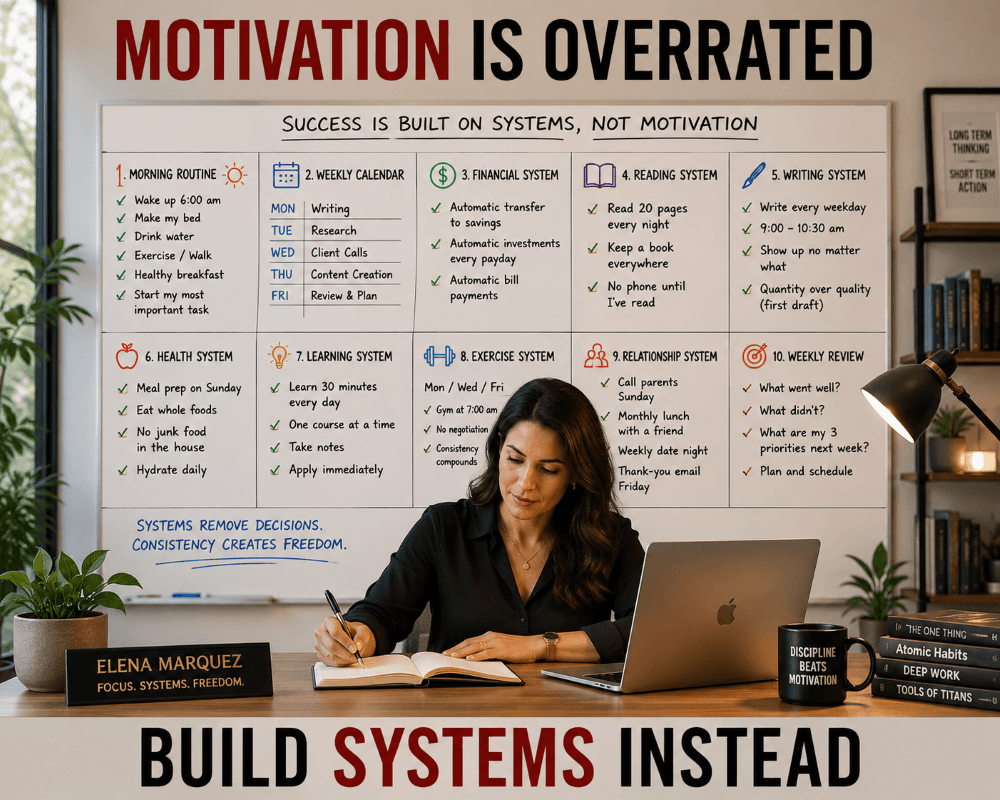
Most people believe successful people wake up every morning overflowing with motivation. They imagine entrepreneurs, athletes, writers, and investors jumping out of bed eager to conquer the day. Occasionaly that happens to me, but not too often.
The truth is much less exciting—and much more useful.
Motivation Is Overrated. Successful people don’t have more motivation than everyone else. They simply build systems that keep them moving even when motivation disappears.
Motivation comes and goes. Systems stay.
If your success depends on feeling inspired every morning, you’ll make progress only on your best days. But if your success depends on routines and systems, you’ll keep moving forward whether you feel motivated or not.
That’s the real secret.
Why Motivation Fails
Motivation is emotional.
Some days you wake up excited. Other days you’re tired, distracted, or discouraged.
Life happens.
If you wait until you “feel like it,” you’ll spend much of your life waiting.
Discipline isn’t about being stronger than everyone else. It’s about removing the need to make the same decision over and over again.
That’s what systems do.
Motivation Is Overrated: Build Systems Instead
A system is simply a process that makes the right action the default choice.
Instead of relying on willpower, you rely on routines.
Instead of hoping you’ll do the work, you make it almost automatic.
Here are twelve systems anyone can build.
1. Build a Morning System
Don’t wake up wondering what you should do.
Create a routine.
For example:
- Wake up at the same time every day.
- Make your bed.
- Drink a glass of water.
- Go for a short walk or exercise.
- Eat a healthy breakfast.
- Begin your most important task before checking social media.
By removing decisions, you conserve mental energy for meaningful work.
I never make my bed, but I wake up, fix coffee, and start working right away. My business relationships are in England and I am in Quebec. By the time I wake up, I already have my mailbox full of messages to answer. After answering the most pressing emails, I do some exercise and have a light breakfast.
2. Create a Calendar System
Many people start the day asking,
“What should I work on today?”
Successful people already know because it’s scheduled.
Instead of keeping a to-do list in your head, assign tasks to specific times.
For example:
- Monday morning: Writing
- Tuesday afternoon: Research
- Wednesday: Client meetings
- Friday: Weekly review
When work has a scheduled place in your calendar, excuses become much harder to make.
After answering many emails, I write one article perday, write a summary of the stock market activity for the day, and go out to dance Salsa.
3. Automate Your Financial System
Saving money shouldn’t depend on self-control.
Instead:
- Automatically transfer money into savings.
- Automatically invest every payday.
- Automatically pay your bills.
Once the system is in place, your wealth grows quietly in the background.
Most of my payments are automated, however there are many that I like to do manually just have more awareness of my personal finances.
4. Develop a Reading System
People often say they wish they read more books.
A better approach is to read twenty pages every evening before bed.
Carry a book everywhere.
Don’t touch your phone until you’ve finished your reading.
Twenty pages a day becomes more than thirty books a year.
5. Create a Writing System
As a writer, I’ve learned that inspiration is unreliable.
Some days the words flow effortlessly.
Other days they don’t.
The solution is simple:
Write at the same time every day.
Some days you’ll produce 300 words.
Other days you’ll write 2,000.
The important thing is showing up.
Professional writers don’t wait for inspiration.
They trust their system.
My personal system is to have many promopts that I write to myself during the day. When I sit down to write, if I don’t a clear idea of what to write at that precise moment, I go to my idea bucket and start writing about it.
6. Build a Healthy Eating System
Most unhealthy eating starts at the grocery store.
If junk food never enters your home, you won’t have to resist it later.
Instead:
- Meal prep on weekends.
- Keep fruit visible.
- Keep healthy snacks within reach.
- Avoid buying foods you know you can’t resist.
Your environment often matters more than your willpower.
I am fortunate. By noon, I need to take a extended break and the supermarket is only about 10 minutes walking distance. I go to the supermarket and buy only the food that I will eat during the next 20 hours.
7. Create a Learning System
Learning shouldn’t happen only when you’re motivated.
Commit to learning for thirty minutes every day.
Whether it’s investing, artificial intelligence, public speaking, or a new language, small daily sessions accumulate into hundreds of hours over a year.
To write blog post, I have learn something new every day; in addition, when I go out to dance salsa, I am also learning new patterns.
8. Build an Exercise System
Don’t negotiate with yourself every morning.
Choose fixed workout days.
For example:
Monday.
Wednesday.
Friday.
Gym at 7:00 a.m.
No debate.
The decision was made months ago.
I do 20 minutes of stretching exercises, 40 minutes of bicycle (I don’t own a car) and at least one hour of dancing, seven days a week.
9. Build Relationship Systems
Healthy relationships require consistency.
You don’t have to wait until you remember.
Instead:
- Call your parents every Sunday.
- Have a monthly lunch with a friend.
- Schedule a weekly date night.
- Send one thank-you message every Friday.
Small habits build lifelong relationships.
10. Create an Information System
Today, many people consume whatever the algorithm serves them.
That’s not a system.
Instead:
Morning:
- Read a book.
- Avoid the news.
Evening:
- Listen to one educational podcast.
- Spend twenty minutes reading quality news.
Consume information intentionally instead of accidentally.
11. Schedule Weekly Reviews
Every Sunday, spend twenty minutes asking yourself:
- What went well this week?
- What didn’t?
- What are my three priorities for next week?
This simple habit prevents small mistakes from becoming large problems.
I do a monthly financial review.
12. Build an Anti-Procrastination System
Large projects feel overwhelming.
Instead of promising yourself you’ll finish the entire task, promise yourself you’ll work for just five minutes.
Starting is usually the hardest part.
Once you’re moving, momentum often carries you much farther than expected.
One of my big secrets is not to own a TV. I can scroll for a few minutes to procrastina, but eventually I get back to work.
Systems Reduce Decisions
One of the greatest advantages of systems is that they reduce decision fatigue.
Every decision consumes mental energy.
Should I exercise today?
Should I save money this month?
Should I write?
Should I read?
Eventually, your brain gets tired of making decisions.
Systems eliminate many of those choices.
You don’t ask yourself whether you’re going to work out.
You already know.
It’s Monday.
You go to the gym.
You don’t wonder whether you’ll save money this month.
The transfer happens automatically.
You don’t debate whether you’ll write today.
Writing starts at 9:00 a.m.
Success becomes less about self-control and more about following a process.
Final Thoughts
People often admire successful individuals because they appear disciplined.
But what they’re really seeing are well-designed systems.
The millionaire who automatically invests every payday.
The author who writes every morning.
The runner who trains every Monday, Wednesday, and Friday.
The reader who finishes thirty books a year.
None of these people rely on extraordinary motivation.
They rely on ordinary routines repeated consistently.
Because in the end, motivation comes and goes.
Systems stay.
And that’s why successful people don’t have more motivation than everyone else.
They simply build systems that keep them moving even when motivation disappears.
Frequently Asked Questions
Is motivation really overrated?
Motivation is useful for getting started, but it is unreliable over the long term. Systems and habits create consistent progress regardless of how you feel.
What is the difference between motivation and discipline?
Motivation is an emotion that comes and goes. Discipline is consistently following a plan even when you don’t feel motivated. Systems make discipline easier.
What is an example of a personal success system?
Examples include automatic investing, exercising on fixed days, writing at the same time every day, reading twenty pages each evening, and conducting a weekly review of your goals.
How long does it take for a system to become a habit?
It varies from person to person and depends on the behavior. The important point isn’t reaching a specific number of days—it’s repeating the behavior consistently until it becomes part of your routine.
Other Personal Development Posts