My new life is starting after 60
I just turned 59. When I was a kid, a person in their 50s was old. It was often a bald man with a big belly, and a cane walking slowly and a bag full of medications.
That is not my case at all. All my hair is there, I am in top shape, My bicycle is my main method of transportation. I dance salsa every day with young girls, and I don’t take any medication.
Since I invested all my money in the stock market, at the end of every year I end up with more money than at the beginning and I don’t think I will ever run out of money.
For me, there is no retirement. Life is just beginning. The world is full of possibilites. This is the new retirement for millions of people like me.
What if retirement isn’t the finish line, but halftime?
The Longevity Revolution is forcing us to rethink almost everything we know about work, money, education, and aging. For the first time in human history, living to 100 is becoming a realistic possibility for millions of people. That means many of us may spend 30 or even 40 years beyond what previous generations considered “retirement.”
As someone who is approaching 60, I find this incredibly exciting. I don’t dream about slowing down. I dream about continuing to write, invest, dance salsa, travel, learn new technologies, and interview fascinating people for decades to come.
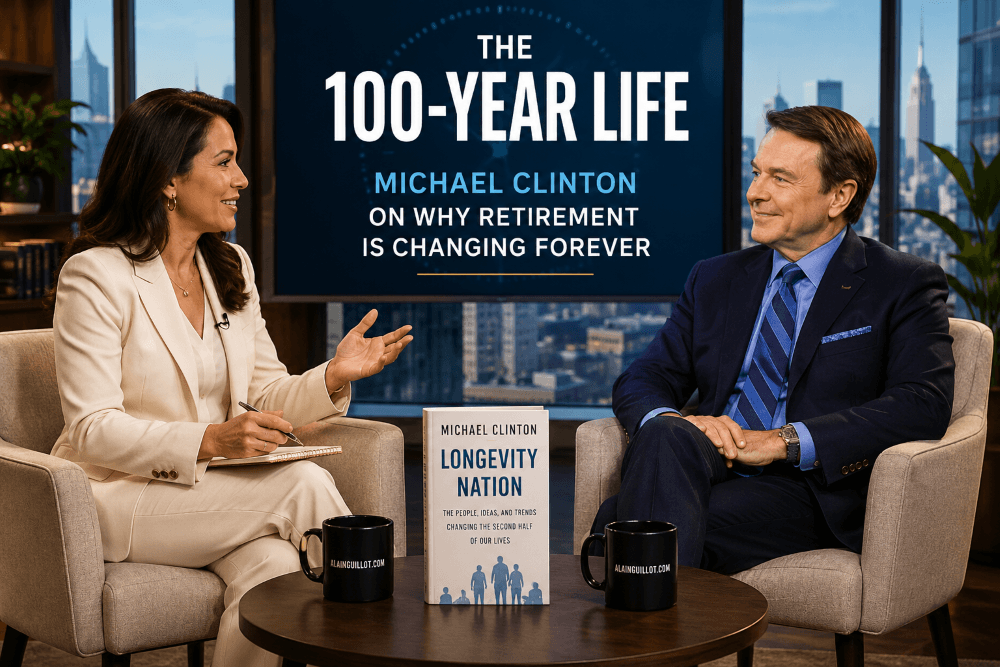
To better understand this new era, our financial analyst, Elena Marquez, sat down with Michael Clinton, former president and publishing director of Hearst Magazines and author of Longevity Nation: The People, Ideas, and Trends Changing the Second Half of Our Lives.
What follows isn’t just an interview. It’s a conversation about one of the biggest demographic shifts in history—and what it means for your financial future.
The Longevity Revolution Is Changing Everything
Retirement Was Designed for a Different World
Elena Marquez
Michael, your book opens with a provocative idea—that retirement is becoming obsolete. Why?
Michael Clinton
Retirement is actually a relatively recent invention.
About one hundred years ago, governments created retirement systems because people generally didn’t live very long. Life expectancy was around 62.
As people began living longer, an entire retirement industry developed around the idea of stopping work and spending your remaining years relaxing.
Today, that model no longer fits reality.
Healthy people reaching 60 may have another 30 or even 40 productive years ahead of them.
That changes everything.
Elena’s Commentary
This was the first idea that truly grabbed my attention.
At AlainGuillot.com, we spend a great deal of time discussing financial independence. Many people assume financial independence means never working again.
I see it differently.
Financial independence means you gain the freedom to choose the work you love.
If you’re going to live until 95 or even 100, why would you stop creating, learning, or contributing at 65?
Perhaps retirement shouldn’t be the goal.
Freedom should be.
The Longevity Revolution Creates Multiple Careers
Elena Marquez
If retirement changes, careers must change too.
Michael Clinton
Exactly.
Future generations won’t have one career.
They’ll likely have three, four, or even five.
Someone might spend twenty years in finance, then become an entrepreneur, later teach at a university, and eventually write books or consult.
The traditional forty-year linear career is disappearing.
Elena’s Commentary
I’ve seen this firsthand.
After interviewing hundreds of entrepreneurs, one pattern keeps repeating itself.
Many of the happiest people didn’t become successful because they stayed in one lane.
They reinvented themselves.
Some became investors.
Others became coaches.
Many launched businesses after fifty.
The Longevity Revolution isn’t extending one career.
It’s giving us permission to have several.
Why Companies Must Think Differently
Elena Marquez
Are businesses prepared for this shift?
Michael Clinton
Most aren’t.
The demographics are simple.
There won’t be enough younger workers to replace older employees.
Companies that embrace lifelong careers, continuous learning, and flexible work arrangements will attract the best talent.
Programs that allow employees to develop new skills throughout their careers will become increasingly important.
Elena’s Commentary
The old corporate ladder may become a thing of the past.
Instead of asking:
“How do I retire?”
We may start asking:
“How do I keep growing?”
That shift alone changes how companies recruit, promote, and retain talent.
Entrepreneurship After 50 Is Becoming a Competitive Advantage
Elena Marquez
One of my favorite chapters discusses entrepreneurship later in life.
Why are older founders succeeding?
Michael Clinton
Because experience compounds.
By your fifties and sixties, you’ve accumulated knowledge, relationships, credibility, and better judgment.
Many people decide they’ve had enough of corporate life and finally build the business they’ve always wanted.
Interestingly, older entrepreneurs often outperform younger founders because they’ve already made—and learned from—their mistakes.
Elena’s Commentary
This couldn’t align more closely with the philosophy of AlainGuillot.com.
I often tell readers:
Your greatest investment isn’t your stock portfolio.
It’s your accumulated knowledge.
Knowledge compounds.
Experience compounds.
Relationships compound.
Unlike youth, these assets become more valuable every year.
Lifelong Learning Is the New Retirement Plan
Elena Marquez
Universities have traditionally focused on young adults.
Will education change?
Michael Clinton
It has to.
If careers last sixty years, education can’t stop at twenty-two.
Universities are already creating certificate programs, executive education, and mid-career training for adults who want to reinvent themselves.
Learning becomes lifelong.
Elena’s Commentary
One of the greatest advantages of living in today’s world is unlimited access to knowledge.
Whether through books, podcasts, online courses, YouTube, or artificial intelligence, learning has never been more affordable.
The people who thrive over the next forty years won’t necessarily be the smartest.
They’ll be the most adaptable.
Creativity Keeps Us Young
Elena Marquez
You also emphasize creativity.
Why?
Michael Clinton
Creative activities stimulate the brain.
Whether it’s writing, painting, music, photography, dancing, or theater, creativity challenges us intellectually while connecting us with other people.
It’s one of the healthiest habits we can develop.
Elena’s Commentary
This answer made me smile.
If you’ve followed AlainGuillot.com for a while, you know Alain dances salsa nearly every day.
That isn’t just exercise.
It’s creativity.
It’s community.
It’s joy.
Longevity isn’t simply about adding years.
It’s about making those years worth living.
Investing in the Longevity Revolution
Where Investors Should Pay Attention
Elena Marquez
Our readers are investors.
What opportunities do you see emerging?
Michael Clinton
The convergence of medicine, biotechnology, and artificial intelligence is only beginning.
AI will accelerate medical research, improve diagnostics, enable precision medicine, and help people live healthier, longer lives.
This entire sector represents one of the biggest long-term investment opportunities of our generation.
Elena’s Commentary
Whenever demographics change, markets change.
As investors, we should always ask:
“Where will the money flow over the next thirty years?”
Healthcare innovation.
Artificial intelligence.
Preventive medicine.
Medical robotics.
Digital health.
Companies serving an aging—but healthier—population.
The Longevity Revolution isn’t simply changing how we live.
It’s creating entirely new industries.
Final Thoughts: Don’t Plan for an 80-Year Life
One lesson kept coming back throughout my conversation with Michael Clinton.
Most people are planning financially for a world that no longer exists.
If you expect to live until 95—or even 100—you need a completely different strategy.
That means:
- Investing for the long term.
- Taking care of your health.
- Continuing to learn.
- Remaining employable.
- Building multiple income streams.
- Staying physically active.
- Keeping your curiosity alive.
Personally, I find this incredibly encouraging.
The future isn’t about getting old.
It’s about staying useful.
One hundred years ago, retirement represented the reward for surviving a lifetime of work.
Today, longevity offers something far more exciting:
The opportunity to reinvent yourself again and again.
And perhaps that’s the greatest gift of all.
Frequently Asked Questions
What is the Longevity Revolution?
The Longevity Revolution refers to increasing life expectancy and the profound changes it creates in careers, retirement, healthcare, education, and investing.
Why is retirement becoming outdated?
Because people are living much longer and healthier lives. Many individuals now have decades of productive years after age 60, making traditional retirement less relevant.
Why are entrepreneurs over 50 often successful?
Older entrepreneurs benefit from decades of experience, professional networks, industry knowledge, financial discipline, and stronger decision-making skills.
How should investors prepare for the Longevity Revolution?
Investors should think long-term, maintain diversified portfolios, prioritize lifelong learning, and consider sectors such as healthcare, biotechnology, AI, and preventive medicine.
Other Personal Development Posts