Motivation even when you feel hopeless isn’t something you find. It’s something you create.
For years, I believed the opposite. I thought successful people woke up inspired while people like me were destined to fail. Looking back, I realize that wasn’t true at all. The difference wasn’t motivation. The difference was action.
I know because there was a time when I felt completely hopeless.
I grew up in Colombia and spent part of my youth involved with drugs and petty crime. I had no direction, no meaningful goals, and no reason to believe my future would be any different from my present. If someone had asked me where I thought I would be in ten years, I probably wouldn’t have had an answer.
I saw myself as a loser.
Then one ordinary day, something extraordinary happened.
Motivation Even When You Feel Hopeless Begins With a Spark
I was flipping through an old issue of National Geographic when I came across a feature about a city I had barely heard of: Montreal.
The photographs were breathtaking.
Tree-lined streets.
Beautiful architecture.
People skating in winter.
Festivals in the summer.
It looked like another world.
To me, it wasn’t simply another city. It was another universe.
At the time, moving there wasn’t just unlikely—it was absurd.
I didn’t speak English.
I didn’t speak French.
I had no money.
I had no friends in Canada.
I had no professional skills.
There was no internet to help me research immigration, housing, or jobs.
I had nothing except curiosity.
Most people would have dismissed the idea immediately.
I couldn’t even allow myself to dream about living there.
But I couldn’t stop thinking about it.
Tiny Actions Changed Everything
Here’s something I’ve learned since then:
Your life doesn’t change because of one giant decision. It changes because of hundreds of tiny decisions.
I didn’t suddenly decide to move to Montreal.
Instead, I took one ridiculously small step.
I visited the local library.
Then I went back again.
I searched for every book I could find about Canada.
I looked through travel guides.
I read newspapers.
I wrote letters asking for information.
Weeks later, I wrote another letter.
And another.
Each action was tiny.
Individually, none of them changed my life.
Together, they changed everything.
Action Creates Motivation
Most people think motivation works like this:
Motivation → Action → Results
Real life is usually the opposite.
Action → Motivation → More Action → Results
Every little thing I learned made Montreal feel slightly less impossible.
Every answer I received in the mail opened another possibility.
Every visit to the library expanded my imagination.
Slowly, something remarkable happened.
Instead of asking,
“Why would someone like me ever move to Canada?”
I began asking,
“What would have to happen for this to become possible?”
That single question changed the direction of my life.
My circumstances hadn’t changed.
I had changed.
And that’s where momentum begins.
Motivation Even When You Feel Hopeless Is Built One Step at a Time
The journey from that first National Geographic magazine to the day I arrived in Montreal wasn’t measured in miles.
It was measured in small, consistent actions.
The process took about four years.
Four years of reading.
Four years of writing letters.
Four years of asking questions.
Four years of imagining possibilities that seemed completely out of reach.
There were countless moments when it would have been easier to quit. Nothing was guaranteed. I had no roadmap, no mentor, and no certainty that my efforts would lead anywhere.
But every small action made the next one a little easier.
That’s an important lesson because many people wait until they feel confident before they begin.
Confidence rarely comes first.
Confidence grows from keeping promises to yourself.
My First Day in Montreal
Eventually, the impossible happened.
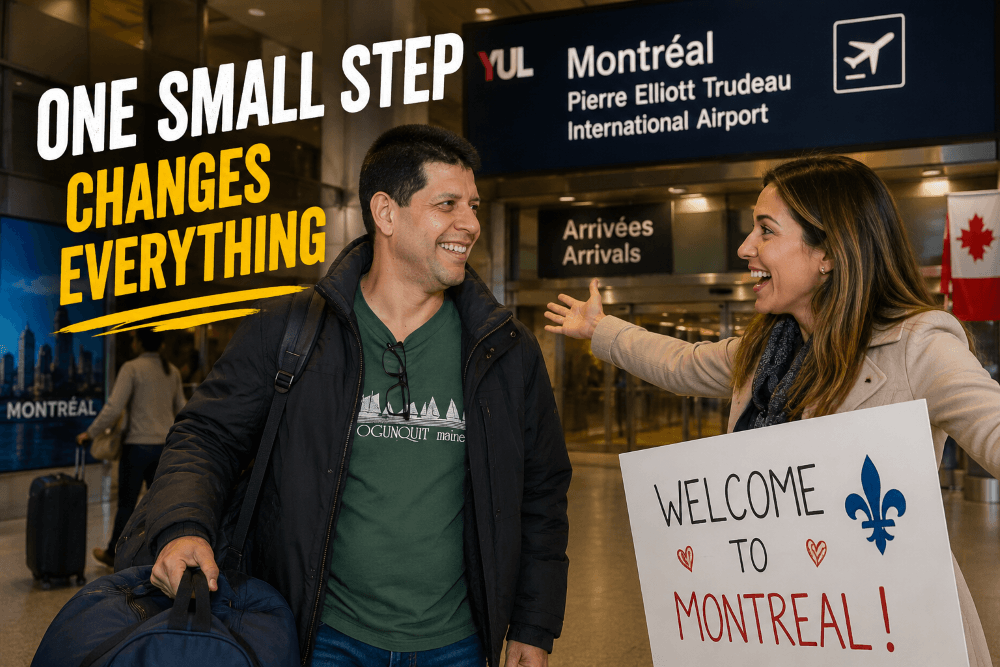
I boarded a plane and landed at Montréal–Pierre Elliott Trudeau International Airport with a small bag of clothes that weren’t nearly warm enough for a Canadian winter.
I didn’t arrive with money.
I didn’t arrive with connections.
I didn’t arrive speaking fluent English or French.
What I did bring was something far more valuable.
I brought four years of momentum.
By then, moving to Montreal no longer felt like an impossible dream. It felt like the natural next step after hundreds of small decisions.
The person who landed in Montreal wasn’t the same person who had stared at those photographs years earlier.
Not because my circumstances had changed overnight.
Because I had changed.
Why Small Actions Matter
People often underestimate the power of tiny actions because the results aren’t immediately visible.
Imagine planting a tree.
For weeks, it looks as though nothing is happening.
Underground, however, roots are spreading in every direction.
When the tree finally begins to grow, it seems sudden.
It isn’t.
The visible growth is simply the result of invisible work.
Personal growth works the same way.
Reading one book won’t transform your life.
Saving your first $100 won’t make you financially independent.
Walking once around the block won’t get you into great shape.
Writing one page won’t produce a bestselling book.
But those actions are how every meaningful achievement begins.
The hardest part isn’t doing something extraordinary.
The hardest part is believing that something ordinary is worth doing today.
Momentum Changes How You See Yourself
Looking back, I realize that the greatest change wasn’t geographical.
It was psychological.
Every small action sent me a quiet message:
“Maybe I’m not the person I thought I was.”
The young man who believed he had no future slowly became someone who solved problems instead of avoiding them.
Instead of saying, “I can’t,” I started asking, “How could I?”
That shift in mindset opened doors I couldn’t even see before.
Our identity is shaped by what we repeatedly do.
If you repeatedly take constructive action—even very small action—you begin to think of yourself as someone who can overcome obstacles.
And once your identity changes, your decisions change with it.
The future doesn’t suddenly become easy.
It becomes possible.
What Happened Twenty-Five Years Later
Today, more than twenty-five years after arriving in Montreal, I sometimes think back to that young man sitting with a National Geographic magazine in his hands.
If I could go back in time and tell him what his future would look like, he probably wouldn’t believe me.
Over the years, I learned two new languages.
I built a career.
I became an entrepreneur.
I invested consistently, even when the stock market was falling and others were panicking.
Little by little, year after year, those small actions accumulated.
Eventually, I achieved something I once believed was reserved for other people.
I became financially independent.
Today, I spend much of my time helping others improve their finances, build better habits, and create lives with more freedom and purpose.
None of that happened because of one lucky break.
It happened because I kept moving forward when I couldn’t see the finish line.
The Biggest Mistake People Make
One of the biggest mistakes people make is believing they need hope before they can act.
In reality, hope often comes after you act.
Think about learning a language.
The first lesson is confusing.
The second isn’t much easier.
But after a few months, you suddenly realize you’re having simple conversations.
The same principle applies to almost every worthwhile goal.
- Starting a business
- Paying off debt
- Losing weight
- Building an investment portfolio
- Writing a book
- Changing careers
At first, progress is almost invisible.
That’s why so many people quit.
They mistake slow progress for no progress.
But slow progress is still progress.
Five Lessons I Wish I Had Learned Earlier
If I could summarize everything I’ve learned, it would be these five lessons:
- Don’t wait until you feel motivated. Start before you’re ready.
- Take the smallest step possible. A tiny action beats a perfect plan that never begins.
- Focus on consistency, not intensity. Small efforts repeated over months and years change lives.
- Protect your imagination. Before reality changes, your vision of what’s possible must change.
- Trust the process. You won’t always see immediate results, but every meaningful achievement is built one step at a time.
These lessons helped me leave behind a life without direction.
They helped me build a future I once thought was impossible.
And they can help you too.
Final Thoughts
If you’re reading this because you feel stuck, discouraged, or hopeless, I want you to know something.
I’ve been there.
Not in exactly the same circumstances as yours, because every person’s story is different.
But I know what it feels like to believe that your future has already been written.
It hasn’t.
The future isn’t created by one giant leap.
It’s created by the next small step.
You don’t need to know how the entire journey will unfold.
You only need to know what you can do today.
Write one email.
Read one chapter.
Take one walk.
Save your first dollar.
Apply for one job.
Have one difficult conversation.
Those actions may seem insignificant.
They’re not.
Little actions create momentum.
Momentum creates confidence.
Confidence creates opportunities.
And opportunities create a life that once seemed impossible.
My journey from a confused young man in Colombia to a financially independent entrepreneur in Montreal began with a single magazine and one simple question:
“What if?”
Perhaps your journey begins today with one small action of your own.
Frequently Asked Questions
Can you find motivation even when you feel hopeless?
Yes. Motivation often follows action rather than preceding it. Taking one small, manageable step can create momentum, making it easier to continue moving forward.
Why do small actions matter so much?
Small actions reduce overwhelm and build consistency. Over time, these seemingly minor efforts compound into significant personal and professional growth.
How do I start when a goal feels impossible?
Break the goal into the smallest possible action. Instead of focusing on the destination, focus on what you can accomplish today.
What if I fail after taking action?
Failure is part of the learning process. Every attempt teaches you something valuable and brings you one step closer to success. The people who ultimately succeed are usually the ones who keep going after setbacks.
Other Personal Development Posts