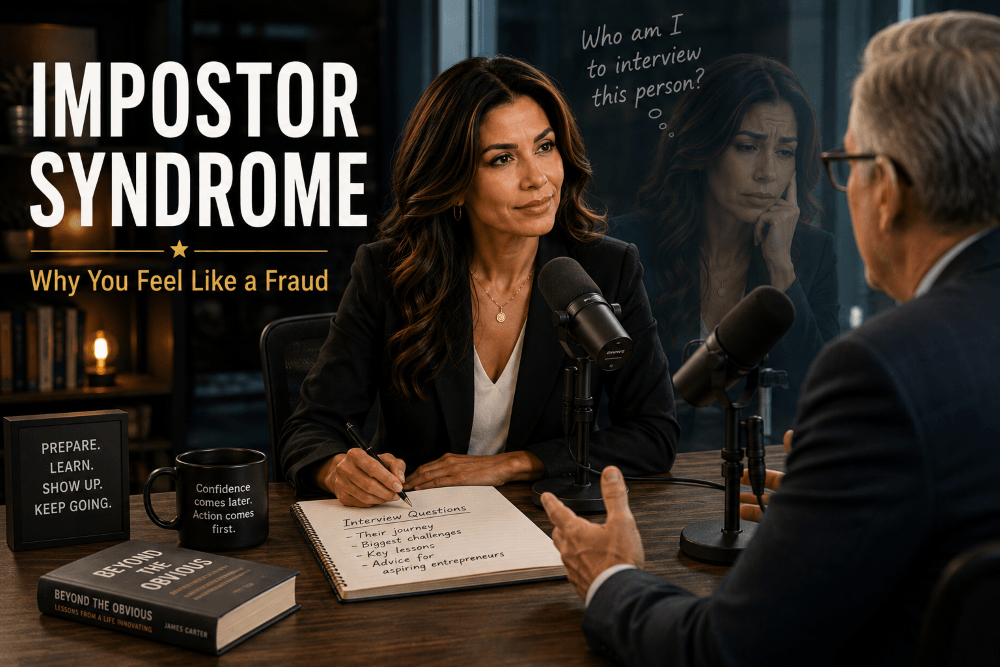
Impostor syndrome is that uncomfortable feeling that maybe you’re not as capable as other people think you are. Despite evidence of your accomplishments, part of you worries that you’ve somehow fooled everyone—and eventually they’ll discover the truth.
I know that feeling.
When I started interviewing people for my podcast, I had plenty of reasons to doubt myself.
English isn’t my first language. I have an accent. I worried that my English wasn’t good enough, that I would make grammatical mistakes, or that listeners would judge the way I spoke.
Then there were my guests.
I was interviewing authors, entrepreneurs, academics and other accomplished people. Sometimes I would look at someone’s biography before an interview and think:
Who am I to interview this person?
They knew more than I did.
They had written books I hadn’t written.
They had credentials I didn’t have.
What if I asked a stupid question?
What if they realized I wasn’t qualified to interview them?
Yet I continued doing it.
And over time, I learned something important about impostor syndrome:
You don’t have to feel confident before you become competent. Sometimes action comes first, competence follows, and confidence arrives later.
What Is Impostor Syndrome?

The concept goes back to psychologists Pauline Clance and Suzanne Imes, who published a paper in 1978 describing what they called the “impostor phenomenon.”
They studied high-achieving women who, despite substantial evidence of their abilities and accomplishments, struggled to internalize their success. They could believe that other people were talented while attributing their own achievements to luck, excessive effort or somehow having fooled others.
The idea has expanded considerably since then.
Research now suggests that impostor feelings aren’t exclusive to women. A large systematic review examining 62 studies involving more than 14,000 participants found impostor feelings among both men and women and across age groups ranging from adolescents to experienced professionals.
That means your successful colleague may experience them.
Your boss may experience them.
The entrepreneur giving the confident presentation may experience them.
And the person interviewing a successful author may certainly experience them.
Is Impostor Syndrome a Mental Disorder?
Despite the name, impostor syndrome isn’t a recognized psychiatric disorder.
It’s not a formal diagnosis in the Diagnostic and Statistical Manual of Mental Disorders, and academic researchers often prefer the term “impostor phenomenon.”
That’s an important distinction.
Feeling uncertain about whether you’re qualified for a new job or nervous about doing something difficult doesn’t automatically mean something is psychologically wrong with you.
Some self-doubt is probably normal.
The problem begins when that doubt prevents you from recognizing your accomplishments, accepting opportunities, taking reasonable risks or doing things you’re perfectly capable of learning to do.
What Does Impostor Syndrome Feel Like?
Impostor syndrome can appear in different ways.
You may:
- Attribute success to luck rather than ability.
- Believe everyone else knows more than you.
- Fear being “found out.”
- Discount compliments or positive feedback.
- Set unrealistically high standards for yourself.
- Compare yourself constantly with other people.
- Overprepare because you’re afraid of making mistakes.
- Avoid opportunities because you don’t feel qualified.
- Assume one mistake proves you never belonged.
- Feel uncomfortable when someone describes you as an expert.
There’s an interesting contradiction here.
The people experiencing impostor feelings aren’t necessarily incompetent.
In many cases, they have plenty of evidence that they’re capable.
They simply have trouble believing the evidence.
Impostor Syndrome Is More Common Than You Might Think
You’ll sometimes encounter claims that a particular percentage of people “have impostor syndrome.”
I would be careful with those statistics.
A major systematic review found estimates ranging from 9% to 82%, largely because researchers used different populations, questionnaires and thresholds.
That’s far too wide a range to declare that “82% of people have impostor syndrome.”
What we can reasonably say is that impostor feelings appear across many occupations, ages and demographic groups.
Research has also found associations between stronger impostor feelings and anxiety, depression, lower job satisfaction and burnout. That doesn’t mean impostor syndrome necessarily causes those problems, but the relationship is another reason not to dismiss persistent self-doubt when it becomes debilitating.
Why Successful People Can Feel Like Frauds
You might imagine that success would eliminate impostor syndrome.
Sometimes it creates new opportunities for it.
You receive a promotion.
Suddenly you’re surrounded by more experienced executives.
You publish your first book.
Now you’re sitting beside authors who have written ten.
You start investing.
You compare yourself with Warren Buffett.
You build a successful business.
Now you’re attending conferences with people running companies ten times larger.
Every time you climb another step, you enter another room containing people who know things you don’t.
That’s not necessarily evidence that you’re an impostor.
It may be evidence that you’re growing.
Sometimes You’re Not an Impostor—You’re a Beginner
This distinction is extremely important.
Suppose someone asks me to perform heart surgery tomorrow.
If I think:
“I’m not qualified to do this.”
That’s not impostor syndrome.
I’m genuinely not qualified.
And there’s nothing wrong with recognizing that.
Sometimes when we feel uncomfortable doing something new, we’re simply inexperienced.
When I started interviewing people, I didn’t know everything.
I wasn’t pretending that I did.
Instead, I prepared.
If I was going to interview someone who knew much more about a subject than I did, I would read.
I would research the guest.
I would read their book.
I would prepare questions.
In other words, I used some of my insecurity as motivation to become better prepared.
That’s very different from allowing insecurity to stop me.
There’s a healthy middle ground between:
“I’m a fraud and shouldn’t be here.”
and
“I’m brilliant and don’t need to learn anything.”
Sometimes the correct answer is:
“I don’t know enough yet. Let me learn.”
Preparation Helps—Until It Becomes Hiding
Preparation can be one of the best responses to self-doubt.
Have an important presentation?
Practice.
Starting a business?
Study the market.
Interviewing someone?
Research them.
Taking on a new professional responsibility?
Learn the skills you don’t yet possess.
But preparation can also become another form of procrastination.
You take one more course.
Read one more book.
Earn one more certificate.
Watch another 50 videos.
And five years later, you’re still “getting ready.”
Eventually you have to enter the arena.
You can prepare for your first podcast interview for months.
Or you can prepare reasonably well, turn on the microphone and discover what you still need to learn.
Perfectionism Feeds Impostor Syndrome
Perfectionism and impostor feelings can make an unpleasant combination.
If your standard is perfection, every mistake becomes evidence against you.
You give a 60-minute presentation that goes wonderfully except for one question you couldn’t answer.
What do you remember afterward?
The question.
You publish 100 articles and one contains an embarrassing typo.
What bothers you?
The typo.
But competent people make mistakes.
Experts don’t know everything.
Successful entrepreneurs make bad decisions.
Good investors lose money.
Good writers write bad sentences.
Good teachers occasionally give bad classes.
Competence doesn’t mean perfection.
Stop Comparing Your Insides With Everyone Else’s Outsides
You have access to information about yourself that you don’t have about anyone else.
You know every insecurity.
Every mistake.
Every moment of confusion.
Every embarrassing failure.
Every time you’ve had absolutely no idea what you’re doing.
With other people, you see the finished product.
The polished LinkedIn profile.
The successful business.
The published book.
The confident interview.
The investment portfolio after 30 years of compounding.
You don’t see the fear that came before it.
That creates an unfair comparison:
Your private doubts versus someone else’s public accomplishments.
You will almost always lose that contest.
How to Deal With Impostor Syndrome
I don’t think the answer is to stand in front of a mirror every morning and tell yourself you’re wonderful.
For me, a more useful approach is to look for evidence and continue taking action.
Here are several strategies worth trying.
1. Create an Evidence File
One thing that has helped me is keeping diaries.
I’ve documented different stages of my financial life, my blogging, my work and other projects.
When I look backward, something interesting happens.
I can see problems that once intimidated me but eventually became ordinary.
Things I didn’t know how to do.
Things I worried about.
Things I eventually learned.
That’s useful evidence.
Create your own evidence file.
Record:
- Accomplishments
- Positive feedback
- Compliments
- Difficult skills you’ve learned
- Problems you’ve solved
- Projects you’ve completed
- Mistakes you’ve recovered from
- Things that used to frighten you
- Moments when someone trusted your expertise
When your brain says:
“You don’t belong here.”
Don’t respond with empty affirmations.
Respond with evidence.
2. Accept Compliments
Someone tells you:
“Great presentation.”
And you immediately respond:
“Oh, it was nothing.”
Why?
Try:
“Thank you.”
You don’t have to explain away your success.
3. Separate Luck From Contribution
Luck exists.
I’ve been lucky many times.
So have most successful people.
But luck and competence aren’t mutually exclusive.
Maybe you were fortunate to meet the right person.
You still had to build the relationship.
Maybe you bought an investment before it increased dramatically.
You still made the investment.
Maybe someone offered you an opportunity.
You still had to do something with it.
Accepting that luck played a role doesn’t require pretending that you played no role.
4. Talk About Your Insecurities
Impostor feelings thrive in secrecy.
Everyone walks into the room pretending to be confident.
Then everyone privately wonders whether they’re the only person who doesn’t belong there.
Talking with trusted colleagues, friends, mentors or peers can reveal how common these feelings are.
5. Learn What You Actually Need to Learn
If your insecurity reveals a genuine weakness, that’s useful information.
Don’t panic.
Learn.
Take the course.
Read the book.
Practice the skill.
Ask someone more experienced.
Not every insecurity is irrational.
Sometimes your brain is correctly telling you:
You need more practice.
6. Don’t Wait for Confidence
This may be the most important lesson I’ve learned.
I could have waited until my English was perfect before interviewing people.
I’d still be waiting.
I could have waited until I knew as much as every guest.
I’d still be waiting.
Instead, I started.
And every interview made the next interview easier.
That’s why I think people often have confidence backward.
We imagine:
Confidence → Action → Competence
But frequently life works like this:
Action → Experience → Competence → Confidence
Do the thing.
Then become better at doing the thing.
Success May Not Make the Feeling Disappear
There’s another trap.
You tell yourself:
“When I accomplish X, I’ll finally feel legitimate.”
Then you accomplish X.
For a few days you feel great.
Soon the goalposts move.
Now everyone at your new level seems more accomplished than you.
So you tell yourself:
“When I accomplish Y, then I’ll feel legitimate.”
And the cycle repeats.
External achievement can provide evidence of competence, but it doesn’t automatically change the story you tell yourself.
At some point, you have to allow yourself to acknowledge:
I earned some of this.
Don’t Let Impostor Syndrome Shrink Your Life
The greatest cost of impostor syndrome isn’t feeling uncomfortable.
It’s what you might not do because of that discomfort.
You don’t apply for the promotion.
You don’t start the business.
You don’t publish the article.
You don’t ask the person on a date.
You don’t teach the class.
You don’t make the investment.
You don’t write the book.
You don’t start the podcast.
You wait until you feel ready.
Then ten years disappear.
This connects with something I’ve written about in How to Achieve Your Dreams: Stop Dreaming and Start Doing.
You don’t need to know the entire path.
You need enough knowledge to take the next reasonable step.
My Impostor Syndrome Never Completely Disappeared
I wish I could finish this story by saying that after enough interviews, all my insecurities disappeared.
Life isn’t that tidy.
There are still people who intimidate me intellectually.
There are still subjects where I feel out of my depth.
I still make mistakes in English.
I still encounter people who know far more than I do.
But that doesn’t bother me the way it once did.
In fact, interviewing someone who knows much more than I do can be an advantage.
I’m curious.
I can ask the questions I genuinely want answered.
And if I don’t understand something, there’s a good chance someone listening doesn’t understand it either.
I don’t have to be the smartest person in the conversation.
I have to be prepared, curious and willing to learn.
Looking back through my diaries also reminds me of something else.
Many of the things I once worried I wasn’t capable of doing eventually became normal parts of my life.
The fear wasn’t necessarily telling me to stop.
Sometimes it was simply telling me:
You’re doing something new.
You Don’t Need Permission to Begin
Maybe you feel like an impostor because you’ve entered a room where everyone seems smarter than you.
Good.
Listen.
Learn.
Ask questions.
Prepare.
Improve.
Maybe you genuinely lack experience.
Become experienced.
Maybe you make mistakes.
Correct them.
Maybe someone knows more than you.
Learn from them.
But don’t automatically interpret discomfort as evidence that you don’t belong.
Growth often feels uncomfortable precisely because you’re operating beyond the limits of what you’ve already mastered.
You don’t have to eliminate every doubt before moving forward.
You don’t need perfect confidence.
You don’t need to convince yourself that you’re the greatest person in the room.
You need enough courage to take the next step.
You don’t have to feel confident before you become competent. Take action, gain experience, improve your skills—and give confidence a chance to catch up.
Frequently Asked Questions About Impostor Syndrome
What is impostor syndrome?
Impostor syndrome, also called the impostor phenomenon, describes persistent feelings of being intellectually or professionally fraudulent despite evidence of competence or achievement. People experiencing it may attribute their success to luck or fear that others will eventually discover they aren’t as capable as they appear.
Is impostor syndrome a mental illness?
No. Impostor syndrome isn’t a recognized psychiatric diagnosis. The term describes a pattern of thoughts and feelings, although research has found associations between stronger impostor feelings and conditions such as anxiety and depression.
How can I deal with impostor syndrome?
Strategies that may help include documenting evidence of your accomplishments, accepting positive feedback, talking about your doubts with trusted people, improving genuine skill gaps, reducing perfectionistic expectations and continuing to take reasonable action even when you don’t feel completely confident. Research into interventions specifically targeting impostor feelings is still developing.
Does impostor syndrome affect successful people?
Yes. The concept originally emerged from observations of accomplished women who struggled to internalize their achievements, and subsequent research has identified impostor feelings among people of different genders, ages and professional backgrounds.
Other Personal Development Posts