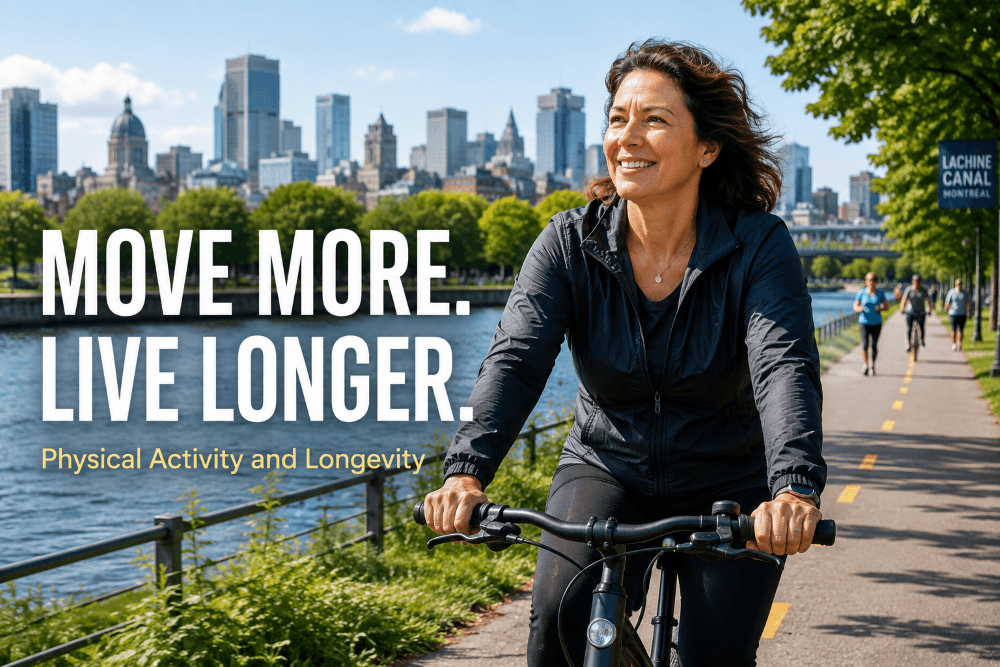
Sitting in front of a computer—or on the couch—for hours every day isn’t doing our bodies any favors. Research on physical activity and longevity consistently points in the same direction: people who move more tend to have better health outcomes and a lower risk of premature death.
Yet modern life seems almost perfectly designed to keep us sitting.
We work at computers. We drive cars. We order food online. We watch television and scroll through our phones. Many people now work from home, eliminating even the walk to the bus stop, train station, parking lot, or office.
Our lives have become extraordinarily convenient.
Our bodies, however, were made to move.
Physical Activity and Longevity: The Cost of Sitting Too Much

There is an important distinction between exercise and physical activity.
Exercise is intentional: going for a run, lifting weights, riding a stationary bike, or attending a fitness class.
Physical activity is broader. It includes walking to the grocery store, climbing stairs, cleaning your apartment, gardening, dancing, cycling to visit a friend, or simply getting up from your desk regularly.
Both matter.
A large meta-analysis published in the British Journal of Sports Medicine examined more than 44,000 middle-aged and older adults whose activity was measured using accelerometers rather than simply asking people how much they exercised.
Researchers found that higher amounts of sedentary time were associated with higher mortality among less-active people. Importantly, about 30 to 40 minutes per day of moderate-to-vigorous physical activity substantially reduced the association between prolonged sitting and mortality.
That’s encouraging.
You don’t necessarily need to become a marathon runner or spend two hours at the gym every day. Consistent movement can make a meaningful difference.
How Much Physical Activity Do We Need?
The World Health Organization recommends that adults get approximately 150–300 minutes of moderate-intensity aerobic physical activity per week, or 75–150 minutes of vigorous activity, or an equivalent combination.
WHO also recommends muscle-strengthening activities involving the major muscle groups at least two days per week.
That works out to roughly 20–40 minutes of moderate physical activity per day.
The exact number shouldn’t become an obsession. The more important principle is remarkably simple:
Move more and sit less.
If you’re currently sedentary, even relatively small increases in activity are worthwhile. You don’t have to go from zero exercise to training for a triathlon.
Start walking.
Take the stairs.
Ride a bicycle.
Dance.
Lift some weights.
Find something you enjoy enough that you’ll actually keep doing it.
My Personal Physical Activity Routine
Because I spend many hours working from home, I make a deliberate effort to move every day.
I have developed the habit of biking for about 40 minutes and dancing for at least an hour a day. Dancing has an additional advantage: it combines physical movement, music, coordination, and social interaction.
I also try to get outside.
I live in Montreal, and I’ll admit that walking outside when it’s -20°C is not particularly appealing. Staying inside my apartment can be very tempting.
But after spending much of the day working at a computer, I need to leave the apartment—not only for my physical health but also for my mental well-being.
I like visiting friends and going to events. Getting out of the house gives me an excuse to walk, explore the city, and interact with other people.
Movement doesn’t always have to look like “exercise.”
Sometimes going to see a friend is exercise.
Sometimes dancing is exercise.
Sometimes walking to a coffee shop is exercise.
The best physical activity may simply be the activity you enjoy enough to repeat tomorrow.
Don’t Forget Strength Training
Cardiovascular exercise gets a lot of attention, but maintaining muscle becomes increasingly important as we get older.
I usually do about 15–20 minutes of weight training before going to bed.
You don’t necessarily need complicated equipment. Depending on your fitness level, strength training can include dumbbells, resistance bands, push-ups, squats, lunges, or other bodyweight exercises.
Maintaining strength can make everyday life easier and help preserve our ability to remain physically independent as we age.
For me, that is one of the most compelling connections between physical activity and longevity.
Living longer is nice.
But living longer while remaining strong enough to travel, dance, carry groceries, climb stairs, and enjoy life is much better.
I Finally Learned to Appreciate Yoga
In the mornings, I also do about 20 minutes of yoga.
I have never been a great believer in yoga. I’ve always preferred activities that feel more active—dancing, cycling, walking, or lifting weights.
But I’ve learned to appreciate what yoga does for me.
It encourages me to stretch my muscles and joints, work on mobility, slow down, and pay attention to how my body feels.
I don’t think everyone needs to practice yoga specifically. But maintaining mobility and flexibility becomes increasingly valuable as we get older.
Exercise Is Also About Mental Health
One reason I exercise has nothing to do with muscles, calories, or cardiovascular fitness.
I simply feel better when I move.
Physical activity can help support mental well-being, and social forms of exercise can provide another important benefit: human connection.
This is particularly relevant for people who work from home.
You can spend an entire day moving between your bed, kitchen, desk, and couch without having a meaningful face-to-face conversation with another human being.
That isn’t how I want to live.
Getting outside gives me movement, fresh air, a change of environment, and opportunities to interact with people.
Those benefits are difficult to measure on a fitness tracker, but they matter.
You Don’t Need a Gym
One of the easiest excuses for inactivity is believing that exercise requires a gym membership.
It doesn’t.
There are countless ways to move your body without going anywhere near a gym:
- Walk around your neighborhood.
- Ride a bicycle or stationary bike.
- Dance in your living room.
- Follow an aerobics or fitness class online.
- Do push-ups, squats, or other bodyweight exercises.
- Use resistance bands or dumbbells.
- Take the stairs instead of the elevator.
- Walk while talking on the phone.
- Get up from your computer periodically and move around.
- Meet a friend for a walk instead of sitting in a café.
It doesn’t matter whether your preferred activity looks impressive.
What matters is that you move.
Don’t Let Perfect Become the Enemy of Good
Some people become discouraged because they think exercise only counts if they do a complete workout.
That’s a mistake.
A 10-minute walk is better than no walk.
Twenty minutes of dancing is better than sitting on the couch.
A short strength-training session is better than waiting until you have enough time for the “perfect” workout.
WHO emphasizes an important idea: some physical activity is better than none.
That may be the most useful fitness advice of all.
Build movement into your life instead of treating exercise as another unpleasant obligation on your calendar.
Physical Activity Is an Investment in Your Future Self
When we think about investing, we usually think about money.
We save and invest today because we want financial security decades from now.
Physical activity works in a similar way.
Every walk, bicycle ride, dance session, yoga routine, and strength workout is a small investment in the person you’ll become 10, 20, or 30 years from now.
Of course, exercise cannot guarantee a long life. Genetics, disease, accidents, nutrition, medical care, luck, and many other factors matter.
But physical activity is one variable we can influence.
I want to keep dancing.
I want to keep traveling.
I want to walk around cities, climb stairs, carry my own groceries, visit friends, and remain independent for as long as possible.
That’s why I move today.
How Are You Doing?
Ask yourself a few simple questions.
Are you moving your body every day?
Are you spending too many uninterrupted hours sitting?
Are you maintaining your strength?
Are you getting outside?
Are you maintaining relationships and spending time with other people?
You don’t need to completely transform your life tomorrow.
Pick one thing.
Go for a walk. Ride your bike. Dance to three songs. Lift some weights. Stretch for 10 minutes.
Then do it again tomorrow.
Your future self may be grateful that you started today.
And if you feel like chatting, send me a message. I answer all my emails.
Frequently Asked Questions
How much physical activity should adults get each week?
The World Health Organization recommends 150–300 minutes of moderate-intensity aerobic physical activity per week, or 75–150 minutes of vigorous activity, or an equivalent combination of the two.
Can exercise compensate for sitting all day?
Research suggests that higher levels of moderate-to-vigorous physical activity can substantially reduce the increased mortality risk associated with prolonged sedentary time. However, it’s still sensible to break up long periods of sitting and incorporate movement throughout the day.
Is walking enough exercise?
Walking can be an excellent form of physical activity, particularly when done at a brisk pace. It can contribute significantly toward weekly aerobic activity recommendations and is inexpensive, accessible, and easy to incorporate into daily life.
Should I do strength training as I get older?
Yes. WHO recommends muscle-strengthening activities involving the major muscle groups at least twice per week for adults. Maintaining strength becomes especially valuable as we age because muscle supports mobility, physical function, and independence.
Other Personal Development Posts