From Chaos to Control: Understanding El Salvador’s Transformation
El Salvador’s transformation from the world’s most dangerous nation to one of the safest jurisdictions in the Americas is a feat many deemed impossible. Just a decade ago, the small Central American nation was synonymous with gang violence, extortion, and a staggering homicide rate.
In 2015, the country recorded a terrifying 106 homicides per 100,000 people. By 2025, that number has plummeted to a microscopic 1.3 per 100,000. Under the leadership of President Nayib Bukele, the nation has undergone a radical shift that has captured the world’s attention.
Through the aggressive “State of Exception,” Bukele’s administration dismantled the shadow government of MS-13 and Barrio 18. This total war on gang structures has allowed the Salvadoran people to finally breathe freely after decades of being held hostage.
The Economic Impact of Security
The primary driver of El Salvador’s transformation has been the restoration of law and order. When a state cannot guarantee the safety of its citizens, the economy inevitably suffocates.
1. The Death of Extortion
For years, small businesses were the lifeblood of the Salvadoran economy, yet they were bled dry by “renta” (extortion). With gang members behind bars, entrepreneurs are keeping their profits. This has led to a surge in local investment and the reopening of shops in formerly “red zones.”
2. The Tourism Boom
El Salvador is now a trending destination for “surf tourism” and international travelers. The “Bitcoin City” initiatives and the rebranding of the coastline as “Surf City” have thrived because travelers finally feel safe exploring the country’s volcanoes and beaches.
3. Foreign Direct Investment (FDI)
Safety is the first metric international investors look for. As the streets cleared of crime, tech companies and international franchises began viewing San Salvador as a viable hub for regional operations.
A New Social Contract: The State of Exception
The catalyst for this change was the 2022 emergency decree. Bukele’s forces executed mass arrests of over 80,000 suspected gang members. This move was not without international pushback, but the domestic results speak for themselves.
- Public Approval: Ratings for the administration consistently hover over 80%.
- Freedom of Movement: Citizens can now cross “invisible borders” between neighborhoods that were previously death sentences.
- Reclaiming Public Space: Parks and plazas that were once gang recruitment grounds are now filled with families and night markets.
Responding to the Critics: Bukele on Human Rights
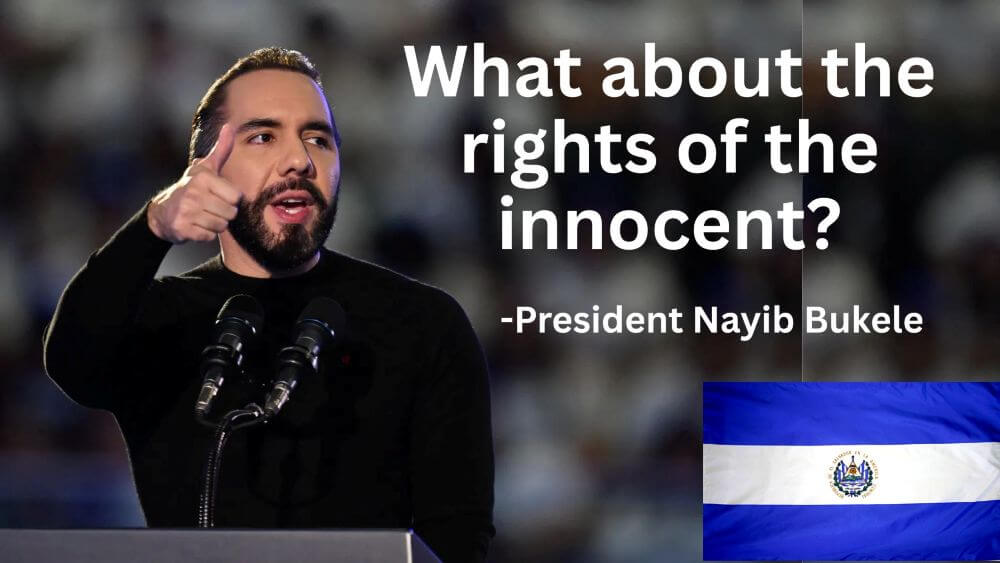
One of the most controversial aspects of El Salvador’s transformation is the criticism from international NGOs regarding human rights. President Bukele has been vocal in his rebuttal, arguing that the “human rights of honest people” must come first.
During a press conference, Bukele delivered a definitive response to these concerns. He addressed the perceived imbalance in how international organizations prioritize the rights of criminals over the rights of victims.
The Full Response from President Nayib Bukele:
“Yes. I have always said that all human beings have rights, and those rights are inherent to being human. That’s why they are called human rights. Others call them natural rights, others fundamental rights — and we all have them. Prisoners have them, criminals have them, drug traffickers have them, gang members have them, rapists have them, murderers have them. Those who have cut off three heads in the street have them. Those who have planted bombs in places where there are children have them. Those who have carried out massacres — they have them. They have human rights.
There are people who say they don’t. I believe they do. It repulses me, but I accept it. They have them.
But what I don’t understand is why the focus is always on their human rights — which they do have — but why is the focus always on the human rights of those who massacre, those who kill children, those who rape women, those who cut off heads? Why are they — who have human rights — the sole priority of human rights organizations?
Here in El Salvador, hundreds of thousands of people were killed, women were raped, children were murdered. There is the story of a young girl we are helping right now who has no arms because gang members threw a bomb at her mother because she hadn’t paid extortion. Her mother died, and she lost her arms in the explosion. There is a grandmother whose hands were cut off because she hadn’t paid, and now she has no hands and continues working to survive.
And nobody stood up for their rights.
Hundreds of thousands of Salvadorans died — and if we look at other countries, it would be millions. People who weren’t harming anyone, who were working, walking down the street, and suddenly three criminals arrived and tried to rape a woman to death.
And I say: “Do they have human rights?” Yes, they do. But what about the woman who was raped and murdered by those three people? No human rights organization came and said, “You must stop raping, you must stop killing. We are going to intervene or spend the billions of dollars we receive to try to prevent this from happening.”
While that was happening, human rights organizations were silent. They said nothing. But let the government arrest those three individuals and put them in prison — and suddenly the concern is whether they are eating well, whether they are receiving medicine, whether they have a mattress. “The poor thing doesn’t have a mattress — we must give him a mattress.”
And the worst part is that these people — who do have human rights and therefore receive food and medical care, etc. — then someone says, “Is that all you’re giving him for lunch? Why is there so little protein?”
And I say, “Do you know what the average Salvadoran eats? A low-income Salvadoran — what does he eat?” And we have to tell him, “Sir, you are going to pay more taxes so that the person who murdered your daughter can eat better.”
So what is happening is this: yes, all criminals have human rights. But what should be the priority for the State? The human rights of working people, honest people, decent people — people who don’t kill, who don’t rape — or the human rights of rapists and murderers?
So we have prioritized the human rights of honest people, and then of course we also consider the human rights of murderers.
All those complaints from those organizations — I would give them some value if they had made complaints before against those who raped, killed, bombed, cut off hands, cut off heads — but they didn’t. Now they only worry about criminals. And I’ve noticed it’s not just in El Salvador; the same thing happens in other countries. You will know whether it happens in Chile. Chileans watching will know whether it happens in Chile — that they only worry about criminals and never say anything about honest people.
To me, it seems like there is something perverse behind these NGOs and so-called human rights organizations. They look more like the legal defense team for criminals.
Now, we do work for human rights. You saw the toughest prison we have, which is CECOT — for people who have killed ten or more people. But you are invited to see the rest of our prison system, where we have training programs. For every day worked, two days are deducted from the sentence. Seventy percent of prisoners in El Salvador will be released in less than a decade. All of them are in rehabilitation programs.
You see them with good attitudes, happy, in the streets repairing schools, cleaning beaches, building the desks your children study at. Because they committed crimes — they are criminals — but they didn’t kill or rape; they committed other crimes. Maybe they broke into a house, maybe they stole a car. That’s wrong, and they deserve prison, but they can be reformed. We believe they can be reformed.
Someone who killed 10 or 20 people — we believe they cannot be reformed.
The Salvadoran prison system is not the best in the world, I’m sure. We don’t have the resources for that, and we are not going to take money from children’s hospitals to spend it on them. But at the Latin American level, it is quite good. Quite good.
Even the figures show it. The number of people who have died in prisons in El Salvador is much lower than in prisons across almost all of Latin America, including Chile proportionally. In fact — something that perhaps shouldn’t be the case, but it’s reality — the percentage of prisoners who die in El Salvador is lower than the percentage of free people who die from natural causes.
Why is that happening? I don’t know. Perhaps because there is more rigorous medical screening inside prison than outside. People outside sometimes don’t go to the doctor, don’t get checkups. But the reality is that the Salvadoran prison system — far from perfect — is one of the best in Latin America.
Additionally, it guarantees that crimes are not ordered from inside. There is no cell signal. Many of you went today — you saw there is no signal. It’s impossible. First, it’s impossible to bring in a cellphone or a computer. But even if someone did, it would just be a paperweight. It wouldn’t work — everything is blocked.
We have a system that does not allow prisons to become criminal headquarters like in other countries. It does not allow murders to be ordered from inside, like in other countries. It does not allow parties like those that used to happen here in El Salvador — parties with prostitutes. They would upload the videos to YouTube from prison.
Gang members would have parties with prostitutes and then upload the videos to YouTube so others could see them. Those videos are probably still on YouTube. YouTube hasn’t taken them down. It’s good they stay there so people can see what used to happen here.
Now that doesn’t happen. No prostitutes, no cameras, no internet to upload videos.
So I believe we have a good prison system. It has been a fundamental pillar in solving the problem of crime in what was once the most dangerous country in the world. Perhaps not having lived in the most dangerous country in the world gives some people the comfort to say, “Maybe we don’t need to go that far.” But the level of disease that existed here — which we cured — and now we are a much safer country than any other in Latin America, much safer than any other — that was the level of medicine we had to apply.
And we have applied it well — taking into account, again, not as priority number one, but as a reality — that criminals do have human rights, and we are taking them into account, but of course prioritizing the human rights of honest people.”
The CECOT and Rehabilitation
A key component of this safety strategy is the Center for the Confinement of Terrorism (CECOT). This mega-prison is designed for high-ranking gang members who have committed heinous acts.
However, Bukele emphasizes that the system is two-tiered. While the “worst of the worst” are isolated to prevent them from ordering hits from inside, others are given a path to redemption.
- Work Programs: Inmates build desks for schools and clean public beaches.
- Sentence Reduction: For every day of work, two days are removed from their sentence.
- Reformable vs. Non-reformable: The state distinguishes between those who stole out of necessity and those who committed mass murder.
Summary: A Blueprint for the Region?
El Salvador’s transformation serves as a provocative case study for the rest of Latin America. By prioritizing the safety of the working class over the procedural comforts of organized crime, Bukele has achieved what many thought was impossible.
While the “State of Exception” continues to stir debate in the halls of the UN, the people of El Salvador are experiencing a new reality: one where children can play in the streets and businesses can thrive without fear.
Frequently Asked Questions (FAQ)
Is El Salvador safe for tourists in 2026? Yes. El Salvador is currently ranked as one of the safest countries in the Western Hemisphere, with homicide rates lower than many major U.S. cities.
What is the “State of Exception”? It is a constitutional tool used by the Bukele administration to suspend certain civil liberties to facilitate the mass arrest and prosecution of gang members.
How has El Salvador’s transformation affected the economy? The country has seen a significant decrease in extortion, a rise in international tourism, and increased domestic consumption as safety has returned to public spaces.
Leave a Reply