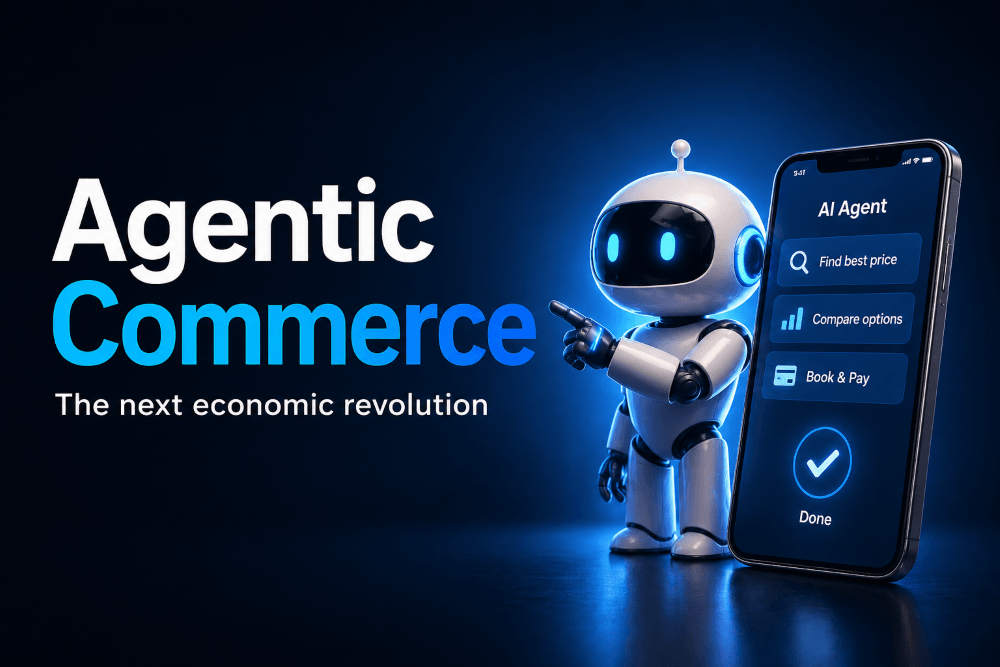
What Is Agentic Commerce?
Agentic commerce is the idea that software—powered by artificial intelligence—can make purchasing decisions and execute payments on your behalf.
Instead of browsing, comparing, and clicking “buy,” your AI agent does it for you.
Companies like Visa Inc. and Mastercard are already building systems to support this shift.
This is not science fiction. It’s the next logical step in automation.
How Agentic Commerce Works
Agentic commerce relies on three layers:
1. Decision Layer (The Agent)
Your AI assistant decides:
- What to buy
- When to buy
- Where to buy
Think of it as a smarter version of a personal shopper.
2. Payment Layer (The Rails)
Once a decision is made, payment happens instantly through:
- Credit cards
- Bank transfers
- Digital wallets
Companies like Stripe and Adyen help enable these transactions.
3. Trust Layer (Security & Identity)
This ensures:
- The AI is authorized
- Spending limits are respected
- Fraud is prevented
Without trust, agentic commerce cannot scale. For businesses implementing these autonomous systems, having reliable IT support services is essential to maintain secure technology infrastructure and protect against cybersecurity risks.
How Regular People Can Use Agentic Commerce
You don’t need to be a programmer to benefit from agentic commerce.
Here’s how it will show up in your daily life:
1. Smarter Shopping
You can tell your AI:
- “Find the cheapest flight next month”
- “Reorder groceries when prices drop”
The agent executes automatically.
2. Subscription Optimization
Your AI can:
- Cancel unused subscriptions
- Switch you to cheaper plans
- Negotiate better deals
3. Financial Automation
Imagine saying:
- “Pay my bills at the lowest cost”
- “Only spend $500/month on discretionary items”
Your AI enforces discipline better than you do.
The Big Winners in Agentic Commerce
Agentic commerce will create enormous winners—but not where most people expect.
🏆 1. Companies That Control the Agent
- Apple
- Microsoft
These companies control the interface.
They decide what gets bought.
🏆 2. Payment Networks (If They Adapt)
- Visa Inc.
- Mastercard
If agentic commerce runs on their rails, they remain dominant.
If not, their margins compress.
🏆 3. Infrastructure Providers
- Stripe
- Adyen
They enable programmable payments for AI systems.
Think of them as the “plumbing” of agentic commerce.
🏆 4. Banks (Conditional Winners)
- JPMorgan Chase
- Royal Bank of Canada
If AI shifts toward direct bank payments, banks gain power.
The Losers in Agentic Commerce
Every disruption creates casualties.
❌ 1. Traditional E-commerce Interfaces
“Add to cart” becomes obsolete.
Your AI doesn’t browse—it executes.
❌ 2. Weak Payment Middlemen
Generic processors without differentiation will be squeezed out.
❌ 3. Merchants With No Pricing Power
AI agents optimize for:
- Lowest price
- Best value
This compresses margins across industries.
❌ 4. Advertising-Driven Discovery
- Meta Platforms
If AI decides what to buy, ads lose influence.
The game shifts from persuasion to optimization.
How Investors Should Think About Agentic Commerce
Agentic commerce is not a trend—it’s a structural shift.
Here’s how to approach it:
1. Follow Control Points
Ask:
- Who controls the agent?
- Who controls the payment rails?
These are the profit centers.
2. Look for “Toll Booth” Businesses
Companies that:
- Take a cut of every transaction
- Provide infrastructure
These scale best.
3. Avoid Commoditized Layers
If a company:
- Doesn’t own the customer
- Doesn’t control pricing
It will struggle.
The Big Idea
Agentic commerce changes one fundamental thing:
Humans stop making purchasing decisions directly.
AI becomes the buyer.
And when that happens, the entire economy reorganizes around:
- Algorithms
- Efficiency
- Price discovery
FAQ: Agentic Commerce
What is agentic commerce in simple terms?
Agentic commerce is when AI agents make and execute purchases on your behalf automatically.
Is agentic commerce already happening?
Yes, early versions exist today through automated payments, subscriptions, and AI assistants.
Will agentic commerce replace credit cards?
Not necessarily. It may use credit cards—or bypass them entirely through bank transfers or new payment systems.
How can investors benefit from agentic commerce?
Focus on companies that control AI agents, payment infrastructure, or transaction networks.
Previous stock market posts