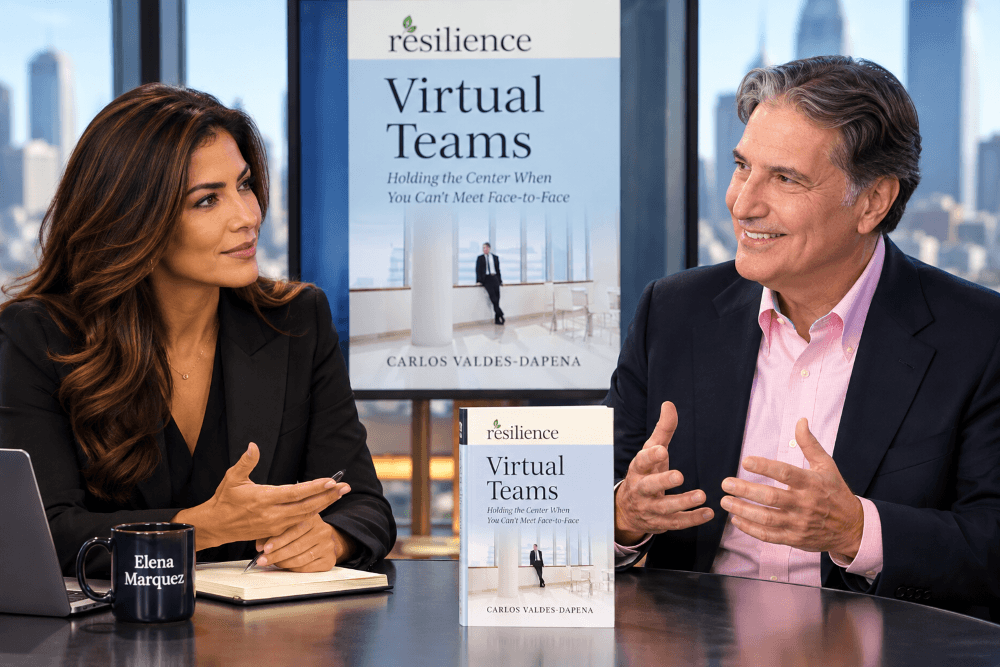
Carlos Valdes-Dapena thinks many companies are approaching teamwork the wrong way.
Businesses spend enormous amounts of time and money trying to turn employees into better team players. They organize retreats, team-building exercises, personality tests, workshops, and countless meetings designed to encourage people to work together.
But what if the answer isn’t more collaboration?
What if the secret to building high-performance teams is knowing when to collaborate—and when not to?
That’s one of the most interesting ideas I took away from my conversation with Carlos Valdes-Dapena, an author, speaker, and collaboration expert who spent 17 years at Mars, Inc. studying how teams actually work.
His conclusion is surprisingly simple:
To collaborate better, collaborate less—and focus your collaboration on the work that really matters.
Who Is Carlos Valdes-Dapena?
Carlos Valdes-Dapena is an organizational development professional, author, speaker, and founder of Corporate Collaboration Resources.
Before starting his own consulting practice, Carlos spent 17 years at Mars, Inc., where he worked on organizational effectiveness and studied collaboration across the company.
Mars gave Carlos an extraordinary laboratory for understanding teamwork.
Instead of simply accepting conventional theories about team building, Carlos and his colleagues looked at how people actually behaved inside a large global organization.
Before Mars, Carlos had also worked with IBM, coaching and consulting with senior leaders. Those experiences in leadership, motivation, business, and organizational development helped shape the approach he would eventually develop at Mars.
What Carlos Valdes-Dapena Learned at Mars
Mars is known for brands such as M&M’s, Snickers, Wrigley, and other products recognized around the world.
Behind those brands are thousands of people who have to make decisions, solve problems, develop products, and coordinate across functions and countries.
Carlos spent years working directly with teams and studying what made collaboration effective.
One of the problems he encountered was that traditional team-building approaches did not always produce lasting improvements.
A team could attend a workshop, complete exercises, talk about personalities, and leave feeling energized.
But then everyone returned to work.
Meetings resumed. Deadlines arrived. Conflicting priorities returned.
The question became:
Did the team-building activity actually change how people worked together?
Carlos began looking for a more practical approach.
His research and work with colleagues at Mars eventually contributed to the development of the High Performance Collaboration framework, or HPC.
Carlos Valdes-Dapena and High-Performance Teams
The central insight behind Carlos Valdes-Dapena’s approach is that collaboration should be intentional.
We tend to assume that more teamwork is automatically better.
It isn’t.
Collaboration has a cost. Every meeting requires people’s time. Every group decision requires coordination. Every additional person involved in a project increases the amount of communication necessary to get the work done.
The objective, therefore, shouldn’t be to maximize collaboration.
It should be to maximize the value created by collaboration.
Great teams determine which work genuinely requires people to work together. They also recognize which tasks are better performed individually.
That’s a very different way of thinking about teamwork.
The Three Imperatives of High Performance Collaboration
Carlos’s High Performance Collaboration framework is built around three fundamental imperatives:
- Clarity
- Intentionality
- Discipline
1. Clarity
People need to understand why they are collaborating in the first place.
What is the team trying to accomplish?
What value can the group create together that its members couldn’t create as effectively by working separately?
Without clarity, collaboration easily turns into meetings, emails, conversations, and activities without a clear purpose.
2. Intentionality
Once people understand why collaboration matters, they can decide deliberately where collaboration is necessary.
This is one of Carlos’s most useful ideas.
Instead of waiting until a problem appears and then asking everyone to help, effective teams identify collaborative work in advance.
They ask:
Which work do we need to do together?
And just as importantly:
Which work don’t we need to do together?
3. Discipline
Good intentions aren’t enough.
Teams need habits and processes that allow them to collaborate consistently.
That can mean agreeing on responsibilities, deciding how decisions will be made, establishing useful meeting routines, checking progress, and periodically evaluating whether the team’s way of working is still effective.
The Six Practices of High Performance Collaboration
Carlos and his colleagues translated those three imperatives into six practical behaviors.
Clarify Context
A team should understand where it fits within the larger organization.
Who does it serve? What results are expected? What business problem exists because this group exists?
Inspire Purpose
The team needs a compelling reason for working together.
The important question isn’t simply, “What are we supposed to do?”
It’s:
“What can we accomplish together that we couldn’t accomplish separately?”
Crystallize Intent
Purpose must eventually become action.
Teams need to identify the specific work that will deliver the results they are trying to create.
Cultivate Collaboration
Once the collaborative work has been identified, determine which relationships are necessary to accomplish it.
Who needs to work with whom?
What does each person contribute?
And what behavior do team members expect from one another?
Activate Ways of Working
Teams need simple processes that support their purpose.
Meetings, communication, decision-making, and accountability should exist to help accomplish the work—not simply because “that’s how we’ve always done it.”
Sustain and Renew
Even successful teams need to learn.
They should periodically examine what’s working, what isn’t, and what needs to change.
High performance isn’t a destination. It’s something a team has to maintain.
Collaborate Less—but Collaborate Better
Perhaps the most counterintuitive lesson from Carlos Valdes-Dapena is that improving teamwork doesn’t necessarily require more teamwork.
Think about the typical workplace.
Eight people attend a one-hour meeting. Two people do most of the talking. Three people occasionally contribute. The remaining three are answering emails while waiting for the meeting to end.
That’s eight hours of human time.
Was collaboration actually necessary?
Maybe the information could have been communicated in an email or shared document.
Now imagine a different situation.
A company is deciding whether to launch a new product. Marketing understands customers. Finance understands the economics. Operations understands production. Sales understands the marketplace.
Bringing those people together may create insights that none of them could produce alone.
That’s valuable collaboration.
The distinction matters.
The question isn’t:
“How can we get everyone to collaborate more?”
It’s:
“Where does collaboration create more value than individual work?”
From Virtual Teams to Today’s Hybrid Workplace
Carlos Valdes-Dapena also wrote Virtual Teams: Holding the Center When You Can’t Meet Face-to-Face.
The book appeared in 2020, when COVID-19 suddenly forced millions of employees around the world to work remotely.
At the time, companies were trying to figure out how to maintain teamwork when employees could no longer share an office.
The circumstances have changed, but the underlying problem hasn’t disappeared.
Remote work, hybrid workplaces, international teams, Zoom meetings, Slack messages, and asynchronous communication have made intentional collaboration even more important.
Technology makes it incredibly easy to include another person in a meeting or copy another colleague on a message.
But easy communication doesn’t necessarily produce effective collaboration.
In fact, it can produce the opposite: over-collaboration.
Carlos’s ideas therefore may be even more useful today than they were when remote work suddenly became widespread.
Lessons From Mars
Carlos is also the author of Lessons from Mars: How One Global Company Cracked the Code on High Performance Collaboration and Teamwork.
The title captures what makes his approach interesting.
These aren’t simply abstract theories about how teams should behave.
The ideas emerged from years of observing and working with teams inside a major global company and asking a practical question:
What actually helps people work better together?
One answer is that teamwork should not be an end in itself.
The purpose of a team is to produce results.
Collaboration is valuable when it helps produce those results more effectively.
What I Learned From Carlos Valdes-Dapena
My biggest takeaway from my conversation with Carlos wasn’t that we need to become better “team players.”
It was almost the opposite.
We have turned collaboration into an unquestioned virtue. If collaboration is good, we assume more collaboration must be even better.
But collaboration has a cost.
It consumes time, attention, energy, and organizational resources.
A one-hour meeting with ten employees doesn’t cost the company one hour. It consumes ten hours of people’s time.
That doesn’t mean meetings are bad.
It means the meeting should create enough value to justify those ten hours.
The same principle applies to teamwork.
Instead of asking:
“How can we collaborate more?”
perhaps managers and employees should ask:
“Where does collaboration actually create value?”
Once you’ve identified that work, collaborate deliberately and do it well.
For everything else, let people work.
That may be one of the simplest ways to build a truly high-performance team.
Watch My Interview With Carlos Valdes-Dapena
In my conversation with Carlos, we discuss teamwork, collaboration, individualism in the workplace, virtual teams, and what he learned from his years working at Mars.
If you lead a team—or simply spend a large part of your working life participating in teams—his ideas may make you reconsider how much collaboration you actually need.
Frequently Asked Questions About Carlos Valdes-Dapena
Who is Carlos Valdes-Dapena?
Carlos Valdes-Dapena is an author, speaker, organizational development professional, and collaboration expert. He spent 17 years at Mars, Inc., where his work contributed to the development of the High Performance Collaboration framework.
What is High Performance Collaboration?
High Performance Collaboration is an approach to teamwork centered on three imperatives: clarity, intentionality, and discipline. The objective is to identify where collaboration creates value and then structure teamwork around that work.
What is Lessons from Mars about?
Lessons from Mars explores what Carlos learned about teamwork and collaboration during his career at Mars, Inc. It challenges some conventional approaches to team building and presents a more intentional way for people to work together.
What does “collaborate less” mean?
Collaborating less doesn’t mean avoiding teamwork. It means avoiding unnecessary collaboration and concentrating people’s collective time and energy on problems where working together produces better results than working independently.
Other Podcast Posts