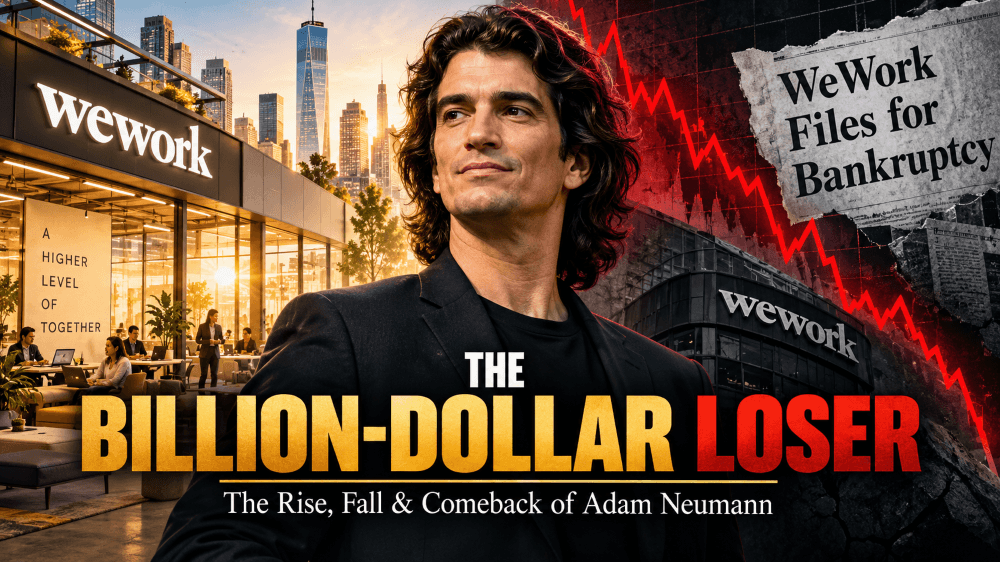

Adam Neumann and WeWork created one of the most extraordinary stories in modern entrepreneurship. WeWork went from a promising coworking startup to a company valued at $47 billion, only to see its planned IPO implode spectacularly in 2019.
But there is something even more remarkable about the story told in Billion Dollar Loser: The Epic Rise and Spectacular Fall of Adam Neumann and WeWork by Reeves Wiedeman.
Adam Neumann may have been the face of one of the biggest corporate fiascos of his generation, but he didn’t exactly end up a loser.
In fact, what happened to Neumann after WeWork might be just as fascinating as what happened while he was running it.
Adam Neumann and WeWork: The Beginning
Adam Neumann was born in Israel in 1979. After serving in the Israeli Navy, he moved to New York, where he attended Baruch College and tried his hand at entrepreneurship.
His early business ideas weren’t exactly revolutionary.
One involved women’s shoes with collapsible heels. Another was a baby clothing company called Krawlers, which sold baby clothes with padded knees.
Neither made him rich.
But then Neumann met architect Miguel McKelvey.
The two created Green Desk, an environmentally friendly shared-office business in Brooklyn. After selling their interest in Green Desk, Neumann and McKelvey launched WeWork in 2010.
This time, Neumann had found his big idea.
WeWork Was Selling More Than Office Space
On the surface, WeWork had a simple business model.
The company leased large amounts of office space from landlords, redesigned the properties into attractive coworking environments, and rented smaller spaces to entrepreneurs, freelancers and companies.
But Adam Neumann wasn’t selling office space.
He was selling a story.
WeWork wasn’t a real-estate company, according to the mythology surrounding it. It was supposedly changing how people worked, lived and interacted.
The company used the language of Silicon Valley rather than commercial real estate.
Employees and investors weren’t merely building an office-rental company. They were supposedly going to “elevate the world’s consciousness.”
And investors bought into the vision.
From Startup to $47 Billion
Money poured into WeWork.
The most important investor was SoftBank, led by Masayoshi Son, who became one of Neumann’s biggest supporters.
At its peak, WeWork achieved a private valuation of approximately $47 billion.
Neumann became a celebrity entrepreneur.
There were company retreats, enormous parties, tequila, private jets and ambitious plans to expand the We brand into housing, education and other industries.
WeWork became We Company.
It launched WeLive.
It created the WeGrow school.
At one point, it seemed as though Adam Neumann wanted to put “We” in front of almost every aspect of human life.
There was only one problem.
The underlying business was losing enormous amounts of money.
The IPO That Exposed Everything
In 2019, WeWork prepared to go public.
This should have been Adam Neumann’s crowning achievement.
Instead, it became his downfall.
When WeWork released the documents required for its initial public offering, public-market investors finally got a detailed look at the company’s finances and corporate governance.
They didn’t like what they saw.
WeWork was losing huge amounts of money while simultaneously committing itself to billions of dollars in long-term leases.
There were also troubling conflicts of interest involving Neumann.
Among the controversies were transactions involving properties connected to Neumann, unusual corporate governance arrangements and Neumann’s extraordinary voting control over the company.
The company’s IPO documents also contained the grandiose language that had helped attract private investors.
Public investors were much less impressed.
The proposed valuation collapsed.
The IPO was withdrawn.
And on September 24, 2019, Adam Neumann stepped down as CEO.
Adam Neumann Lost WeWork—but Didn’t Walk Away Poor
This is where the title Billion Dollar Loser becomes wonderfully ironic.
Neumann lost control of his company.
His reputation was severely damaged.
WeWork’s $47 billion valuation evaporated.
Thousands of employees eventually lost their jobs.
But Neumann himself walked away extraordinarily wealthy.
SoftBank put together a rescue deal for WeWork in October 2019. The original separation arrangements included the opportunity for Neumann to sell nearly $1 billion of stock, a $185 million consulting agreement and access to hundreds of millions of dollars in credit.
The arrangements were later renegotiated following legal disputes between Neumann and SoftBank.
So although Neumann suffered one of the most public entrepreneurial failures in modern business history, he remained a very wealthy man.
It’s difficult to imagine a better illustration of the phrase:
Privatize the gains and socialize the losses.
What Happened to WeWork After Adam Neumann?
Removing Neumann did not solve WeWork’s fundamental problems.
The company eventually reached the stock market in 2021 through a merger with a special-purpose acquisition company, or SPAC.
But the business continued struggling.
Then came the final humiliation.
In November 2023, WeWork filed for Chapter 11 bankruptcy protection in the United States.
Think about that trajectory.
$47 billion valuation → failed IPO → public company → bankruptcy.
WeWork restructured its enormous lease obligations and emerged from Chapter 11 in June 2024 under new ownership and leadership.
The WeWork brand survived.
The financial empire that Adam Neumann had created did not.
Adam Neumann Tried to Buy WeWork Back
Then the story became almost unbelievable.
In 2024, while WeWork was going through bankruptcy, Adam Neumann tried to buy his old company back.
His new company, Flow, and a group of financial partners submitted an offer worth hundreds of millions of dollars for WeWork.
Imagine founding a company, being forced out after its spectacular collapse, watching it go bankrupt—and then returning a few years later trying to buy it at a fraction of its former valuation.
Neumann ultimately abandoned the bid in May 2024.
But he was already working on something potentially much bigger.
Adam Neumann’s Second Act: Flow
In 2022, Neumann announced a new real-estate company called Flow.
If that sounds somewhat familiar, it should.
Flow is focused on residential real estate and attempts to combine housing, technology, services and community.
In other words, Neumann is once again pursuing the idea that real estate can become something larger by combining physical space with community and a powerful brand.
And Silicon Valley gave him another chance.
Venture-capital firm Andreessen Horowitz initially invested about $350 million in Flow.
The investment attracted enormous attention because Flow had barely begun operating and its founder was the man associated with the WeWork disaster.
Yet Neumann demonstrated something that entrepreneurs learn very quickly:
The ability to raise capital is itself an extraordinary entrepreneurial skill.
And investors weren’t finished backing him.
In 2025, Flow raised more than $100 million in additional financing in a round that reportedly valued the company at approximately $2.5 billion.
By 2026, Flow was expanding its residential real-estate operations in South Florida and the Middle East.
Adam Neumann was back.
Was Adam Neumann Really a Failure?
This is the question that stayed with me after reading Billion Dollar Loser.
It’s easy to portray Adam Neumann as an incompetent entrepreneur who somehow convinced investors to give him billions of dollars.
I think that’s too simplistic.
Neumann clearly had remarkable abilities.
He could sell.
He could recruit.
He could inspire employees.
He could attract investors.
He understood branding.
And perhaps most importantly, he could persuade sophisticated people to believe in his vision.
Those are genuine entrepreneurial skills.
His problem was that charisma, storytelling and fundraising became disconnected from economic reality.
A business ultimately has to create enough value to justify what investors are paying for it.
At WeWork, the narrative ran far ahead of the numbers.
The Investors Deserve Some Blame Too
One of the reasons I like Billion Dollar Loser is that the WeWork story shouldn’t simply be interpreted as:
Crazy founder fools everyone.
Many of the people funding WeWork were sophisticated professional investors.
They had accountants.
They had lawyers.
They had analysts.
They understood finance.
And they kept giving Adam Neumann money.
Why?
Because everyone was afraid of missing out.
As WeWork’s valuation increased, skepticism became expensive. If Neumann really was building the next great technology company, investors who passed on WeWork would look foolish.
That created a powerful feedback loop.
Higher valuations attracted more attention.
More attention attracted more money.
More money allowed faster expansion.
Faster expansion justified still higher valuations.
Until eventually someone asked the simplest question:
Does this business actually justify a $47 billion valuation?
The answer was no.
What Entrepreneurs Can Learn From Adam Neumann and WeWork
There are several lessons I took from Billion Dollar Loser.
- Storytelling matters. Neumann’s ability to communicate an enormous vision helped turn an office-leasing business into one of the world’s most valuable startups.
- But storytelling cannot replace economics. Eventually revenue, expenses, debt, cash flow and profitability matter.
- Growth isn’t automatically value creation. A company can grow rapidly while destroying capital.
- Corporate governance matters. Giving a charismatic founder enormous control can become dangerous when there aren’t effective checks and balances.
- Investors are susceptible to FOMO too. Sophisticated investors can make irrational decisions when everyone around them appears to be getting rich.
- Failure isn’t always final. Perhaps the strangest lesson is that reputation works differently at the highest levels of entrepreneurship. Neumann presided over a historic corporate collapse and was still able to raise hundreds of millions of dollars for his next venture.
My Review of Billion Dollar Loser
Reeves Wiedeman has written an entertaining business book rather than a dry corporate history.
Billion Dollar Loser works because Adam Neumann is such an extraordinary character.
He’s ambitious, charismatic, persuasive, excessive and at times almost unbelievable.
But the book is really about more than one entrepreneur.
It’s about startup culture.
It’s about venture capital.
It’s about cheap money.
It’s about charismatic founders.
And above all, it’s about what happens when a great story becomes more important than a great business.
That’s what makes the WeWork story worth remembering.
And knowing what happened afterward makes the title Billion Dollar Loser even more fascinating.
Adam Neumann lost WeWork.
WeWork eventually went bankrupt.
And somehow, a few years later, investors were once again giving Adam Neumann hundreds of millions of dollars to reinvent real estate.
Only in the world of entrepreneurship could a story like that be possible.
Frequently Asked Questions
What happened to Adam Neumann after WeWork?
Adam Neumann stepped down as WeWork CEO in September 2019 after the company’s attempted IPO collapsed. He remained wealthy after leaving WeWork and later founded the residential real-estate company Flow, attracting hundreds of millions of dollars in new investment.
Did Adam Neumann lose all his money when WeWork collapsed?
No. Despite losing control of WeWork and suffering substantial reputational damage, Neumann remained wealthy. His departure involved a complicated financial arrangement with SoftBank that included stock transactions, consulting compensation and financing, with the original terms later renegotiated.
What happened to WeWork?
WeWork eventually became publicly traded through a SPAC transaction in 2021. The company continued struggling financially and filed for Chapter 11 bankruptcy protection in November 2023. It completed its restructuring and emerged from Chapter 11 in June 2024.
What is Adam Neumann doing now?
Adam Neumann is the founder of Flow, a residential real-estate company combining apartments, technology, hospitality and community-oriented services. Flow raised additional capital in 2025 at a reported valuation of approximately $2.5 billion and has continued expanding its real-estate operations.
BILLION DOLLAR LOSER
The Epic Rise and Spectacular Fall of Adam Neumann and WeWork
By Reeves Wiedeman
The author, Reeves Wiedeman, is a Contributing Editor at New York magazine. He has written for The New Yorker, The New York Times Magazine, Rolling Stone, Harper’s, Men’s Journal, and other publications.
Adam Neumann proved one more time that the American Dream is alive and well.
In 10 years Adam Neumann came to the US as an immigrant from Israel and built a business (WeWork) from $0 to a multi-billion dollar enterprise. Never mind that the business fell short of Adam’s own expectations.
It also highlights the different sets of skills necessary to create a business and to run a business. Visionaries generally are not great operators and Adam Neumann proved that one more time.
The book recounts, in chronological order, the life of Adam Neumann, the co-founder of WeWork, and parts of the life of other important characters such as Miguel McKelvey co-founder of WeWork, Rebekah Paltrow (Adam’s wife), and Masayoshi Son, a Japanese venture capitalist who also came to the US with no money and right now is one of the wealthiest venture capitalists in the world.
Adam Neumann came to the US with the preset idea of building wealth. He was dreaming big right from the start. Nothing in his past showed signs of out of the ordinary intelligence, business savvy, or self-confidence. It’s my understanding that he had a deluge of grandiosity.
He created two businesses that failed, but when he met Miguel McKelvey, something seemed to click. They got along very well and they decided to create their first business together, Green Desk in 2008, a shared-workspace business focusing on sustainability.
The business ideal was very simple and easy to understand. In 2008, in the aftermath of the financial crisis, they leased a space on long term basis, they chopped it up into smaller spaces and rented it out for short term at a higher rate.

There was nothing revolutionary nor groundbreaking about this business model, yet Adam Neumann was able to convince investors that he was doing something different and special and investors were willing to give him more and more money to expand and grow his vision.
The amazing superpower Adam Neumann had was that he was able to draw a picture in the sky representing his vision and people would see the same picture, would feel convinced that it was a great business opportunity, and would write a check to own a part of that dream.
Unfortunately Adam Neumann was a better storyteller than a business operator. He was also a pot smoker, and a big spender. As he got more and more funding to finance his dream, his actions became more erratic.
The crescendo of his fantasy world materialized when he met Masayoshi Son, a Japanese venture capitalist
What was the problem with WeWork? The problem was that was not making a profit. It was making big promises, but it was not sustainable.
As investors chipped in, Adam Neumann’s dream continued to grow, but eventually, he ran out of investors and the whole castle in the sky began to crumble.
As a last-minute ditch for more capital, Adam Newmann decided to do an IPO (Initial Public Offering). The problem was that the SEC (Security Exchange Commission) found too many irregularities in the filing and the spell of Neumann’s stories were beginning to dispel.
Eventually, the IPO was canceled. Neumann was ousted from his position of CEO, but with a golden parachute of one billion dollars.
The way the author, Reeves Wiedeman, tells the story is captivating and riveting. Not only do we learn about the rise and fall of WeWork and Adam Newmann, but we also learn the ins and outs of venture capitalism and thus the book becomes entertaining and educational. It’s also a cautionary tale for investors and founders with little or no restrain.

By buying the book with our link, you will be helping this blog.
Final score. 4 stars ⭐. The book is entertaining and educational, but it’s about a current topic that will not be current in a few months. In other words, the book has a short shelf life. In a few months, there will be more current and salacious dramas which will get all the attention. In the same way that people don’t talk or care that much about the life of John D. Rockefeller, no one will care about the life of Adam Neumann.
Related Posts