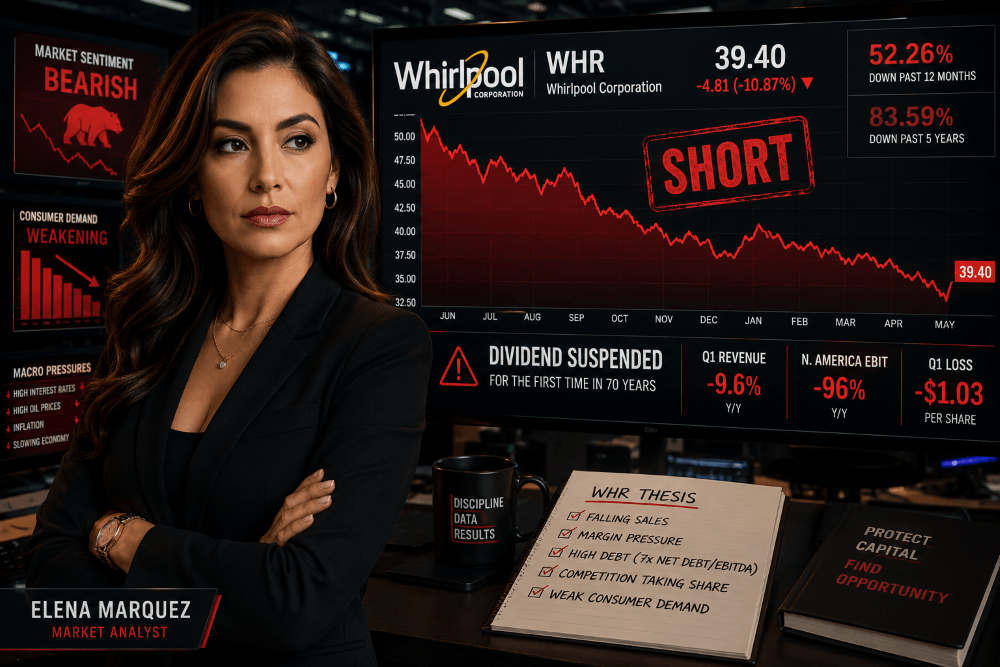
I initiated a short position in WHR at $39.40 on May 18th because I believe the company continues to face structural and cyclical problems that could push the stock significantly lower in the coming months.
The bearish case against Whirlpool is not based on one bad quarter alone. The company has been deteriorating for years, and recent results suggest management still has not found a convincing path forward.
After losing more than 52% of its value during the past 12 months and more than 83% over the last five years, Whirlpool appears trapped in a long-term downtrend fueled by weakening consumer demand, declining profitability, and rising financial pressure.

A Business Losing Consumer Relevance
Whirlpool was once one of the most respected appliance manufacturers in North America. Today, the company appears to be losing market share while consumer preferences evolve and competition intensifies.
The recent quarterly report reinforced many investor concerns:
- Revenue declined 9.6% year-over-year
- North American EBIT plunged 96%
- The company reported a quarterly loss of $1.03 per share
- Whirlpool suspended its dividend for the first time in roughly 70 years
Dividend suspensions are often major warning signs. Management typically avoids cutting dividends unless financial stress becomes severe. For income investors, this decision likely destroyed one of the few remaining reasons to hold the stock. And generally, short sellers stay away from companies who pay dividends.
Rising Prices Could Backfire
One of Whirlpool’s responses to its financial challenges has been implementing its largest price increase in more than a decade.
That strategy may help margins temporarily, but it also creates new risks.
Consumers are already under pressure from:
- Higher interest rates
- Elevated oil and energy prices
- Persistent inflation
- Weak housing activity
- Reduced discretionary spending
In a fragile economy, higher appliance prices may simply push consumers toward competitors offering cheaper alternatives.
This is especially concerning in a “K-shaped economy,” where wealthier households continue spending while millions of middle- and lower-income consumers reduce purchases and delay replacing major appliances.
The Long-Term Numbers Remain Weak
The deeper problem with Whirlpool is that the negative trend has persisted for years.
Revenue Continues Declining
Sales have fallen approximately 5.8% annually over the last five years. That is not a temporary slowdown — it suggests the company is struggling against broader market trends.
When a company experiences declining sales over such a long period, investors must ask whether the problem is cyclical or structural.
At this stage, Whirlpool increasingly looks like a structural decline story.
Free Cash Flow Is Deteriorating
Whirlpool’s free cash flow margin declined by 5.4 percentage points during the past five years.
This matters because free cash flow is what companies use to:
- Reduce debt
- Pay dividends
- Repurchase shares
- Invest in future growth
Shrinking cash flow limits management’s flexibility precisely when the company needs it most.
Whirlpool’s Debt Could Become Dangerous
One of the most concerning aspects of the Whirlpool bear thesis is leverage.
The company reportedly carries a net debt-to-EBITDA ratio near 7×. That level of leverage becomes extremely dangerous when earnings are falling rapidly.
If macroeconomic conditions worsen further, Whirlpool could face:
- Credit rating pressure
- Higher refinancing costs
- Reduced strategic flexibility
- Potential shareholder dilution
Debt is manageable during economic expansion. It becomes a major threat during recessions.
Why I Believe WHR Could Reach $35
My short-term target on WHR is currently $35 per share.
That target reflects several ongoing risks:
- Weak consumer demand
- Continued earnings pressure
- Declining housing activity
- Margin compression
- Competitive pricing pressure
- Elevated debt levels
- Reduced investor confidence after the dividend suspension
The stock market often punishes companies that lose investor trust, especially when management appears reactive rather than proactive.
At the moment, Whirlpool looks more like a company defending against decline than one positioning for future growth.
What Could Prove This Bear Thesis Wrong?
Every short thesis carries risk.
Several developments could invalidate the bearish outlook:
- Strong improvement in consumer spending
- Lower interest rates boosting appliance demand
- Successful restructuring efforts
- Faster-than-expected debt reduction
- Significant market share recovery
- An offer to buy the company at a premium
- Higher tariff on international competitors
A leadership change or major operational turnaround could also shift investor sentiment quickly.
For now, however, I believe the broader trend remains negative.
Final Thoughts
Whirlpool’s problems appear larger than one disappointing earnings report. The company faces weakening demand, shrinking profitability, rising leverage, and increasing competitive pressure.
While many investors search for bargains among heavily beaten-down stocks, some companies become “value traps” — businesses that look cheap but continue deteriorating fundamentally.
At current conditions, Whirlpool may still have further downside ahead.
Frequently Asked Questions
Is Whirlpool stock a good short-selling candidate?
Some investors believe Whirlpool faces significant long-term challenges, including declining sales, high debt, and weak consumer demand, making it a potential short candidate.
Why did Whirlpool suspend its dividend?
The dividend suspension appears tied to financial pressure, declining profitability, and management’s desire to preserve cash and reduce debt.
What risks exist when shorting WHR stock?
Short selling carries substantial risk. Positive earnings surprises, lower interest rates, or improved consumer spending could trigger sharp rallies.
Could Whirlpool recover in the future?
Yes. A successful restructuring, debt reduction, or stronger housing market could improve Whirlpool’s outlook over time.
Disclaimer: The information provided in this newsletter is for informational and educational purposes only. It does not constitute investment, financial, or legal advice. I am not a registered investment advisor. All “Buy,” “Hold,” or “Sell” ratings are expressions of personal opinion and should not be construed as recommendations to purchase or sell any security.
Other Stock Market blog posts