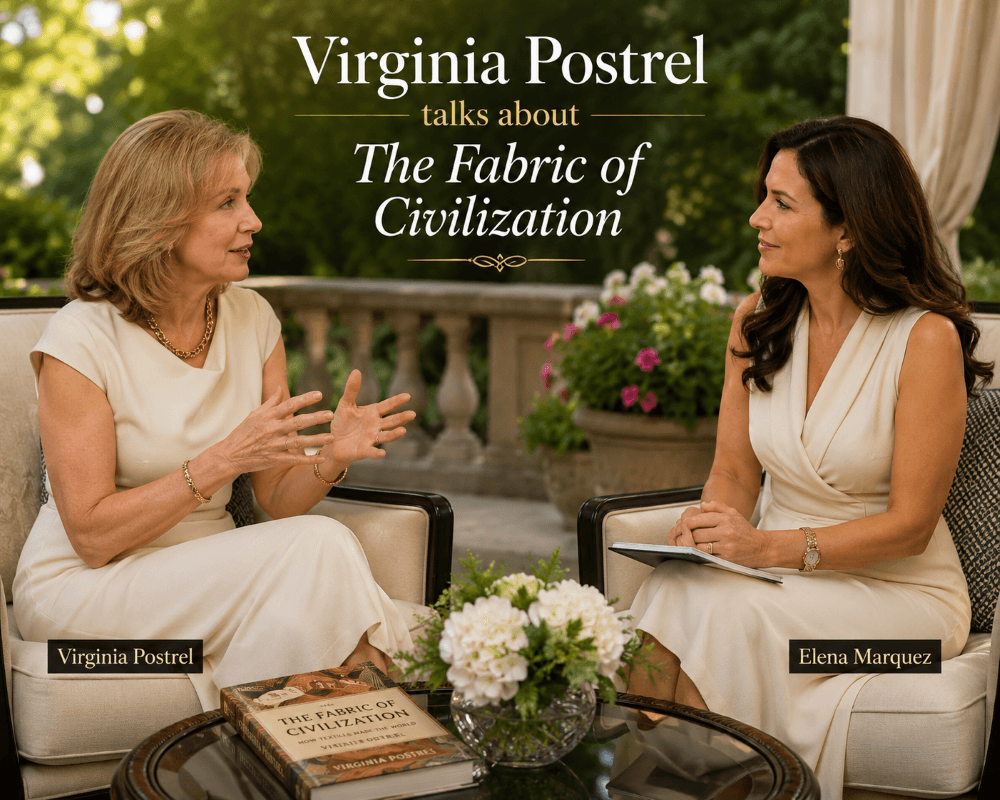
When most people think about the forces that shaped civilization, they think of wars, kings, inventions, or great empires. Yet The Fabric of Civilization argues that one of humanity’s greatest innovations has been something much more familiar: textiles.
I had the pleasure of interviewing author Virginia Postrel shortly after the publication of The Fabric of Civilization: How Textiles Made the World. Five years later, the book remains one of the most fascinating works I’ve read on the intersection of technology, economics, culture, and innovation.
If you enjoy understanding how societies develop—and why today’s technologies often have ancient roots—this book deserves a place on your reading list.
Who Is Virginia Postrel?
Virginia Postrel is an author, journalist, and speaker whose work explores the intersection of culture, economics, science, and commerce.
She has written for publications including The Wall Street Journal, The New York Times, The Atlantic, and Inc. Magazine. Her writing is known for making complex historical and economic ideas accessible to general readers.
Writing in Vanity Fair, Sam Tanenhaus described her as:
“A master D.J. who sequences the latest riffs from the hard sciences, the social sciences, business, and technology.”
That ability to connect seemingly unrelated subjects is exactly what makes The Fabric of Civilization so compelling.

The Fabric of Civilization Shows That Cloth Built the Modern World
At first glance, textiles may seem like an unlikely subject for a history book.
After all, fabric is something we wear every day without giving it much thought.
But The Fabric of Civilization demonstrates that textiles were among humanity’s greatest technological achievements.
Long before computers, electricity, or automobiles, producing cloth required extraordinary innovation.
Making fabric demanded advances in:
- Agriculture
- Chemistry
- Mathematics
- Engineering
- International trade
- Manufacturing
- Finance
Every thread tells part of the story of civilization itself.
How Textiles Influenced History
One of the most surprising lessons from The Fabric of Civilization is how deeply textiles influenced world events.
Virginia Postrel explains how:
- Minoans exported luxurious purple-dyed wool throughout the Mediterranean.
- Chinese silk became one of history’s most valuable luxury goods.
- Textile merchants helped create modern banking systems.
- Cloth production financed Renaissance art and architecture.
- The textile industry accelerated scientific discoveries.
- Weaving techniques even inspired the binary thinking that eventually led to modern computing.
Few industries have had such an enormous influence on human progress.
Why This Book Matters Today
Although the book focuses on history, its lessons are remarkably modern.
Today’s economy revolves around software, artificial intelligence, and advanced manufacturing.
Thousands of years ago, textiles occupied a similar position.
The most advanced societies weren’t simply those with the largest armies—they were often those with the most sophisticated textile industries.
Innovation, specialization, trade, and entrepreneurship created prosperity then just as they do today.
The technologies change.
The economic principles remain remarkably consistent.
The Hidden Technology Behind Everyday Life
One reason I enjoyed The Fabric of Civilization is that it reminds us how easy it is to overlook extraordinary innovations simply because they become ordinary.
We rarely stop to think about our clothing.
Yet behind every shirt, pair of jeans, or winter coat lies thousands of years of accumulated knowledge.
From spinning flax in prehistoric villages to today’s automated weaving machines and 3D knitting technologies, textiles represent continuous human ingenuity.
It’s a reminder that civilization advances not only through dramatic breakthroughs, but also through countless incremental improvements.

My Conversation with Virginia Postrel
During our conversation, Virginia explained that textiles are far more than fashion.
They connect agriculture, science, engineering, economics, global trade, and culture into one remarkable story.
Her research draws from archaeology, economics, chemistry, anthropology, and business history to paint a picture that is both educational and entertaining.
What impressed me most was how she transformed an everyday object into a window for understanding civilization itself.
That’s the hallmark of great nonfiction.
It changes the way you see the world.
Final Thoughts
Many history books focus on battles, politics, or famous leaders.
The Fabric of Civilization reminds us that economic progress often comes from quieter revolutions—innovations that improve everyday life.
Textiles helped build cities, finance empires, expand international trade, spread scientific knowledge, and inspire new technologies.
After interviewing Virginia Postrel, I came away with a much deeper appreciation for something we usually take for granted.
The next time you get dressed in the morning, remember that you’re wearing one of humanity’s greatest inventions.
Frequently Asked Questions
What is The Fabric of Civilization about?
The book explores how textiles influenced technology, trade, economics, politics, and culture throughout human history.
Who is Virginia Postrel?
Virginia Postrel is an author, journalist, and speaker whose work focuses on economics, innovation, culture, design, and technology.
Why were textiles so important to civilization?
Textiles drove advances in agriculture, manufacturing, chemistry, mathematics, international trade, banking, and engineering, making them one of history’s most influential industries.
Is The Fabric of Civilization worth reading?
Absolutely. It offers a fresh perspective on world history and demonstrates how ordinary objects can shape extraordinary events.
Where to find Virginia?
Other Podcast Posts