For the past 25 years, I have followed a remarkably simple investment strategy.
Whenever I have money available, I buy broad stock market index funds.
I don’t try to predict recessions. I don’t chase hot stocks. I don’t spend my evenings studying charts or listening to market gurus. My assumption has always been simple: ten years from today, the global economy will almost certainly be larger than it is today, and the stock market will likely reflect that growth.
This approach has served me well.
But there is one situation where I become more aggressive.
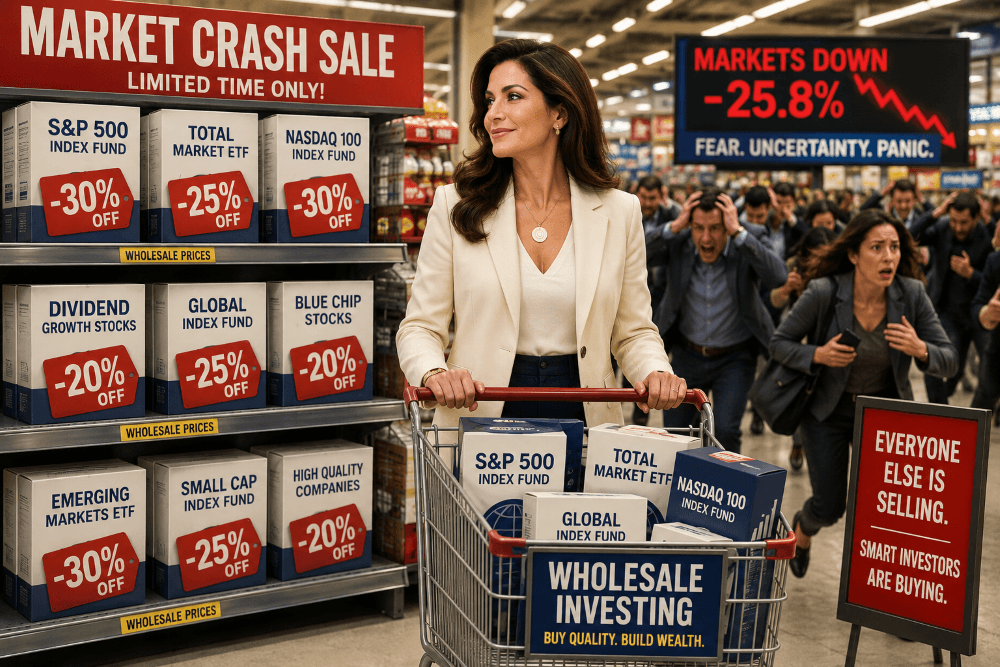
When the stock market falls by more than 20%, I stop thinking like a retail investor and start thinking like a wholesale investor.
What Is Wholesale Investing?
When most people hear the phrase “wholesale investing,” they think about real estate or buying products in bulk.
I think about something entirely different.
Wholesale investing means buying excellent assets when they are temporarily on sale.
Imagine walking into your favorite grocery store and discovering that everything you normally buy is suddenly 30% cheaper. You wouldn’t panic. You would probably fill your shopping cart.
Yet the opposite happens in the stock market.
When prices fall, many investors become terrified. They stop buying, sell their investments, or swear they’ll wait until “things feel safer.”
Ironically, the safest feeling usually arrives after prices have already recovered.
Wholesale Prices Exist in the Stock Market
Every business has wholesale prices.
Retail stores buy merchandise below the price they eventually charge customers.
Car dealerships purchase vehicles from manufacturers at wholesale prices.
Restaurants buy ingredients from wholesalers before serving meals to customers.
The stock market works in much the same way.
Most of the time, stocks trade at prices investors are comfortable paying.
Occasionally, fear sweeps through the market, and those same businesses become dramatically cheaper—not because the companies suddenly became worthless, but because investors became emotional.
That is when wholesale investing becomes possible.
Wholesale Investing Requires Courage
Buying during a market crash sounds easy when looking back through history.
Living through one is something entirely different.
News headlines predict economic collapse.
Friends insist that “this time is different.”
Television experts explain why markets may never recover.
Every instinct tells you to protect yourself.
Yet history has repeatedly shown that periods of widespread fear have often been some of the best long-term buying opportunities for diversified investors.
As Warren Buffett famously said:
“Be fearful when others are greedy, and greedy when others are fearful.”
That isn’t advice to gamble.
It’s advice to recognize that markets are driven as much by emotion as by business fundamentals.
I don’t know where the market will be next month. I don’t know where it will be next year. But if history is any guide, I have tremendous confidence that ten years from now it will be substantially higher than it is today. When the market falls 20%, 30%, or 40%, I don’t see catastrophe—I see wholesale prices.
Wholesale Investing FAQ
What is wholesale investing in the stock market?
Wholesale investing means buying quality stocks or index funds when prices are temporarily depressed. Instead of waiting for optimism to return, wholesale investors buy during fear, crashes, and bear markets.
Is wholesale investing the same as market timing?
No. Market timing means trying to predict short-term market movements. Wholesale investing is different. It means continuing to invest regularly, but becoming more aggressive when the market is clearly cheaper than usual.
When do stocks become wholesale investments?
A broad market decline of 20% or more is often considered a bear market. For long-term investors, that kind of decline can create wholesale prices, especially when buying diversified index funds.
Is borrowing money to invest risky?
Yes. Borrowing to invest increases both potential gains and potential losses. It should only be done carefully, with modest amounts, strong collateral, and the emotional ability to survive further market declines.
Other Stock Market blog posts