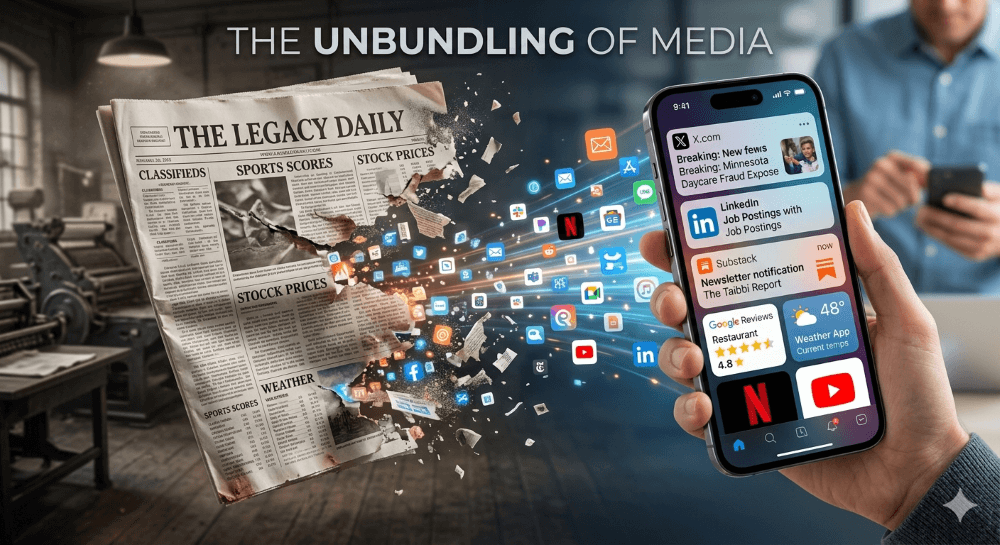
The era of the “all-in-one” newsroom is officially over. For decades, a few major networks and newspapers acted as the ultimate gatekeepers of information, deciding what was “fit to print.” Today, that structure has crumbled. The unbundling of media has transformed how we consume information, shifting power away from legacy institutions and into the hands of independent creators and specialized platforms.
The Death of the All-in-One Bundle
In the past, the local newspaper was a bundle of diverse services. You bought it for the front-page news, but you also relied on it for the Sunday classifieds, the sports scores, stock market tickers, and the movie showtimes.
Digital innovation systematically stripped these layers away. Craigslist was the first blow, migrating classified ads to the web. Soon, specialized apps and sites took over the rest:
- Financial Data: Investors now track individual stock prices on dedicated platforms like Yahoo Finance or specialized trading apps.
- Weather: We check our phones for real-time updates rather than waiting for the 6:00 PM news.
- Employment: Job seekers have abandoned the “Help Wanted” section for LinkedIn, Indeed, and Glassdoor.
- Lifestyle: For restaurant reviews, we trust the collective intelligence of Google Reviews over a single food critic.
Why the Unbundling of Media is Accelerating
The unbundling of media isn’t just about convenience; it is a response to a massive crisis of trust. Legacy media has increasingly retreated into partisan silos. Whether it is CNN and the New York Times on the left or Fox News on the right, the objective “middle ground” has all but vanished.
The Rise of the Independent Journalist
People are increasingly placing their trust in individuals rather than corporate brands. Audiences now prefer the long-form, unfiltered conversations of creators like Joe Rogan over teleprompter-led segments by journalists with elite degrees.
This shift is so significant that even the White House has adapted. The press room now reserves a seat for “New Media,” acknowledging the influence of independent journalists who reach millions via YouTube and podcasts.
“The legacy media business model was built on a bundle that no longer exists. Today, the individual is the brand.”
High-Stakes Truth: The Power of Citizen Journalism
When traditional outlets fail to investigate sensitive or complex stories, citizen journalists step in. A prime example is Nick Shirley, whose work on the fraud in Minnesota daycares sent shockwaves through the country.
- The Investigation: Shirley produced a 41-minute video exposing daycare centers receiving millions in federal funds while appearing vacant.
- The Impact: After being amplified by Elon Musk on X, the story garnered over 100 million views.
- The Result: The Department of Justice eventually charged over 70 defendants in a $250 million scheme, freezing $185 million in funds.
For his efforts in uncovering what legacy media missed, Shirley was awarded $100,000 by Elon Musk and X. This level of impact proves that a single dedicated individual can now outperform an entire newsroom.
The Substack Revolution and X.com
For those seeking depth without the corporate filter, the newsletter economy is booming. Talented journalists are leaving major networks to build their own empires on Substack.
- Andrew Sullivan: Earning an estimated $1–2 million per year.
- Matt Taibbi: Earning an estimated $2–3 million per year.
Meanwhile, X.com has become the go-to destination for raw, breaking news. While networks spend hours vetting and “spinning” a story, real-time updates from witnesses and independent analysts on X provide an unfiltered look at world events as they happen.
High-profile anchors like Don Lemon, Tucker Carlson, and Joy Reid have also been let go from their networks, underscoring how traditional media is shedding its biggest personalities amid declining viewership and trust.
Summary: A New Era of Information
The unbundling of media has permanently altered the landscape. We no longer need a “middleman” to tell us what to think or where to find the weather. By choosing independent voices, specialized apps, and real-time platforms like X, we are reclaiming our role as active participants in the information economy.
Frequently Asked Questions
What does the unbundling of media mean? It refers to the process where the various components of a traditional newspaper or news broadcast (ads, sports, weather, opinion) are broken apart and offered by specialized digital platforms.
Why is legacy media losing trust? Many viewers perceive a growing partisan bias in major networks. Additionally, the rise of independent creators allows for more transparent, long-form, and unfiltered content.
How do independent journalists make money? Many use platforms like Substack for subscriptions, YouTube for ad revenue, or receive direct support from their audience through platforms like Patreon.
Previous opinion posts
- Democrat Labor Policies: From Slavery to Illegal Aliens, They Love Cheap Labor
- Global Feminism: Refocusing on Real Women’s Rights
- The Future of Work and Technology: Living the Nomad Life in Montreal