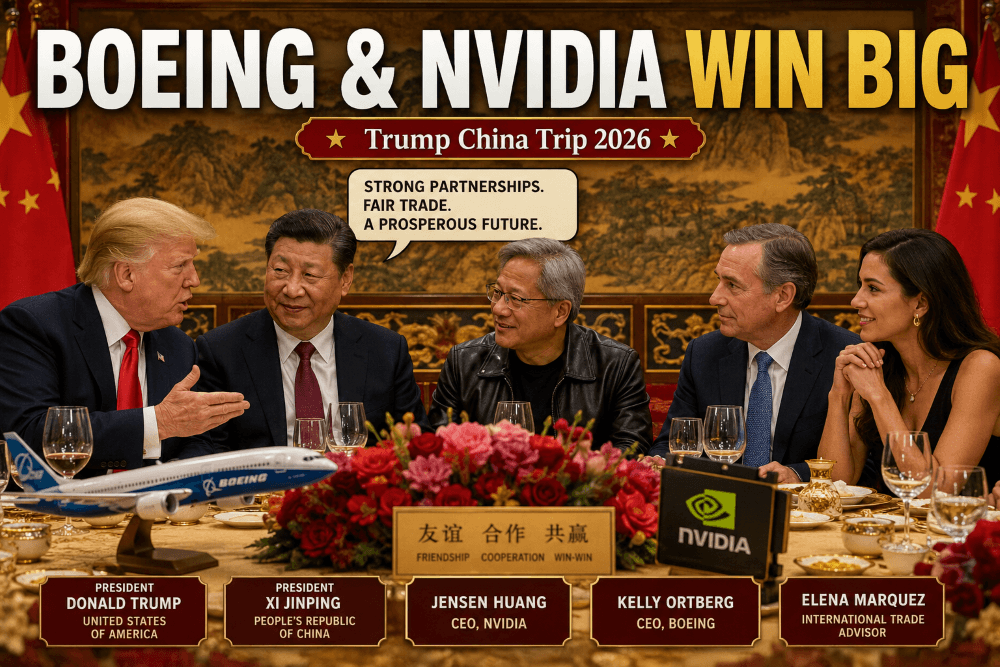
President Donald Trump’s high-profile trip to China in May 2026, accompanied by a delegation of prominent U.S. CEOs, has sparked significant interest in its potential economic repercussions. The visit aimed to ease trade tensions, improve market access, and secure deals in key sectors like aviation, technology, agriculture, and finance.
This article examines the full list of CEOs and companies involved, early outcomes, which firms gained ground, and how investors should respond.
The Context of the Trump-Xi Summit
The summit in Beijing focused on reciprocal trade, investment access, agricultural and energy purchases, and broader geopolitical issues. While no sweeping new trade agreement was immediately announced, the presence of top executives signaled strong U.S. business interest in deeper China engagement.
Xi Jinping emphasized that China’s door to the outside world would open wider, creating a generally positive tone for U.S. firms operating in or exporting to the world’s second-largest economy.
Full List of CEOs and Companies in the Delegation
The delegation included around 16-17 top executives. Here is the comprehensive list based on reports:
- Elon Musk – Tesla (TSLA) and SpaceX
- Tim Cook – Apple (AAPL)
- Jensen Huang – NVIDIA (NVDA)
- Larry Fink – BlackRock (BLK)
- Stephen Schwarzman – Blackstone (BX)
- Kelly Ortberg – Boeing (BA)
- Brian Sikes – Cargill
- Jane Fraser – Citigroup (C)
- Cristiano Amon – Qualcomm (QCOM)
- Sanjay Mehrotra – Micron Technology (MU)
- David Solomon – Goldman Sachs (GS)
- Michael Miebach – Mastercard (MA)
- Ryan McInerney – Visa (V)
- Dina Powell McCormick – Meta (META)
- H. Lawrence Culp – GE Aerospace (GE)
- Jim Anderson – Coherent (COHR)
- Jacob Thaysen – Illumina (ILMN)
- Others invited or noted: Chuck Robbins (Cisco – did not attend due to earnings)
This high-powered group represented trillions in market value and diverse sectors.
Companies That Achieved or Are Positioned to Benefit
Boeing (BA) stands out as the clearest near-term winner. The trip aligned with advanced negotiations for a massive aircraft order—potentially 500+ 737 MAX narrowbodies and dozens to 100 widebody jets. This would mark China’s first major Boeing purchase in years and provide a significant boost to production and U.S. jobs. CEO Kelly Ortberg expressed high confidence in an agreement including aircraft orders.
NVIDIA (NVDA) benefits from prior U.S. approval (earlier in 2026) clearing around 10 Chinese firms to purchase the H200 AI chip, NVIDIA’s second-most powerful AI processor. Jensen Huang’s last-minute inclusion amplified focus on semiconductor access. This supports revenue growth amid AI demand while navigating export controls.
Agriculture & Commodities (Cargill and U.S. farmers): Expectations remain high for increased Chinese purchases of U.S. soybeans, corn, beef, and energy products, following the pattern of past summits.
Tesla (TSLA): Elon Musk’s presence reinforces Tesla’s strong position in China’s EV market and potential for expanded operations or reduced regulatory hurdles.
Finance & Payments (BlackRock, Blackstone, Citi, Goldman, Visa, Mastercard): These firms seek deeper market access, regulatory easing, and investment opportunities in China’s financial sector.
Tech names like Apple, Qualcomm, and Micron hope for better supply chain stability and market access.
Companies with Limited or No Immediate Achievements
Many participants, particularly in tech and finance, secured no specific new orders during the short trip. Outcomes remain largely aspirational:
- Apple, Meta, Qualcomm, Micron: No announced breakthroughs on tariffs, chip restrictions, or app/store issues. Benefits are expected to materialize gradually through improved relations rather than immediate contracts.
- Illumina, Coherent, GE (beyond aerospace): Participation was more about relationship-building than tangible deals.
- Broader delegation: Symbolic presence outweighed concrete wins for most non-aviation/agriculture firms at this early stage.
The trip’s value lies more in frameworks for future cooperation than instant transactions.
Broader Economic Repercussions
Positive signals could reduce tariff risks, stabilize supply chains, and boost bilateral trade. U.S. exports in planes, chips, food, and energy may rise, while Chinese firms gain limited access to advanced technology.
However, core issues like intellectual property, subsidies, and Taiwan remain unresolved. Markets reacted with optimism, lifting shares of involved companies (especially BA, NVDA, TSLA) on deal speculation.
Longer-term, sustained engagement could support U.S. GDP growth in export sectors while pressuring domestic manufacturers facing Chinese competition.
How Investors Should React
Investors should view the trip as a catalyst for selective opportunities rather than a broad transformation:
- Buy/hold Boeing on any confirmed order news, but watch execution risks.
- NVIDIA remains strong due to AI tailwinds and the H200 approval; use dips for accumulation.
- Diversify exposure to Tesla, Apple, and semis for China-related upside.
- Monitor agriculture ETFs or commodity plays for purchase announcements.
- Risk management: Avoid overexposure—geopolitical surprises can reverse gains quickly. Focus on companies with real China revenue or order pipelines.
Overall, maintain a long-term perspective. Diplomatic trips like this often deliver incremental wins over months, not days.
FAQ
Q: What was the main goal of Trump’s 2026 China trip with CEOs? A: The primary goals were to improve trade relations, secure market access for U.S. companies, and facilitate deals in aviation, technology, and agriculture.
Q: Did Boeing secure a new order from China during the trip? A: No final announcement yet, but negotiations advanced significantly. A large order involving hundreds of aircraft is widely anticipated as a key outcome.
Q: How does the Nvidia H200 approval fit into the trip? A: The earlier U.S. clearance for Chinese firms to buy H200 chips provided positive momentum. Jensen Huang’s participation highlighted ongoing AI chip opportunities.
Q: Should investors buy stocks after the Trump China trip? A: Selectively yes—focus on companies with direct exposure like Boeing, NVIDIA, and Tesla. Avoid broad bets; watch for follow-up announcements on purchases and access.
Other Stock Market blog posts