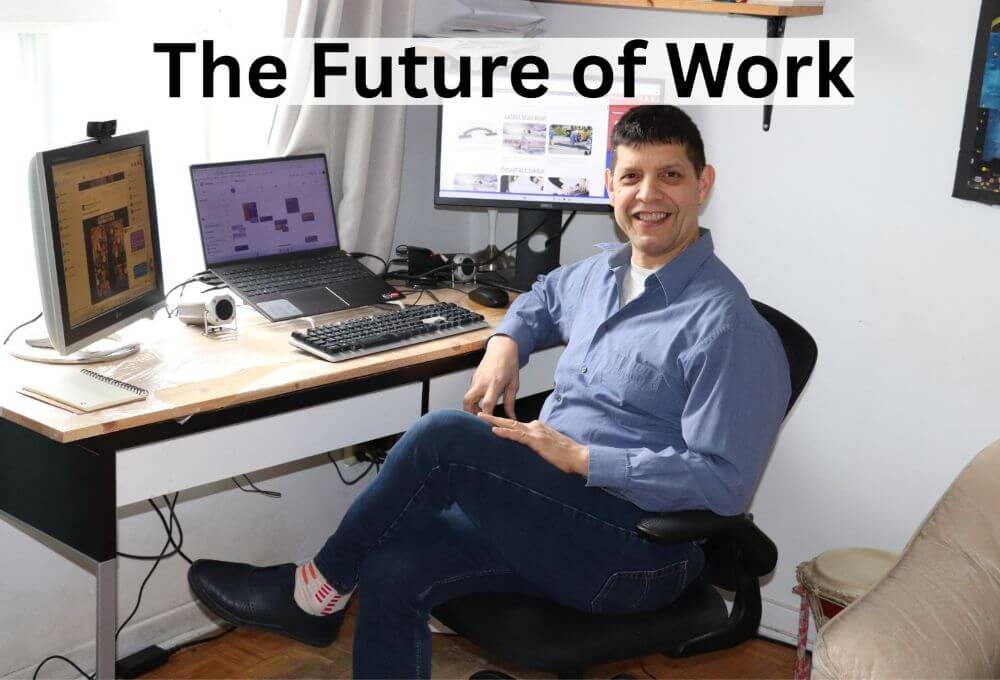
I sit in my small apartment on the second floor of a building with a charmingly dilapidated facade. I am in the trendiest neighborhood of Montreal, but my mind is usually thousands of miles away. From my corner office—a simple desk tucked into the corner of my living room—I overlook a peaceful street and start my day at 7 am. As an independent worker in the SEO industry, I am a small but vital cog in the wheel of global commerce.
The future of work and technology is already here, and it looks a lot like my living room. I spend my hours building link strategies for clients in England, India, Israel, the UAE, and Estonia. Their customers, in turn, are scattered across the U.S. and Australia. Technology has rendered my physical location irrelevant; I am a digital nomad who chose to stay put, but the “office” is wherever my laptop opens.
A Global Workforce Under One Roof
The shift in how we earn a living isn’t just happening to me. Just one floor below, my friend Cheryl is also participating in the future of work and technology. She teaches English as a second language online.
On any given afternoon, she is virtually transported to:
- China
- Turkey
- Brazil
- Germany
We live in Montreal because we love the coffee and the culture, but we don’t have to be here. Ten years ago, our career paths would have been unimaginable to the average person. Today, they are the blueprint for a new generation of workers who view the world as their oyster.
10 Innovations Defining the Future of Work and Technology
The geeks say we haven’t seen anything yet. We are currently converting science fiction into reality at an exponential rate. Here are ten technologies that have already fundamentally altered the way we exist and produce value:
- Voice-controlled Assistants: Siri and Alexa have turned talking to computers from a “Star Trek” trope into a daily chore-shifter.
- AI Outperforming Humans: In 2011, IBM Watson’s Jeopardy! win signaled the era of machines mastering complex knowledge tasks.
- Self-Driving Cars: Tesla and Waymo are turning our commute into a hands-free experience.
- Ubiquitous Video Calls: Zoom and FaceTime have killed the “distance” in long-distance relationships and business deals.
- Wearable Tech: The Androi Watch tracks our biology in real-time, acting as a medical tricorder on our wrists.
- GPS Navigation: We have forgotten what it’s like to be truly lost, thanks to satellite-to-phone pinpointing.
- 3D Printing: We can now “print” everything from prosthetics to engine parts, resembling the “replicators” of sci-fi.
- Drones: From photography, to war, to agricultural monitoring, drones have mastered the sky.
- Real-Time Translation: Google Translate is breaking down the final barrier to a truly globalized workforce.
The Economic Prediction: Abundance vs. Distribution
As we look toward the future of work and technology, I see two distinct economic outcomes. The first is incredibly optimistic: Abundance.
Technological progress is essentially a “free lunch.” As machines become more efficient, the cost of solving major human problems drops. We are moving toward a world where “need” is no longer the primary driver of human suffering because we will have the tools to provide for everyone.
However, the second prediction is a warning: The Problem of Distribution. While technology creates abundance, it also creates “spread.” As the tech races ahead, those without the skills or access to these tools are left behind. Wealth, income, and social mobility are becoming concentrated among those who can pilot the machines.
“Work saves us from three great evils: boredom, vice, and need.” — Voltaire
Thanks to the future of work and technology, “need” will be the easiest evil to solve. The real challenge for the next generation will be addressing the boredom and vice that arise when people want to contribute but find themselves excluded from the digital loop.
Summary: Embracing the Digital Shift
The future of work and technology is not a distant destination; it is the reality of an SEO consultant and an ESL teacher living in a small building in Montreal. We have traded the cubicle for the corner of the living room and the local market for a global stage. As we continue to innovate, our greatest task won’t be the technology itself, but ensuring that the abundance it creates is accessible to all.
Frequently Asked Questions (FAQ)
How is the future of work and technology changing employment? It is shifting the focus from physical presence to digital output. Tools like AI and high-speed internet allow workers to be location-independent and serve global markets.
What are the biggest challenges of the future of work? The main challenge is the “distribution” of wealth and opportunity. While technology creates abundance, it can also increase the gap between high-skilled tech workers and those in traditional industries.
Can any job be done remotely in the future? While many service and knowledge-based jobs are becoming remote, technology like 3D printing and robotics is also beginning to automate physical labor, changing the nature of “on-site” work.