Originally published December 2020 | Updated October 19, 2026
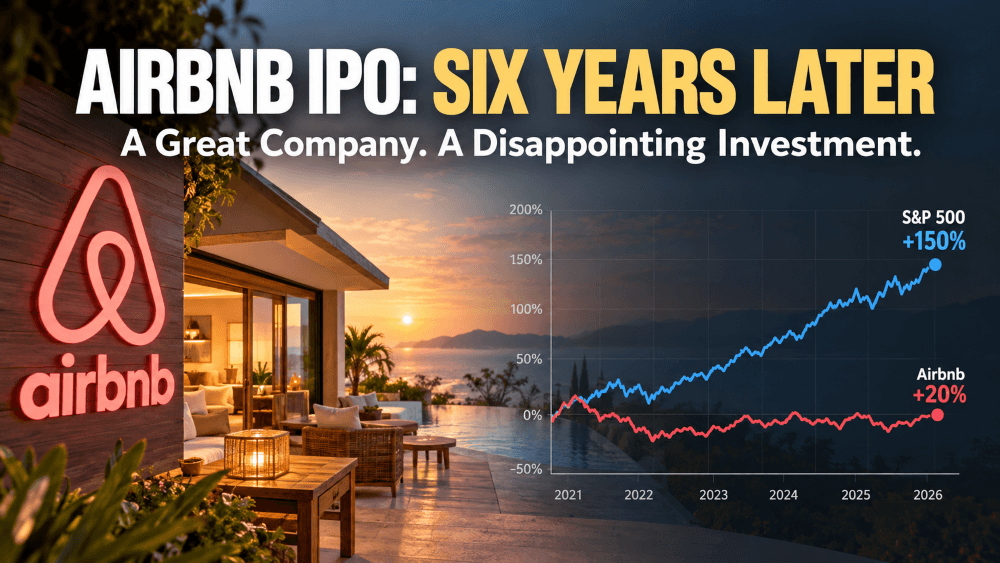
October 2026 update: Almost six years after Airbnb’s IPO, the stock has gained only about 20% from its first-day opening price. That’s a disappointing performance compared with the S&P 500 that on the same time period delivered a return of 115%, and a reminder of why I prefer index investing.
December 2020: My Brain Said No, but My Heart Said Yes
On December 10, 2020, Airbnb went public on the Nasdaq.
When I heard the announcement, my brain said, “No,” while my heart said, “Let’s do this!”
My heart won.
I bought Airbnb shares at the opening price of $146, expecting to make at least a 100% profit within five years.
I even bought the shares on margin, meaning I borrowed money to invest. My borrowing cost was 2.5% per year. If everything went according to plan, I would make money using someone else’s money.
Of course, things don’t always go according to plan.
When I shared the news with my social media community, several people asked why an index investor like me would buy an individual stock.
There are two reasons for every action: the right reason and the real reason.
The real reason was FOMO — fear of missing out.
The right reason? Let me explain.
I Already Made $250,000 With Airbnb
I was an early adopter of Airbnb, starting in the summer of 2009.
As soon as I discovered the platform, I became obsessed with the business opportunity.
I borrowed money from friends and family at 10% interest to make a 20% down payment on a property. I financed the remaining 80% with a bank mortgage at 3%.
My plan was simple: buy a property and rent it to travelers through Airbnb.
A traditional tenant would have paid approximately $1,000 per month. But through Airbnb, I could generate:
- $1,500 per month during the low season.
- $3,000 per month during the shoulder season.
- $6,000 per month during the high season.
On average, I was collecting about three times as much as a traditional landlord.
The following year, I bought a second property. In the third year, I bought a third. By the fourth year, I had also leased two additional properties to operate as short-term rentals.
During my highest-grossing year, the business generated approximately $200,000 in revenue.
There was one major problem: I wasn’t complying with the city’s short-term rental regulations.
I was exposing myself to substantial fines, and after approximately six years, the legal risk became too uncomfortable.
I could have moved my operations to areas where short-term rentals were permitted, but I decided I had enjoyed a good run.
I sold two properties for a modest profit and kept another property, which I rented to a traditional long-term tenant.
Altogether, Airbnb helped me make approximately $250,000.
Airbnb Changed My Financial Life
After selling my properties and closing my short-term rental business, I invested my money in index funds and became a blogger and podcaster.
I owe much of my relaxed lifestyle and financial independence to Airbnb.
So when the company went public in December 2020, I felt a strong emotional connection.
I had been there almost from the beginning. I had experienced firsthand how Airbnb could transform an ordinary property into a profitable business.
Now I had the opportunity to own a small piece of the company itself.
Together with Brian Chesky, Joe Gebbia, Nate Blecharczyk, and millions of other shareholders, I could participate in Airbnb’s future.
At least, that was how I saw it.
Why I Believed Airbnb Was a Great Investment
Airbnb had become one of the most recognizable brands in the hospitality industry.
By the time of its IPO, it had millions of listings worldwide and had fundamentally changed how people traveled.
Unlike traditional hotel chains, Airbnb didn’t need to build or own the properties listed on its platform.
The hosts supplied the properties, maintained them, and assumed much of the financial risk.
Airbnb provided the marketplace, technology, payment infrastructure, and brand recognition.
I loved that business model.
I also believed the company would benefit from changing travel habits and the eventual recovery from the COVID-19 pandemic.
Millions of people had been stuck at home. Once travel restrictions disappeared, I expected an explosion in demand.
Airbnb seemed perfectly positioned to benefit.
The Tesla Effect
At the time, Tesla was one of the hottest stocks on Wall Street.
Investors weren’t buying Tesla shares solely because of the company’s financial performance. They were also buying the story, the brand, and the excitement surrounding its future.
I believed Airbnb could experience something similar.
It was a recognizable, fashionable brand with millions of enthusiastic customers.
I thought investors would be willing to pay a premium to own a piece of the company.
Looking back, this was also a warning sign.
I wasn’t carefully calculating Airbnb’s intrinsic value. I was making assumptions about how enthusiastic other investors might become.
That’s speculation, not necessarily investing.
And I knew it.
The American Dream Is Alive and Well
One of the things I admired most about Airbnb was its origin story.
Brian Chesky and Joe Gebbia were struggling to pay their rent when they came up with the idea of renting air mattresses in their apartment to visitors.
That simple idea eventually grew into a global company.
I find stories like this inspiring.
You don’t necessarily need enormous amounts of capital to start a business. Sometimes an idea, determination, and a willingness to take risks can create extraordinary opportunities.
Airbnb was proof of that.
And I had personally benefited from the opportunity the founders created.
The First Five Days of Owning Airbnb
My excitement quickly turned into anxiety.
After I bought the stock, its price started falling.
Within the first few trading days, I watched my investment decline approximately 17% before recovering.
It was an emotional roller coaster.
Instead of concentrating on my regular activities, I was constantly checking the stock price.
I listened to financial news, looked for analyst opinions, and wondered whether I had made a mistake.
I still believed Airbnb could double in value, perhaps even within a year.
But I was discovering something important about myself.
I Sold After Just 10 Days
I admit it: holding individual stocks isn’t for me.
After approximately ten days, I sold my Airbnb shares.
I made a profit of about 13%.
Not bad for ten days of speculation.
But the experience reminded me why I had become an index investor in the first place.
When I own individual stocks, I become obsessed with their daily movements.
When I own index funds, I don’t worry nearly as much.
Earlier in 2020, I had experienced the same problem when I bought Beyond Meat shares.
Airbnb was another reminder that my personality is better suited to diversified, long-term investing.
I sold my shares, collected my profit, and returned to my usual strategy.
At the time, I wondered whether I would regret selling so early.
Almost six years later, I have my answer.
The first five days of owning Airbnb

October 2026 Update: Airbnb Has Been a Disappointing Long-Term Investment
It’s now October 2026, almost six years since Airbnb went public.
And the results have been underwhelming.
Airbnb shares began trading at approximately $146 on December 10, 2020.
As of October 19, 2026, the stock trades at approximately $175.46.
That’s a gain of only about 20% in almost six years.
To put that into perspective, $10,000 invested in Airbnb at its first-day opening price would be worth approximately $12,018 today, before taxes and trading costs.
That’s not a particularly impressive result for someone who took the risk of owning an individual stock.
Meanwhile, the S&P 500 has delivered a substantially stronger return over the same period. The S&P has gone up over 115% over the same time period, almost six times as much.
And an investor holding a low-cost S&P 500 index fund would also have benefited from reinvested dividends.
The comparison is particularly disappointing because Airbnb was supposed to be an exciting growth company.
I originally expected the stock to double within five years.
Instead, nearly six years later, it has appreciated by only about one-fifth.
A Great Company Isn’t Always a Great Investment
This is perhaps the most important lesson from my Airbnb experience.
I still admire Airbnb as a business.
It created an entirely new marketplace, transformed the hospitality industry, and helped thousands of entrepreneurs — including me — generate income.
But a great business and a great investment are not necessarily the same thing.
The price you pay matters.
When Airbnb went public, investors were already paying a substantial premium for its brand, growth potential, and business model.
Much of the optimism was already reflected in the stock price.
Even when a company succeeds operationally, its shareholders can earn disappointing returns if they pay too much for the shares.
That is one of the risks of investing in popular IPOs.
By the time ordinary investors can buy shares on the public market, much of the excitement may already be priced in.
Why I Prefer Index Funds
The Airbnb experience reinforces my preference for index investing.
When I buy an S&P 500 index fund, I don’t have to predict which company will outperform.
I don’t need to follow individual earnings announcements or worry about whether a particular CEO makes the right decisions.
I own hundreds of companies, including established businesses and emerging winners.
Some will disappoint. Others will perform exceptionally well.
I don’t have to identify the winners in advance.
And perhaps most importantly, index investing gives me peace of mind.
I can spend my time writing, teaching, traveling, and enjoying life rather than constantly watching stock prices.
My Final Lesson From Airbnb
Airbnb played an important role in my financial life.
As a host, it helped me build wealth.
As a short-term stock trader, it gave me a quick 13% profit.
But as a long-term investment, its performance since the IPO has been disappointing.
Had I held the shares from December 2020 until October 2026, I would have earned approximately 20%, significantly less than I could have earned from the S&P 500.
I was fortunate to sell after ten days with a profit, although I certainly didn’t know how the stock would perform over the following six years.
My experience illustrates three important lessons:
- Don’t confuse a company you love with a stock you should buy. Personal experience with a product doesn’t guarantee investment success.
- The price you pay matters. Even a wonderful company can deliver poor returns if its shares are too expensive.
- Know yourself as an investor. The best investment strategy is one you can follow consistently without sacrificing your peace of mind.
Almost six years later, I’m still happy with my decision to remain primarily an index investor.
I don’t need to find the next Airbnb, Tesla, or Nvidia.
I’m perfectly happy owning a small piece of hundreds of businesses through low-cost index funds.
Sometimes the most boring investment strategy is also the most rewarding.
What about you? Have you ever bought a stock because you loved the company, only to discover that it wasn’t such a great investment?
Other speculative posts