Introduction: A Difficult Trading Day Ends With Encouraging News From Nvidia
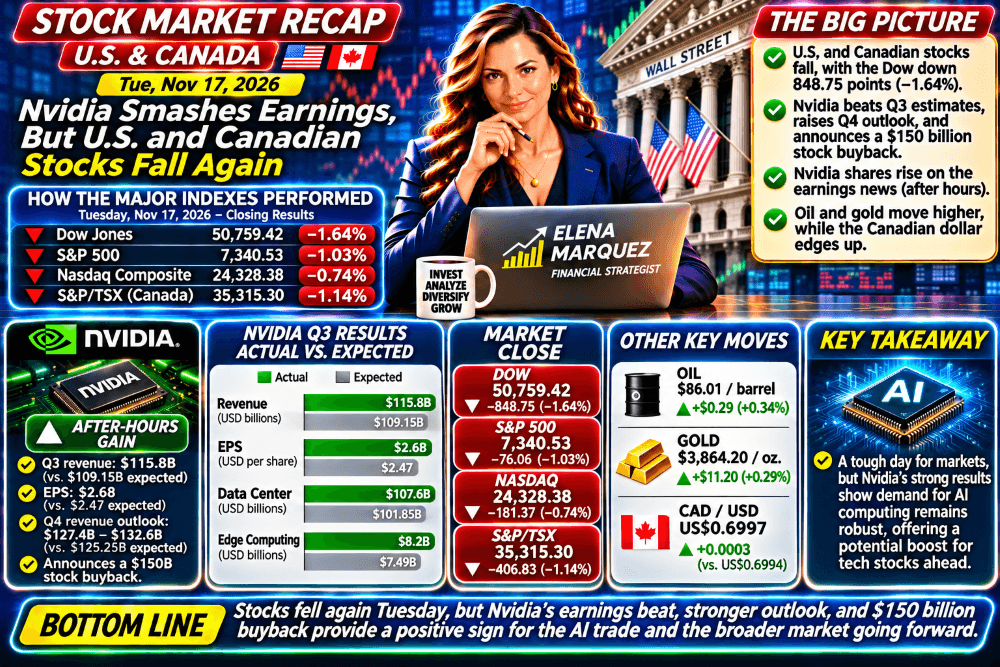
U.S. and Canadian stocks declined Tuesday, November 17, 2026, as investors continued reducing their exposure to equities, particularly technology companies.
The Dow Jones Industrial Average suffered the largest point decline among the major U.S. indexes, falling 848.75 points to close at 50,759.42.
The S&P 500 declined 76.06 points, finishing at 7,340.53, while the Nasdaq Composite lost 181.37 points to close at 24,328.38.
Canada’s S&P/TSX Composite also experienced substantial selling pressure, dropping 406.83 points to finish at 35,315.30.
However, after the closing bell, Nvidia delivered an important development for the artificial intelligence industry.
The semiconductor giant reported third-quarter earnings and revenue that exceeded Wall Street’s expectations, issued stronger-than-anticipated guidance for the fourth quarter, and announced a $150 billion share repurchase program.
Nvidia shares rose in response to the earnings announcement, according to the supplied report.
The results provided a potentially encouraging signal for investors concerned about the sustainability of AI infrastructure spending.
The central story of November 17: Stocks fell sharply during regular trading, but Nvidia’s strong earnings offered renewed evidence of substantial demand for artificial intelligence computing.
1. How the Major Stock Indexes Performed
U.S. & Canadian Stock Market Performance
Tuesday, November 17, 2026 | Daily Change
-848.75 points
-76.06 points
-181.37 points
-406.83 points
| Index | Closing value | Point change | % change |
|---|---|---|---|
| Dow Jones | 50,759.42 | −848.75 | −1.64% |
| S&P 500 | 7,340.53 | −76.06 | −1.03% |
| Nasdaq Composite | 24,328.38 | −181.37 | −0.74% |
| S&P/TSX Composite | 35,315.30 | −406.83 | −1.14% |
The Dow experienced the largest percentage decline among the four indexes, losing approximately 1.64%.
The S&P 500 fell just over 1%, while the Nasdaq declined 0.74%.
Canada’s TSX lost 1.14%, extending Monday’s decline.
What caused the selloff?
Investors entered Tuesday facing several uncertainties.
Nvidia’s earnings announcement was scheduled for after the closing bell.
Technology companies remained sensitive to elevated interest rates and concerns about AI valuations.
Meanwhile, investors continued evaluating whether the extraordinary amounts being invested in artificial intelligence would eventually generate sufficient profits.
The selloff demonstrated how uncertainty surrounding future earnings and interest rates can affect financial markets.
Importantly, Nvidia’s earnings announcement occurred after the regular trading session, meaning its positive results were not reflected in the indexes’ official closing values.
2. Nvidia Beats Wall Street’s Earnings Expectations
The Secret to Nvidia’s AI Success – IEEE Spectrum
Nvidia delivered stronger-than-expected financial results Tuesday evening.
The company reported third-quarter revenue of $115.8 billion, exceeding Wall Street’s forecast of $109.15 billion.
Earnings per share reached $2.68, compared with analysts’ expectations of $2.47.
Both figures represented substantial growth from the corresponding quarter a year earlier.
Nvidia Q3 Earnings: Actual vs. Expectations
November 17, 2026 | Quarterly Results
How much did Nvidia exceed expectations?
Nvidia’s revenue exceeded estimates by approximately $6.65 billion, or 6.1%.
Earnings per share exceeded expectations by $0.21, or approximately 8.5%.
These are substantial differences for a company of Nvidia’s size.
A remarkable increase from last year
Nvidia reported third-quarter revenue of $57 billion a year earlier.
This year’s $115.8 billion represents approximately 103% year-over-year revenue growth.
Earnings per share increased from $1.30 to $2.68, an increase of approximately 106%.
Such growth is unusual for a company already operating at an enormous scale.
The results suggest that demand for AI computing technology remains strong.
3. Nvidia Forecasts Another Strong Quarter
Nvidia’s fourth-quarter outlook was another encouraging part of its earnings announcement.
The company expects revenue between $127.4 billion and $132.6 billion.
The midpoint of that range is $130 billion.
Wall Street analysts had anticipated approximately $125.25 billion.
Nvidia Q4 Revenue Guidance
$130 billion
Midpoint of management’s projected range
Guidance range
$127.4B–$132.6B
Analyst forecast
$125.25B
Midpoint above forecast
+$4.75B (+3.8%)
The stronger-than-expected outlook suggests Nvidia anticipates continued growth in AI infrastructure spending.
Why guidance matters
Stock prices depend not only on past financial performance but also on expectations for future earnings.
A company can report excellent quarterly results and still see its shares decline if its future outlook disappoints investors.
Conversely, strong forward guidance can encourage investors even during periods of market uncertainty.
Nvidia’s outlook suggests management expects demand for its products to remain substantial.
However, investors will continue monitoring whether that demand can be sustained over the longer term.
4. Data Center Revenue Reaches $107.6 Billion
AI Cluster Solutions for Scalable Compute | Hypertec
Nvidia’s Data Center business continued to dominate its financial performance.
The division generated $107.6 billion in revenue, exceeding analysts’ expectation of $101.85 billion.
Its Edge Computing segment contributed another $8.2 billion, compared with expectations of $7.49 billion.
| Nvidia business | Actual revenue | Expected revenue |
|---|---|---|
| Data Center | $107.6B | $101.85B |
| Edge Computing | $8.2B | $7.49B |
| Total | $115.8B | $109.15B |
Why the Data Center business is so important
Artificial intelligence requires enormous computing capacity.
Companies building advanced AI systems need specialized processors, networking equipment, and supporting infrastructure.
Nvidia supplies much of this technology.
Its Data Center business benefits from spending by cloud computing providers, AI developers, and enterprises building advanced computing systems.
The division accounted for approximately 93% of Nvidia’s reported quarterly revenue.
This concentration demonstrates Nvidia’s dependence on the AI infrastructure investment cycle.
The opportunity and the risk
Strong demand creates opportunities for continued growth.
However, Nvidia’s results also depend heavily on whether its largest customers maintain their spending.
If major technology companies reduce AI capital expenditures, Nvidia could face slower growth.
For investors, monitoring AI infrastructure spending will remain essential.
5. Nvidia Announces a $150 Billion Stock Buyback
One of the most significant announcements accompanying Nvidia’s earnings was a new $150 billion share repurchase program.
A buyback allows a company to purchase its own shares, potentially reducing the number of shares outstanding.
Why companies repurchase shares
Companies may use excess cash to repurchase shares rather than distribute all available capital through dividends.
If the share count declines, earnings per share may increase even without a corresponding increase in total profits.
Buybacks can also signal that management believes the company’s shares offer attractive value.
However, that interpretation is not guaranteed.
Why $150 billion is significant
A $150 billion authorization is enormous.
It reflects Nvidia’s financial scale and its stated willingness to return capital to shareholders.
However, an authorization does not necessarily mean the company will immediately spend the entire amount.
Repurchases may occur over time, depending on market conditions and management decisions.
Are buybacks always good for shareholders?
Not necessarily.
The benefits depend partly on the price paid.
If a company repurchases shares when they are significantly overvalued, the transaction may destroy shareholder value.
If it repurchases shares at attractive valuations, remaining shareholders may benefit.
For investors, the important question is whether the company is allocating capital efficiently.
A buyback is not automatically a good investment simply because the amount is large.
6. Nvidia Reports Under New Leadership
Tuesday’s earnings report was described as Nvidia’s first since CFO Colette Kress assumed the role of interim CEO following Jensen Huang’s reported resignation.
The leadership transition has attracted considerable attention because Huang played such an influential role in Nvidia’s development.
He helped transform the company from a graphics processor manufacturer into a dominant supplier of artificial intelligence computing technology.
Why leadership transitions matter
A company’s competitive advantages may include its technology, intellectual property, employees, customer relationships, and corporate culture.
However, senior executives influence how those resources are managed.
Leadership transitions can create uncertainty about strategy, capital allocation, and organizational priorities.
For Nvidia, investors will be watching whether the company maintains its technological leadership and customer relationships.
Strong earnings offer reassurance
The company’s reported financial performance suggests that its underlying business remains strong despite the leadership uncertainty.
Revenue more than doubled from a year earlier, while the company provided an optimistic outlook for the next quarter.
Nevertheless, investors will continue evaluating how the transition affects long-term strategy.
7. Canada: TSX Drops More Than 400 Points
News | Microsoft Expands Purchases in Toronto Area With 28 Acres North of City for $95 Million
Canada’s S&P/TSX Composite experienced another difficult session Tuesday.
The index fell 406.83 points, or approximately 1.14%, closing at 35,315.30.
This followed Monday’s decline of 383.77 points.
Over the two sessions, the TSX lost a combined 790.60 points.
Canada’s TSX — Two-Day Decline
November 13–17, 2026
Friday close
36,105.90
Tuesday close
35,315.30
Two-day point change
−790.60
Two-day percentage change
−2.19%
Technology stocks weigh on Canada’s market
According to the supplied report, technology-sector losses contributed to the TSX’s decline.
Although Canada’s stock market has a smaller technology weighting than the Nasdaq, it remains exposed to changes in global investor sentiment.
Canadian equities are also influenced by developments in the United States, interest rates, commodity prices, and international economic conditions.
What this means for Canadian investors
The two-day decline illustrates how quickly markets can reverse course.
The TSX had finished the previous week higher, but those gains were erased during Monday and Tuesday’s trading.
For long-term investors, daily volatility is an unavoidable part of equity investing.
The challenge is determining whether price declines reflect temporary uncertainty or more fundamental changes in economic conditions.
8. Canadian Dollar Edges Higher
The Canadian dollar strengthened slightly Tuesday.
It traded at US$0.6997, compared with US$0.6994 Monday.
Canadian Dollar
US$0.6997
Value of C$1 · November 17, 2026
Previous session
US$0.6994
Daily change
+US$0.0003
The movement was relatively small, but currency fluctuations matter for Canadian investors holding U.S. assets.
When the Canadian dollar weakens, the Canadian-dollar value of U.S.-dollar investments increases, all else being equal.
When the Canadian dollar strengthens, the opposite occurs.
Currency changes can therefore affect portfolio returns independently of stock-price movements.
9. Oil Prices Rise Modestly
Big Oil’s profits from refining are expected to decline in 2025
Oil prices increased modestly Tuesday.
The December crude oil futures contract gained US$0.29, closing at US$86.01 per barrel.
This represented an increase of approximately 0.34%.
Why oil prices matter for Canada
Canada is a major energy producer.
Oil prices influence the profitability of Canadian energy companies and can affect investment and employment in producing regions.
Higher oil prices may support energy-sector earnings.
However, they can also increase transportation costs and contribute to inflation.
Oil remains sensitive to geopolitics
Energy markets continue responding to developments in the Middle East and global shipping conditions.
Earlier reports indicated that shipments through the Strait of Hormuz were recovering.
Nevertheless, geopolitical uncertainty remains an important factor for oil prices.
Investors should distinguish short-term commodity price movements from longer-term changes in global supply and demand.
10. Gold Gains as Investors Navigate Uncertainty
Unearthing Power: How 10 Countries Control 60% of the World’s Gold
Gold prices also increased Tuesday.
The December gold futures contract rose US$11.20, finishing at US$3,864.20 per ounce.
That represented an increase of approximately 0.29%.
Why investors buy gold
Gold is often considered a store of value.
Some investors hold it as protection against inflation, currency depreciation, or financial instability.
However, gold prices can also experience significant volatility.
Unlike stocks, gold does not generate corporate earnings or dividends.
Its value depends on supply, demand, investor sentiment, and broader monetary conditions.
Gold and interest rates
Higher interest rates can make gold less attractive because investors can earn income from bonds and other interest-bearing assets.
However, gold can still rise during periods of uncertainty.
Tuesday’s modest increase occurred alongside declines in major stock indexes.
This illustrates how different asset classes can respond differently to the same economic environment.
11. What Investors Should Watch Next
Nvidia’s market reaction
Investors will assess the company’s earnings beat, stronger guidance, and $150 billion buyback when regular trading resumes.
Anthropic’s reported IPO
The anticipated public offering could provide an important test of investor appetite for AI companies at elevated valuations.
Federal Reserve policy
Investors will continue evaluating inflation data and expectations for the December interest-rate decision.
Technology-sector sentiment
Will Nvidia’s results restore confidence across semiconductor and AI infrastructure stocks?
Canadian market stability
Investors will watch whether the TSX can recover after losing more than 790 points in two sessions.
12. The Biggest Investment Lesson of November 17
Tuesday’s trading session provides an interesting contrast.
During regular trading, investors sold stocks aggressively.
After the closing bell, Nvidia announced financial results that exceeded expectations.
This illustrates a fundamental feature of financial markets.
Stock prices reflect expectations, not simply the quality of a company’s business.
A company can deliver extraordinary growth and still experience significant volatility if investors are uncertain about its future.
Nvidia’s revenue more than doubled from the previous year.
Its earnings exceeded forecasts.
Its management provided optimistic guidance.
Yet investors must still consider valuation, competition, capital spending, and leadership stability.
Strong earnings do not eliminate investment risk
A company can be financially successful while its stock remains expensive.
If investors have already priced in extraordinary future growth, even excellent results may not justify further increases in the share price.
Conversely, a company that exceeds expectations can attract renewed investor interest.
The relationship between business performance and investment returns depends heavily on the price paid.
Why diversification remains important
The sharp declines in U.S. and Canadian stock indexes demonstrate that even broad markets experience periods of volatility.
Investors who concentrate heavily in one company or industry may face even greater risks.
Diversification across companies, industries, and asset classes can reduce dependence on a single outcome.
It cannot eliminate market losses, but it can help investors manage uncertainty.
The long-term perspective
For investors with long time horizons, daily market movements should be considered in the context of long-term financial objectives.
The most important questions remain whether businesses are profitable, financially sound, competitively positioned, and reasonably valued.
Attempting to predict every market reaction is far less reliable than maintaining a disciplined investment process.
Conclusion: Nvidia Delivers Strong Results After a Difficult Day for Stocks
Tuesday, November 17, 2026, was another challenging session for U.S. and Canadian investors.
The Dow Jones declined 848.75 points, the S&P 500 fell 76.06 points, and the Nasdaq Composite lost 181.37 points.
Canada’s TSX dropped 406.83 points, extending its two-day decline to 790.60 points.
However, Nvidia’s after-hours earnings announcement provided a potentially encouraging development.
The company reported revenue of $115.8 billion and earnings per share of $2.68, both above expectations.
It also forecast approximately $130 billion in fourth-quarter revenue and announced a $150 billion share repurchase program.
These results suggest that demand for AI computing infrastructure remains substantial.
Nevertheless, investors must distinguish between strong business performance and attractive stock valuations.
The key takeaway: Nvidia’s earnings demonstrate the extraordinary growth of AI infrastructure, but long-term investment success still depends on valuation, diversification, and disciplined risk management.
Other Stock Market blog posts
Leave a Reply