| 📊 Alain’s Holdings — July 16, 2026 | ||||
|---|---|---|---|---|
| Symbol | Name | Price | Change | Change % |
| VOO | Vanguard S&P 500 ETF | 690.14 | -3.66 | -0.53% |
| QQQ | Invesco QQQ Trust | 705.94 | -11.80 | -1.64% |
| XIU.TO | iShares S&P/TSX 60 ETF | 52.98 | +0.01 | +0.02% |
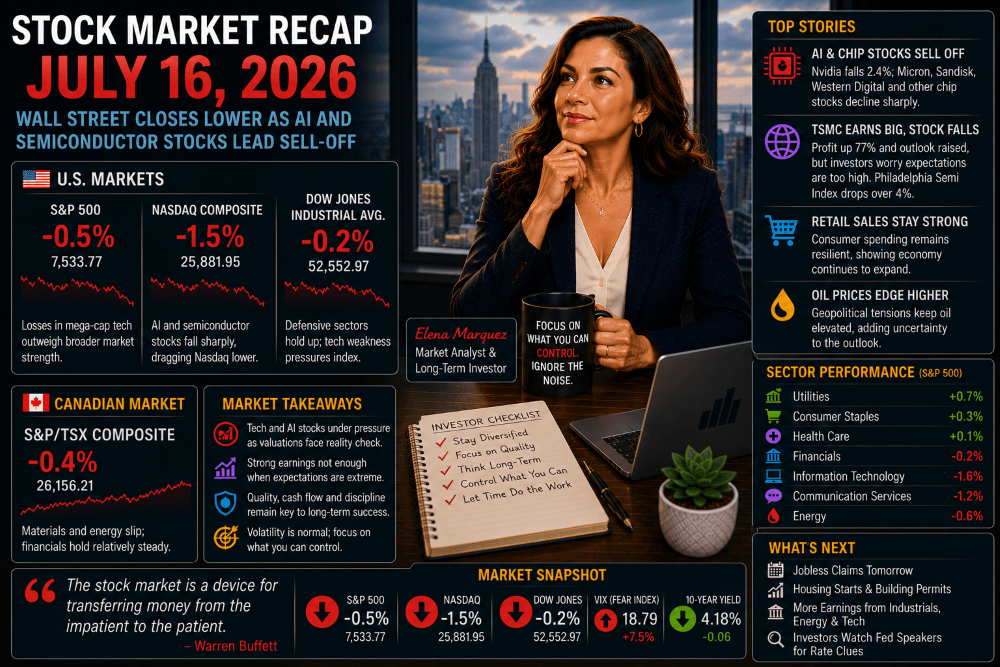
Wall Street closed lower Thursday as a broad selloff in semiconductor and AI-related stocks overshadowed strong corporate earnings. The S&P 500 fell 0.5%, the Nasdaq dropped 1.5%, and the Dow declined 0.2%.
- S&P 500: −0.5% to 7,533.77
- Nasdaq Composite: −1.5% to 25,881.95
- Dow Jones: −0.2% to 52,552.97
The selloff was concentrated in AI and semiconductor stocks. Nvidia fell 2.4%, while Micron, Sandisk, Western Digital and other chip-related companies declined sharply. More S&P 500 stocks actually rose than fell, but losses among the index’s largest technology companies outweighed the broader strength.
Shares of Alphabet (GOOG, GOOGL) sank more than 4% after Bloomberg reported the tech giant was behind schedule on the delivery of Gemini 3.5 Pro, its most powerful AI model.
Investors, meanwhile, continue to monitor oil’s movement through the Strait of Hormuz after the US launched its latest wave of airstrikes on Iran on Wednesday. The Wall Street Journal reported Wednesday that Trump was briefed by aides on options to expand the conflict, including by increasing bombing and deploying ground forces.
The spotlight remained firmly on earnings.
TSMC reported very strong earnings—profit reportedly increased 77%—but its U.S.-listed shares still fell. Investors appeared concerned that expectations for AI companies had become so demanding that even excellent results were insufficient. The Philadelphia Semiconductor Index dropped more than 4%.
The financial sector also contributed to today’s gains.
Several regional banks reported solid quarterly earnings, suggesting that higher interest rates continue to support lending margins while credit quality remains healthy. Those results added to the positive tone established earlier in the week by the largest U.S. banks.
Consumer spending remained resilient despite higher borrowing costs, reinforcing the view that the U.S. economy continues to grow without showing significant signs of weakness. While that may reduce the urgency for Federal Reserve rate cuts, it also supports the outlook for corporate earnings. (reuters.com)
This week’s market has highlighted an important shift.
For much of the year, investors debated inflation, interest rates, geopolitics, and artificial intelligence spending.
Now, the conversation is becoming more straightforward.
Companies are beginning to report their numbers.
And those numbers are telling investors which businesses are successfully converting AI investments, economic resilience, and operational discipline into higher profits.
Markets will always react to headlines.
But over time, earnings remain the foundation upon which long-term stock prices are built.