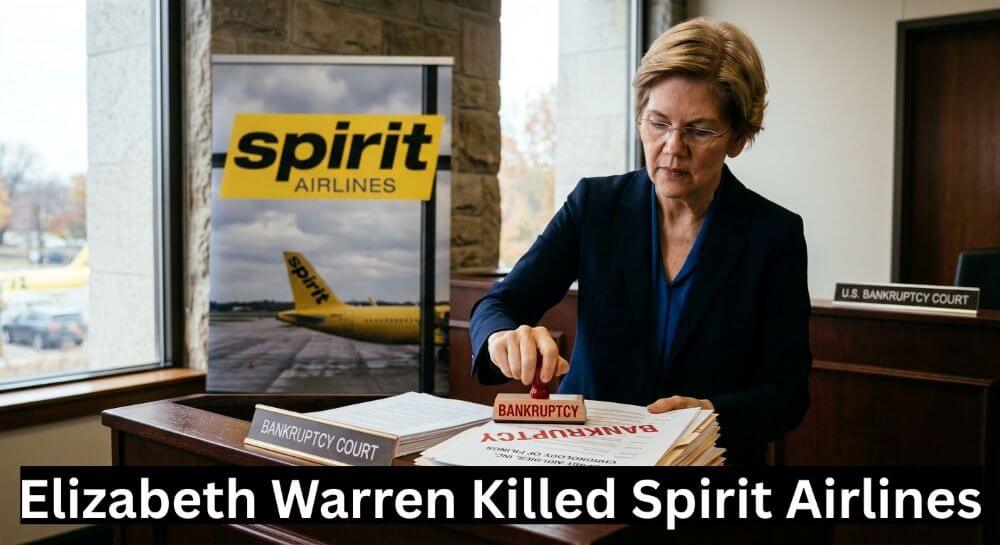
The Spirit Airlines collapse is officially complete, and the wreckage is scattered across the American travel landscape. On May 2, 2026, the bright yellow planes that once represented the freedom of budget travel were grounded for good.
While the current administration is left cleaning up the mess, the fingerprints of the previous regime—specifically Pete Buttigieg and Elizabeth Warren—are all over this economic corpse. Their small mentality didn’t protect consumers; it strangled a company that was already fighting for air.
The Blocked Merger: A Death Sentence in Disguise
The primary catalyst for the Spirit Airlines collapse was the Biden-Buttigieg administration’s 2024 decision to block a $3.8 billion merger with JetBlue. At the time, Elizabeth Warren cheered the move, calling it a “win for flyers.”
Transportation Secretary Sean Duffy recently set the record straight, noting that the DOJ and Buttigieg’s DOT “tanked that deal” based on a radical antitrust ideology. They bragged about protecting “competition” while ignoring the fact that Spirit was a failing business.
Without the capital and operational scale that JetBlue offered, Spirit was left to face rising fuel costs and market volatility alone. The “victory” Warren celebrated was actually a death sentence for the carrier.
The Human Cost of Small Mentality
When big government plays games with private industry, the consequences aren’t just numbers on a spreadsheet. They are real people who are now out of work.
- Thousands of Jobs Lost: Over 17,000 employees, including pilots, flight attendants, and mechanics, are now facing an uncertain future.
- Vanishing Retirement Funds: Investors and employees with company stock saw their holdings evaporate into a $2.5 billion hole of losses.
- Stranded Families: Thousands of passengers were left at gates with no customer service and no way home, forced to pay “rescue fares” on other airlines.
The radical policies of Joe Biden and Pete Buttigieg turned their backs on the American workforce. By blocking the only viable lifeline, they ensured that thousands of families would pay the price for their bureaucratic ego.
Consumers Suffer as Competition Dies
The irony of the Spirit Airlines collapse is that it achieved the exact opposite of what Elizabeth Warren claimed it would. Instead of lower prices, travelers are now facing a sky with fewer choices.
- The “Big Four” Get Stronger: By killing the merger that could have challenged legacy carriers, the government handed more power to United, Delta, and American.
- Higher Fares: With the ultra-low-cost leader gone, there is no longer a “downward pressure” on ticket prices.
- Less Service: Smaller regional airports that relied on Spirit are now losing connectivity, hurting local economies.
As Sean Duffy pointed out, these bureaucrats bragged about their intervention. Now, as flyers scramble for $600 replacement tickets, those brags look like total ignorance of how markets actually work.
A Legacy of Economic Failure
Socialists and big-government advocates like Warren and Buttigieg seem to believe they can micromanage a complex industry from a desk in D.C. They were warned that Spirit could not survive on its own, yet they chose to gamble with thousands of jobs.
The result is a more expensive, less accessible airline industry. The Spirit Airlines collapse wasn’t an accident; it was a policy choice. We are now living in the “victory” they promised, and it’s a disaster for every American who just wanted an affordable way to fly.
FAQ: The Aftermath of the Spirit Airlines Collapse
Was the Spirit Airlines collapse preventable?
Yes. Most industry experts agree that if the JetBlue merger had been allowed to proceed in 2024, the combined entity would have had the capital to survive current fuel price surges.
What did Pete Buttigieg do to cause the shutdown?
As Transportation Secretary, Buttigieg championed the DOJ’s move to block Spirit’s merger. This prevented the airline from securing the investment needed to fix its debt-heavy balance sheet.
How will this affect future airfare prices?
The removal of an ultra-low-cost carrier (ULCC) typically leads to a 15-20% increase in fares on competing routes, as legacy airlines no longer have to price-match Spirit’s budget options.
Previous Politics posts