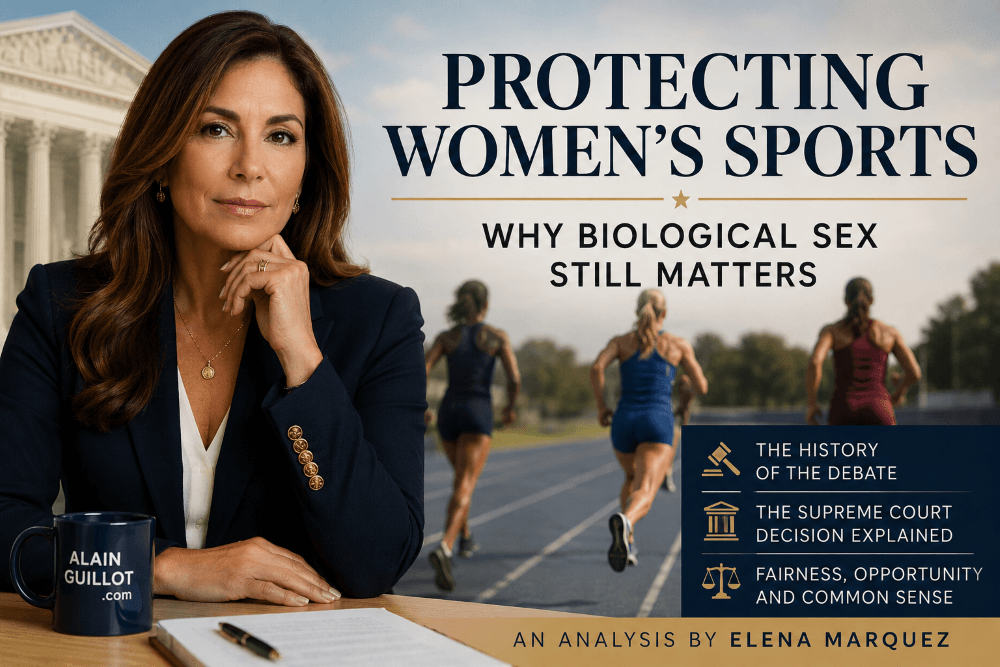
Protecting Women’s Sports has become one of the most debated public policy issues of the past decade. In my view, women’s athletic competitions should remain reserved for biological females because they were created to ensure fair competition and equal opportunities. The recent U.S. Supreme Court decision allowing states to enforce laws based on biological sex in school sports reinforces the principle that fairness remains a legitimate government objective.
This issue is often portrayed as a conflict between compassion and fairness. I believe that framing is misleading. We can respect every person’s dignity while recognizing that athletic competition presents unique challenges that require objective rules.
Why Protecting Women’s Sports Matters
Competitive sports separate athletes into divisions for one simple reason: biology matters.
No one objects to separating athletes by age or weight in many sports because physical differences influence performance. Likewise, men’s and women’s divisions exist because, on average, males who have experienced male puberty develop physical characteristics that can provide advantages in strength, speed, endurance, and power.
Without separate women’s categories, many female athletes could lose opportunities to compete, earn scholarships, and reach elite levels of competition.
In my opinion, protecting women’s sports is ultimately about preserving the purpose for which women’s athletic divisions were created.
The History Behind the Debate
For decades, women’s sports were protected under Title IX, the landmark 1972 federal law prohibiting sex discrimination in educational programs receiving federal funding.
Title IX dramatically expanded athletic opportunities for girls and women throughout the United States.
For many years, participation rules were relatively straightforward because eligibility was generally determined by biological sex.
The debate changed as more transgender athletes sought to compete according to their gender identity. Schools, athletic associations, and governments responded in different ways.
Some organizations adopted policies allowing participation based primarily on gender identity.
Others concluded that biological differences remained relevant to competitive fairness and introduced rules based on biological sex, particularly after male puberty.
The result was a patchwork of policies that eventually produced numerous legal challenges.
The Supreme Court’s Decision
The recent Supreme Court decision (West Virginia v. B. P. J.) allows states such as Idaho and West Virginia to enforce laws limiting girls’ and women’s school sports to biological females while litigation continues, reflecting the Court’s conclusion that the states had shown sufficient legal justification under the applicable standards for the challenged laws to remain in effect.
Although the broader legal debate surrounding transgender rights continues in other contexts, the Court recognized that preserving fairness in women’s athletics is a legitimate governmental interest.
Importantly, the ruling does not answer every legal question involving transgender rights or athletics. Future cases involving professional sports, private organizations, or other legal issues may still reach the courts.
Nevertheless, the decision represents an important development in how American law approaches women’s sports.
Why I Support This Approach
In my view, supporting women’s sports based on biological sex is neither discriminatory nor hostile toward transgender individuals (men dressed up as women).
Rather, it acknowledges that competitive sports are one of the few areas where physical differences directly influence outcomes.
Every sport establishes eligibility rules.
Examples include:
- Age divisions
- Weight classes
- Amateur versus professional status
- Drug-testing regulations
- Equipment standards
Eligibility based on biological sex follows the same principle: establishing objective rules designed to preserve competitive fairness.
Respect for every individual should remain a social value regardless of athletic policy.
At the same time, fairness for female athletes should not become secondary.
A Difficult Balance
Reasonable people disagree on this issue.
Many advocates argue that transgender athletes should be able to participate according to their gender identity because inclusion is an important social value.
Others, including myself, believe that preserving fair competition for women justifies maintaining biological-sex categories in school athletics.
Recognizing that these perspectives involve competing values is important. Public policy often requires balancing interests that cannot all be fully satisfied at once.
Looking Ahead
The Supreme Court’s decision is unlikely to end the debate.
State legislatures, athletic associations, schools, and courts will continue refining policies as new cases emerge.
What I hope does change is the quality of the discussion.
People should be able to debate this issue respectfully, acknowledge the humanity of everyone involved, and honestly consider the scientific, legal, and ethical questions without assuming bad faith from those who disagree.
For me, the central principle remains straightforward.
Women’s sports were created because biological differences matter in athletic competition.
Protecting those categories continues to serve the original purpose of expanding opportunities for female athletes, and I believe that purpose remains worth preserving.
Frequently Asked Questions
Why were women’s sports divisions created?
Women’s sports divisions were established to provide fair athletic competition and equal opportunities for female athletes, recognizing average physical differences between males and females.
What did the Supreme Court decide?
The Supreme Court allowed states such as Idaho and West Virginia to continue enforcing laws that reserve girls’ and women’s school sports for biological females while related legal challenges proceed, recognizing fairness in women’s athletics as a legitimate governmental interest.
Does this decision affect all sports?
No. The decision concerns certain state laws governing school athletics. Different rules may apply in professional sports, international competitions, and private athletic organizations.
Can people disagree respectfully on this issue?
Yes. The debate involves competing values, including inclusion, equality, fairness, and athletic opportunity. Respectful discussion benefits everyone, even when people reach different conclusions.
Other Law Posts