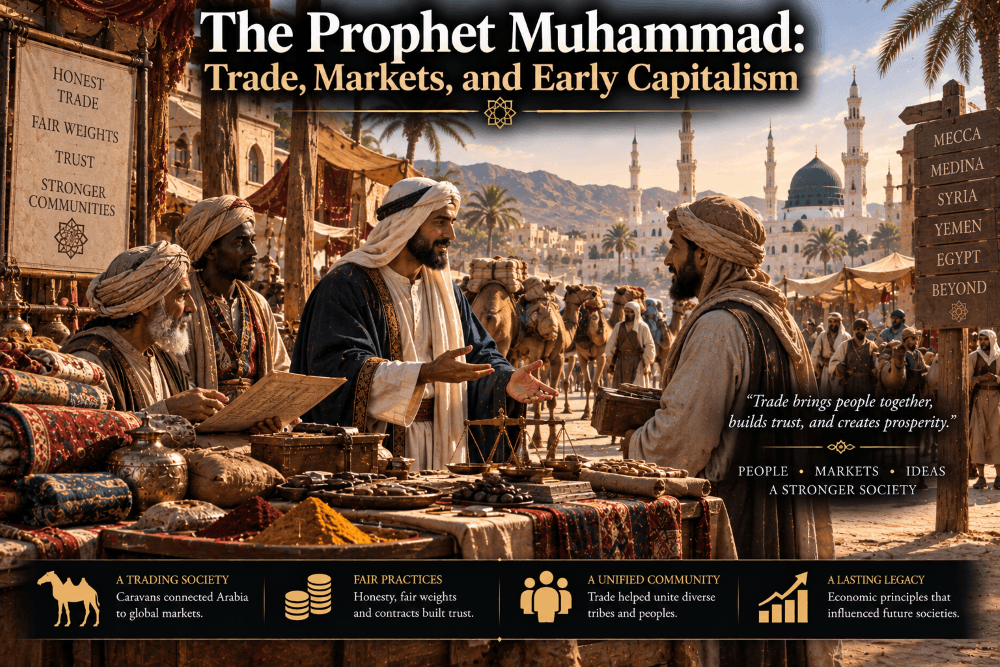
Long before he became a religious leader, the Prophet Muhammad spent years as a working merchant, learning long-distance trade from the inside. According to Islamic tradition and the work of many historians studying the period, that commercial background shaped economic principles he later introduced in Medina, ideas around open markets, price formation, risk-sharing, and ethical trade regulation that some historians and economists trace forward into the development of later commercial practices in Europe.
Early Life and the Meccan Caravan Trade
A Merchant’s Upbringing
According to Islamic tradition, Muhammad was born in Mecca around 570 CE and was orphaned at a young age, eventually raised within his extended family.
- His uncle, Abu Talib, guided him into the long-distance caravan trade that formed the economic backbone of Meccan society.
- Meccan commerce centered on high-value goods, including gold, spices, and silk, transported across vast desert routes using large camel caravans.
- This trade required genuine logistical sophistication, coordinating supplies, routes, and security across harsh and often dangerous terrain.
This early, hands-on experience gave Muhammad direct, practical knowledge of commerce well before his later religious and political leadership.
Marriage to Khadijah
In 595 CE, according to traditional accounts, Muhammad married Khadijah, a wealthy and independently successful businesswoman roughly fifteen years his senior.
- Khadijah had built her own substantial trading enterprise, employing agents to manage caravan ventures on her behalf.
- She reportedly hired Muhammad to manage a trading expedition to Syria, and his success in this venture led to their eventual marriage.
- Their relationship functioned in part as a genuine commercial partnership, with Khadijah acting as his primary financial backer and business collaborator.
Many historians highlight this relationship as reflecting the significant, if often underrecognized, commercial roles women held within pre-Islamic Arabian trading society.
Economic Reforms After the Hijrah
Building an Open Market in Medina
After relocating to Medina in 622 CE, an event known as the Hijrah, Muhammad introduced economic policies that many historians describe as notably market-oriented for their era.
- He established a new market intended to compete directly with Medina’s existing Jewish-controlled trade hubs.
- This market was reportedly declared open to all traders, with no tax levied on those conducting business there.
- According to Islamic tradition, this policy aimed to encourage broader participation in trade and reduce barriers that existing arrangements had imposed.
Refusing to Set Prices
During a period of significant scarcity, Muhammad reportedly declined requests to impose price controls on goods.
- According to hadith accounts, he stated that prices were in the hands of God, effectively declining to interfere directly with market pricing even amid hardship.
- Many economists and historians point to this episode as an early example of price deregulation, prioritizing market-driven pricing over direct government intervention.
- This approach reflected a broader philosophy found within his economic teachings, favoring open exchange over centralized control in most circumstances.
Balancing Markets With Ethical Regulation
Despite this general preference for open markets, Muhammad’s economic framework included significant ethical guardrails.
- Zakat, a mandatory form of charitable giving, functioned as a redistributive mechanism balancing market freedom with social welfare obligations.
- Monopolistic practices and market cornering were explicitly prohibited under Islamic commercial guidance.
- Market inspectors, known as muhtasib, were tasked with monitoring marketplaces for fraud, unfair practices, and what would today be recognized as forms of insider trading.
This combination of market openness alongside ethical constraint distinguishes early Islamic economic teaching from a purely unregulated market approach.
Risk-Sharing Instead of Interest
The Prohibition of Riba
Islamic teaching, established during and after Muhammad’s life, strictly prohibits riba, commonly translated as interest or usury.
- This prohibition reflected concerns about exploitative lending practices that could trap borrowers in escalating debt.
- Rather than simply banning credit and investment outright, Islamic commercial practice developed alternative structures for financing ventures.
- These alternatives centered on shared risk and shared reward between investors and entrepreneurs.
Qirad as an Early Investment Model
One significant alternative structure, known as qirad or sometimes mudarabah, closely resembles principles found in modern venture financing.
- Under this model, an investor provided capital to an entrepreneur undertaking a trading venture.
- Profits were shared between both parties according to a pre-agreed ratio, while financial losses were generally borne by the capital provider.
- Many historians and economists have noted the structural similarity between qirad and modern equity-based investment arrangements, where investors share in a venture’s upside and downside rather than collecting fixed interest.
Possible Pathways Into Later European Commerce
Some historians and economic linguists argue that Islamic commercial practices influenced later trading customs in medieval Europe, primarily through extensive Mediterranean trade contact with cities like Venice and Genoa. This remains an area of ongoing historical and linguistic scholarship rather than settled consensus, but the proposed connections are notable.
- Some scholars trace the modern concept of “risk” in commercial contexts to Arabic commercial terminology that entered European trade language around the 1200s, though etymologists continue to debate the precise linguistic path.
- Certain historians have drawn parallels between the Islamic waqf, a charitable endowment structure, and the later development of trust structures in medieval England, associated with groups like the Knights Templar and Franciscan orders.
- Words connected to European trade terminology, including tariff and douane, are widely traced by linguists back to Arabic commercial vocabulary, reflecting centuries of Mediterranean trading contact.
These proposed linkages illustrate how extensively Mediterranean trade networks connected the Islamic world with medieval Europe, though the precise extent of direct influence remains a subject linguists and historians continue to study and debate.
Lessons from the Prophet Muhammad’s Economic Legacy
- Personal commercial experience shapes economic philosophy. Muhammad’s years as an active trader appear to have directly informed his later economic teachings.
- Open markets and ethical limits can coexist. His framework combined market openness with clear prohibitions against exploitation and unfair practice.
- Risk-sharing offers an alternative to interest-based finance. The qirad model demonstrates that investment and entrepreneurship don’t require interest-bearing debt to function.
Frequently Asked Questions
What was the Prophet Muhammad’s occupation before his religious mission? According to Islamic tradition, he worked as a merchant engaged in long-distance caravan trade, gaining direct commercial experience that later informed his economic teachings.
Who was Khadijah, and what role did she play in Muhammad’s life? Khadijah was a wealthy, independent businesswoman who employed Muhammad to manage a trading expedition and later became his wife, acting as a significant financial backer and commercial partner.
Why does Islamic teaching prohibit interest, or riba? The prohibition reflects concerns about exploitative lending, and Islamic commercial tradition developed alternative structures like qirad, which rely on shared risk and shared reward rather than fixed interest payments.
Did Islamic economic practices influence medieval European commerce? Some historians and linguists suggest Mediterranean trade contact introduced Islamic commercial concepts and terminology into European trade practice, though the extent of direct influence remains an area of ongoing scholarly discussion.