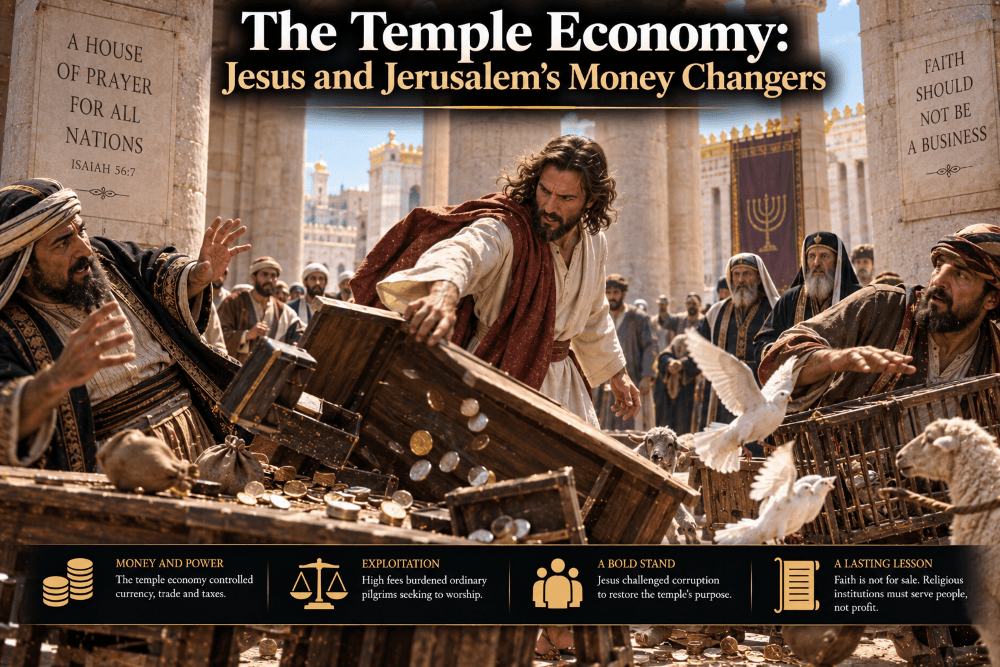
Most retellings of Jesus overturning the money changers’ tables focus on the moral or theological dimension of the moment. Historians and biblical scholars studying the period also point to something else: a genuinely sophisticated, and deeply extractive, Temple economy operating at the heart of Jerusalem. Understanding that economic system, built on currency monopolies, crushing taxation, and centralized religious authority, adds important context to one of history’s most famous acts of protest.
The Temple as an Economic Powerhouse
A Massive Religious and Commercial Complex
The Jerusalem Temple, significantly expanded under King Herod, functioned as far more than a place of worship.
- Historians generally describe it as the largest public complex in the Eastern Mediterranean during this period.
- During major festivals like Passover, Jerusalem’s population reportedly swelled from around 60,000 residents to well over a million pilgrims, according to ancient sources, though modern historians debate the precision of these figures.
- This massive seasonal influx of pilgrims created enormous economic activity concentrated directly around the Temple complex.
The Currency Monopoly
Jewish religious law required an annual Temple tax, and this requirement created a lucrative, controlled financial system.
- The tax was payable only in Tyrian shekels, a high-purity silver coin trusted for its consistent metal content.
- Pilgrims arriving with other currencies needed to exchange their money for Tyrian shekels before they could pay the tax or make Temple offerings.
- Money changers operating in the Temple’s outer courtyard, known as the Court of the Gentiles, handled these conversions, charging exchange fees that flowed back to the Temple hierarchy.
This currency requirement effectively gave Temple authorities a controlled monopoly over a necessary transaction that every observant pilgrim had to complete.
Colonial Governance and Extraction
The Temple’s economic power operated within a broader system of Roman colonial control.
- High priests, including figures like Annas and Caiaphas, were appointed with Roman approval and answered to Roman authority.
- These religious leaders also managed local tax collection on Rome’s behalf, blending religious and colonial administrative functions.
- This arrangement created what many historians describe as a genuinely extractive economic system, funneling wealth both to the Temple hierarchy and to Rome.
Jesus’s Economic Background and Teachings
A Peasant Craftsman’s Context
Historical scholarship generally places Jesus’s early life within Galilee’s peasant economy, a context very different from Jerusalem’s Temple wealth.
- Growing up in Nazareth, Jesus is widely believed by historians to have worked as a construction laborer, a tekton in Greek, possibly involved in Herod’s public building projects in nearby Sepphoris.
- This background placed him within Galilee’s working peasant class rather than among the religious or economic elite.
- Scholars often note that this lived experience likely shaped his later teachings about wealth, poverty, and economic justice.
The Weight of Taxation
Peasants in Jesus’s era faced an extraordinarily heavy combined tax burden.
- Historians estimate effective tax rates, combining Roman tariffs, local levies, and religious tithes, may have reached 60 to 70 percent for ordinary peasant households.
- No meaningful bankruptcy protection existed, meaning debt could quickly spiral into land loss or debt bondage.
- This economic pressure forms an important backdrop for understanding the audience Jesus’s ministry primarily addressed.
A Different Vision for Wealth
According to the Gospel accounts and much scholarly interpretation, Jesus’s teachings framed money and resources in terms fundamentally different from the Temple’s institutional model.
- His teachings often treated wealth as ultimately belonging to God, intended for direct communal support rather than institutional accumulation.
- His ministry operated in a notably decentralized, low-overhead manner, without the elaborate institutional structure the Temple represented.
- Many scholars interpret this approach as an implicit, and at times explicit, challenge to the Temple’s centralized religious and economic authority.
The Cleansing of the Temple
An Act Read as Economic Protest
The episode commonly called the “cleansing of the Temple,” described across the Gospel accounts, is interpreted by many historians as pointed economic and political protest, not solely a religious gesture.
- When Jesus overturned the money changers’ tables, many scholars read this as a direct challenge to a system that monetized access to religious practice.
- Some historical analyses suggest that silver accumulated in the Temple treasury contributed to liquidity shortages affecting ordinary peasants in the surrounding economy.
- This interpretation frames the act as confronting institutional power concentrated at the intersection of religious authority and economic extraction.
It’s worth noting that interpretations of this event vary significantly among historians and theologians, and this economic framing represents one significant scholarly lens rather than a single settled consensus.
Political Consequences
According to the Gospel narratives, this confrontation contributed directly to the events leading to Jesus’s execution.
- Temple authorities, reportedly concerned about instability during the politically volatile Passover season, handed Jesus over to Roman governor Pontius Pilate.
- Rome generally responded to perceived threats of unrest with swift, forceful suppression, particularly during large festival gatherings when crowds posed genuine political risk.
- This combination of religious, economic, and political tension culminated in Jesus’s crucifixion, according to the Gospel accounts.
The Long-Term Legacy
Escalating Tensions
The underlying economic and political pressures highlighted by this episode didn’t resolve with Jesus’s death. They continued building over subsequent decades.
- Tensions between Jewish populations and Roman colonial administration, intertwined with ongoing economic extraction, continued escalating throughout the following decades.
- These tensions eventually culminated in the First Jewish-Roman War, a major and increasingly desperate revolt against Roman rule.
- In 70 CE, Roman forces destroyed the Jerusalem Temple entirely, permanently ending the Temple-based economic and religious system described throughout this chapter.
This destruction marked a profound turning point, ending the centralized Temple economy that had shaped religious and economic life in Jerusalem for generations.
Lessons from the Temple Economy
- Currency control creates concentrated power. The mandatory Tyrian shekel system gave Temple authorities significant economic leverage over ordinary pilgrims.
- Extractive systems generate resistance. Heavy taxation and centralized economic control created conditions that fueled both individual protest and eventual large-scale rebellion.
- Economic and religious authority often intertwine. Understanding Temple-era Jerusalem requires recognizing how deeply religious institutions and economic extraction were connected.
Frequently Asked Questions
Why did pilgrims need to exchange currency at the Jerusalem Temple? Jewish religious law required the annual Temple tax to be paid in Tyrian shekels, a high-purity silver coin, so pilgrims arriving with other currencies needed to exchange money through Temple money changers.
What economic background did Jesus likely come from? Historical scholarship generally places Jesus within Galilee’s peasant class, with many historians suggesting he worked as a construction laborer, possibly on Herod’s building projects near Sepphoris.
How is the cleansing of the Temple interpreted historically? Many historians and scholars interpret this episode as an act of protest against the Temple’s economic system, which monetized religious access and concentrated wealth within the Temple hierarchy.
What happened to the Jerusalem Temple after this period? Rising tensions between Jewish populations and Roman colonial rule eventually led to the First Jewish-Roman War, culminating in Rome’s destruction of the Temple in 70 CE.