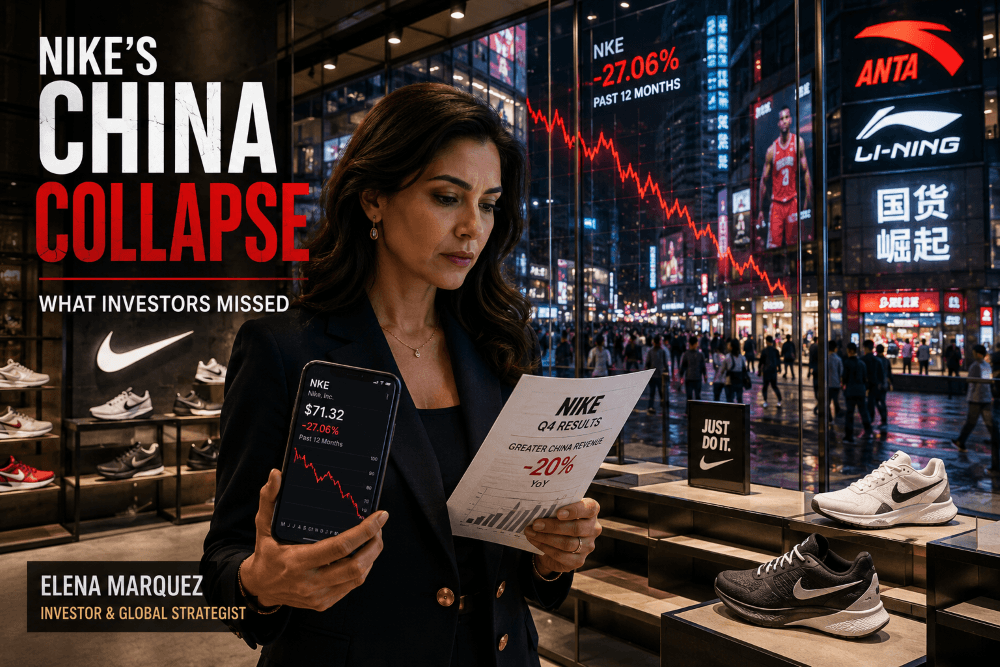
For decades, Nike was considered one of the greatest consumer brands in the world. Investors viewed the company as untouchable. But during the past 12 months, Nike shareholders have suffered a painful reality check.
Nike shares have fallen roughly 27%, while the S&P 500 has gained about 27% over the same period. That is a staggering performance gap for a company that once dominated global sportswear.
The biggest problem? China.
Nike spent nearly 50 years building the Chinese market. Today, that same market is becoming one of the company’s greatest weaknesses.
The story offers important lessons for investors, retailers, and multinational corporations that believed China would provide endless growth forever.
Nike Stock and the China Dream
The Nike China story began long before most American companies even considered doing business there.
In the late 1970s, Nike co-founder Phil Knight visited China shortly after the country began opening to the West. At the time, China was emerging from the Cultural Revolution and remained economically isolated.
Most American executives saw risk.
Phil Knight saw opportunity.
His vision was simple but ambitious:
“One billion people, two billion feet.”
Knight understood earlier than almost anyone that China could eventually become both:
- A low-cost manufacturing base
- A massive consumer market
It was a brilliant strategy.
Nike first used China to manufacture shoes cheaply. Then, as China’s middle class grew richer, Chinese consumers began buying Nike products themselves.
The formula worked spectacularly.
How Nike Won China
Nike Became a Status Symbol
During the 1980s and 1990s, foreign brands carried enormous prestige in China.
Nike leaned heavily into this image. The company sponsored Chinese athletes, Olympic teams, and sporting events. Wearing Nike became associated with success, wealth, and modernity.
For many Chinese consumers, Nike was not just a shoe company.
It represented the West.
China Became Nike’s Cash Machine
By the late 2000s and early 2010s, China had evolved into one of Nike’s most profitable regions.
The numbers were extraordinary.
At one point, Nike reported 20 consecutive quarters of double-digit revenue growth in China. Investors loved the story because China offered both high growth and high profit margins.
China became the blueprint for Western corporations chasing international expansion.
If you wanted proof that globalization worked, Nike was the example.
Why Nike Lost China
1. Nationalism Changed the Game
Around 2021, Nike became entangled in geopolitical tensions involving Xinjiang cotton and allegations of human rights abuses.
Nike announced it would avoid sourcing cotton from Xinjiang.
That decision triggered a backlash inside China.
Chinese consumers posted videos burning Nike shoes online, and nationalist sentiment rapidly turned against Western brands.
This exposed a harsh reality for multinational corporations:
It is becoming increasingly difficult to satisfy both Western political expectations and Chinese political expectations simultaneously.
Companies now risk alienating one side no matter what they do.
2. Chinese Competitors Got Better
For years, Nike benefited from weak local competition.
That era is over.
Chinese brands like ANTA Sports and Li-Ning dramatically improved product quality while maintaining lower prices.
These companies no longer produce “cheap knockoffs.”
They now create legitimate performance products backed by serious innovation.
ANTA even recruited NBA stars like Klay Thompson and Kyrie Irving, directly challenging Nike’s basketball dominance.
Meanwhile, Li-Ning partnered with Dwyane Wade to create the “Way of Wade” sneaker line.
Nike suddenly faced sophisticated domestic rivals that understood Chinese consumers better than foreign executives did.
3. Nike Failed to Adapt to Chinese Retail Culture
Chinese consumers shop differently than Western consumers.
The Chinese market moves faster, embraces trends earlier, and relies heavily on livestream shopping and social commerce platforms like Douyin.
Local brands adapted quickly.
Nike hesitated.
While Chinese competitors experimented with AI livestream hosts and aggressive digital campaigns, Nike relied heavily on legacy products like Air Jordans.
The problem?
Many younger Chinese consumers have little emotional connection to Michael Jordan.
What worked in America no longer worked automatically in China.
Lessons for Investors
Global Dominance Is Never Permanent
Nike looked unstoppable just a few years ago.
Investors assumed China growth would continue indefinitely. That assumption turned out to be dangerously wrong.
Even elite global brands can lose relevance surprisingly fast.
Local Competition Always Evolves
Many Western companies underestimate how quickly Chinese competitors improve.
At first, local companies compete on price.
Eventually, they compete on quality, technology, speed, and innovation.
Tesla is facing this issue in electric vehicles. Apple faces it in smartphones. Nike now faces it in athletic wear.
The pattern keeps repeating.
Political Risk Matters
For years, investors treated China as purely an economic opportunity.
Now it is also a geopolitical risk.
Companies operating globally must navigate:
- Nationalism
- Trade tensions
- Human rights controversies
- Supply chain risks
- Cultural differences
These issues can directly impact revenues and stock prices.
Can Nike Recover?
Nike is attempting a turnaround.
The company is reducing excess inventory, redesigning stores, and focusing more heavily on running products and innovation.
But the challenge is enormous.
China is no longer an easy-growth market dominated by foreign brands. It is now one of the most competitive consumer markets in the world.
Nike may recover partially.
But recreating the glory days of endless double-digit growth in China appears unlikely.
And that matters because investors once priced Nike as if those glory days would last forever.
The Bigger Warning for Investors
The Nike story is bigger than sneakers.
It is a warning about globalization itself.
For decades, American companies assumed they could:
- Manufacture cheaply in China
- Sell premium products globally
- Expand endlessly into Chinese consumer markets
That model is under pressure.
China is no longer just the factory of the world.
It is producing world-class competitors.
And increasingly, Chinese consumers are choosing local brands over foreign ones.
Investors who fail to recognize this shift may find themselves holding yesterday’s winners.
FAQ
Why has Nike stock performed so poorly?
Nike stock has struggled due to slowing sales, weak innovation, inventory problems, and major declines in China revenue.
Why is China important to Nike?
China was one of Nike’s fastest-growing and most profitable markets for many years, contributing significantly to company earnings.
Which Chinese companies are competing with Nike?
Major Chinese competitors include ANTA Sports and Li-Ning, both of which have improved product quality and gained market share.
Can Nike recover in China?
Nike may stabilize its business, but returning to the explosive growth rates of the past will be difficult due to intense competition and changing consumer preferences.
Other Stock Market blog posts