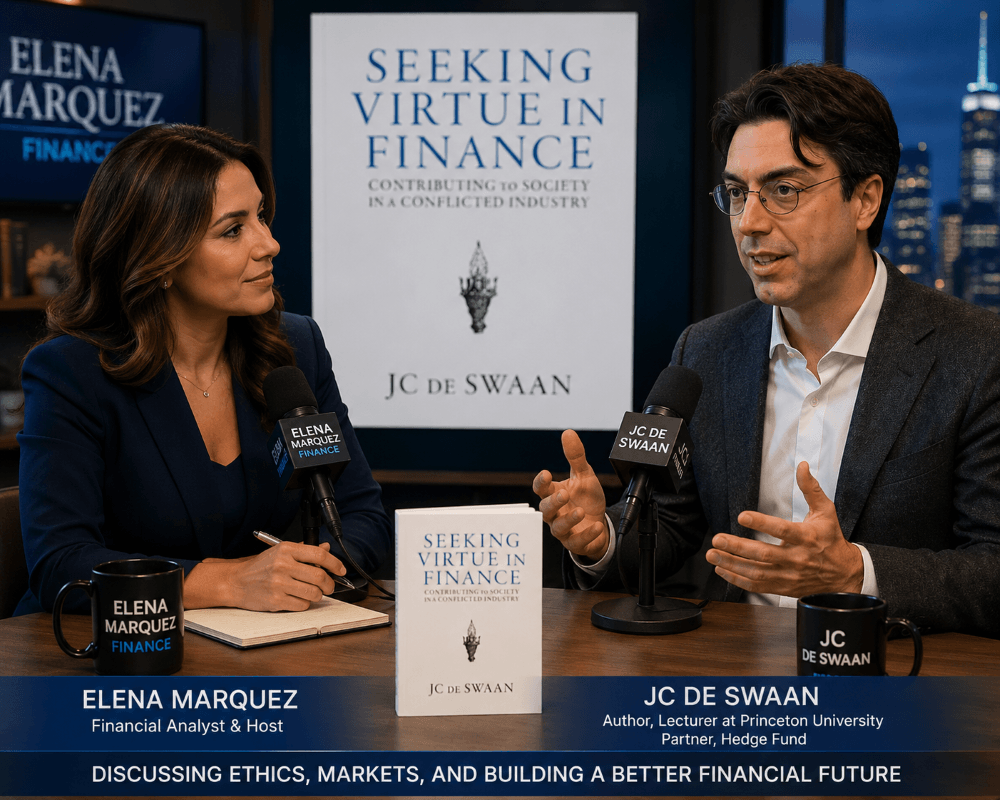
Seeking Virtue in Finance is an unusual book because it asks a question that many people assume has already been answered: Can someone build a successful career in finance while remaining ethical?
For decades, popular culture has portrayed finance as a world dominated by greed, manipulation, and short-term profits. Movies like Wall Street and The Wolf of Wall Street have reinforced the stereotype that success on Wall Street often comes at the expense of honesty and integrity.
Real-life scandals have only strengthened that perception. The 2008 financial crisis exposed excessive risk-taking by major financial institutions. Later, banks such as Wells Fargo admitted to creating millions of unauthorized customer accounts. These events damaged public trust and left many people wondering whether finance serves society—or merely enriches those at the top.
Jean-Christophe (J.C.) de Swaan argues that this cynical view tells only part of the story.
In Seeking Virtue in Finance, he presents a compelling case that finance, when practiced responsibly, can become one of society’s most valuable professions.
Who Is J.C. de Swaan?

Jean-Christophe de Swaan is both an academic and an investment professional.
He lectures in the Economics Department at Princeton University, where he is affiliated with the Bendheim Center for Finance. His courses focus on ethics in finance and Asian capital markets. Beyond Princeton, he has taught at the University of Cambridge’s Judge Business School, Yale University, Hong Kong University of Science and Technology, and Cheung Kong Graduate School of Business in Beijing.
Unlike many academics who study finance from the outside, de Swaan also works as a partner at a hedge fund. His combination of practical experience and philosophical thinking gives the book a perspective that is both realistic and thoughtful.
That dual vantage point matters because the ethical questions de Swaan raises rarely stay theoretical. They surface in the daily decisions investors make on the trading platforms where orders are placed and positions managed. A professional weighing the tools of the trade has to consider not only execution speed and cost, but whether the incentives built into those tools nudge behaviour toward short-term gain at the expense of the longer view the book argues for.
Seeking Virtue in Finance Is About More Than Making Money

Following the Global Financial Crisis, governments, investors, and business leaders began asking whether finance had lost sight of its true purpose.
Rather than dismissing the entire industry, de Swaan explores how finance professionals can improve it from within.
His central argument is straightforward:
Finance should exist to allocate capital efficiently, support economic growth, and improve society—not simply maximize short-term profits.
Instead of encouraging readers to abandon the financial industry, he encourages them to become the kind of professionals who make the industry better.
Seeking Virtue in Finance and Aristotle’s Virtue Ethics
One of the book’s most interesting features is its use of Aristotle’s philosophy.
Rather than relying only on rules or regulations, de Swaan argues that good finance depends on good character.
He highlights virtues such as:
- Integrity
- Prudence
- Honesty
- Moderation
- Practical wisdom
- Courage
- Responsibility
These qualities help financial professionals make better decisions even when regulations cannot anticipate every ethical dilemma.
Character matters because financial markets often reward short-term success, while ethical decisions usually require thinking about long-term consequences.
Why This Book Still Matters Today
Although the book was written several years ago, its message has become even more relevant.
Today’s financial industry faces new ethical questions involving:
- Artificial intelligence in investment decisions
- Cryptocurrency markets
- Retail investing through commission-free trading apps
- Social media’s influence on markets
- Corporate governance
- Fiduciary responsibility
Technology changes rapidly, but ethical principles remain remarkably constant.
Investors continue to rely on trust. Without trust, financial markets cannot function efficiently.
Challenging the Definition of Success
One of de Swaan’s strongest arguments is that success should not be measured solely by income, bonuses, or assets under management.
Instead, professionals should ask:
- Did my work create value?
- Did I improve clients’ lives?
- Did I strengthen financial markets?
- Can I be proud of the decisions I made?
This broader definition of success is refreshing in an industry often criticized for rewarding only financial performance.
Ethical Investing: De Swaan, Buffett, Munger, and Bogle
J.C. de Swaan’s philosophy fits comfortably alongside the thinking of some of the most respected investors of the past century. Although they approached finance from different backgrounds, Warren Buffett, Charlie Munger, and John C. Bogle all argued that long-term success depends as much on character as it does on intelligence.
Buffett has often remarked that when hiring people, he looks for three qualities: integrity, intelligence, and energy—and if the first is missing, the other two can become dangerous. Charlie Munger repeatedly emphasized the importance of earning and protecting a reputation, observing that while it can take decades to build trust, it can be destroyed in minutes. John Bogle, who revolutionized investing by creating the first index mutual fund for individual investors, consistently argued that the financial industry should place clients’ interests ahead of its own profits. His famous advice, “Stay the course,” reflected not only an investment strategy but also a philosophy of patience, discipline, and long-term thinking.
These ideas closely mirror de Swaan’s central message. Ethical finance is not simply about avoiding fraud or complying with regulations. It is about cultivating the habits, judgment, and moral character that enable professionals to make sound decisions over an entire career. In the long run, integrity is more than a personal virtue—it is a competitive advantage. Investors, clients, and business partners naturally gravitate toward people they trust, and trust remains one of the most valuable assets anyone in finance can possess.
Praise from Leading Thinkers
The book received endorsements from an impressive group of scholars and business leaders.
Among them are:
- Jeffrey Sachs, Columbia University
- Alan Blinder, Princeton University
- Adam Grant, bestselling author of Think Again and Originals
- Arthur Brooks, Harvard Kennedy School
- Janet Cowell, CEO of Girls Who Invest
Many praised the book for demonstrating that profitability and ethical behavior are not mutually exclusive.
My Thoughts
I appreciate books that challenge popular stereotypes.
It is easy to criticize finance by pointing to its worst actors. Every profession has bad examples. Medicine has fraudulent doctors. Politics has corrupt politicians. Journalism has sensationalism.
Finance is no different.
At its best, finance performs one of society’s most important functions: directing capital toward productive businesses, funding innovation, creating jobs, and helping individuals build wealth for retirement.
Without functioning financial markets, economic growth would slow dramatically.
That does not excuse misconduct. Bad incentives, excessive leverage, conflicts of interest, and regulatory failures deserve scrutiny. But it is equally important to recognize that many professionals enter finance with genuine intentions of helping clients and improving capital allocation.
De Swaan reminds us that ethical finance is not an impossible ideal—it is a practical necessity.
Final Thoughts
Seeking Virtue in Finance offers a refreshing alternative to the common narrative that Wall Street and ethics are incompatible.
Rather than condemning the financial industry, J.C. de Swaan encourages thoughtful professionals to improve it from within through integrity, wisdom, and responsibility.
Whether you are a student considering a career in finance, an investor managing your own portfolio, or simply someone interested in business ethics, this book provides valuable insights into how financial success and moral character can coexist.
It is a reminder that markets work best when they are built on trust—and trust ultimately depends on virtue.
Frequently Asked Questions
Is Seeking Virtue in Finance worth reading?
Yes. It offers a balanced perspective on the financial industry by combining practical experience with ethical philosophy, making it valuable for professionals, students, and investors alike.
Who is J.C. de Swaan?
J.C. de Swaan is a Princeton University lecturer, hedge fund partner, and author specializing in finance, ethics, and capital markets.
What is the main message of Seeking Virtue in Finance?
The book argues that finance should serve society by allocating capital responsibly and that ethical leadership is essential for long-term success.
Is ethical investing profitable?
Ethical investing does not guarantee higher returns, but many investors believe strong governance, transparency, and responsible management can contribute to better long-term outcomes.
Other Podcast Posts