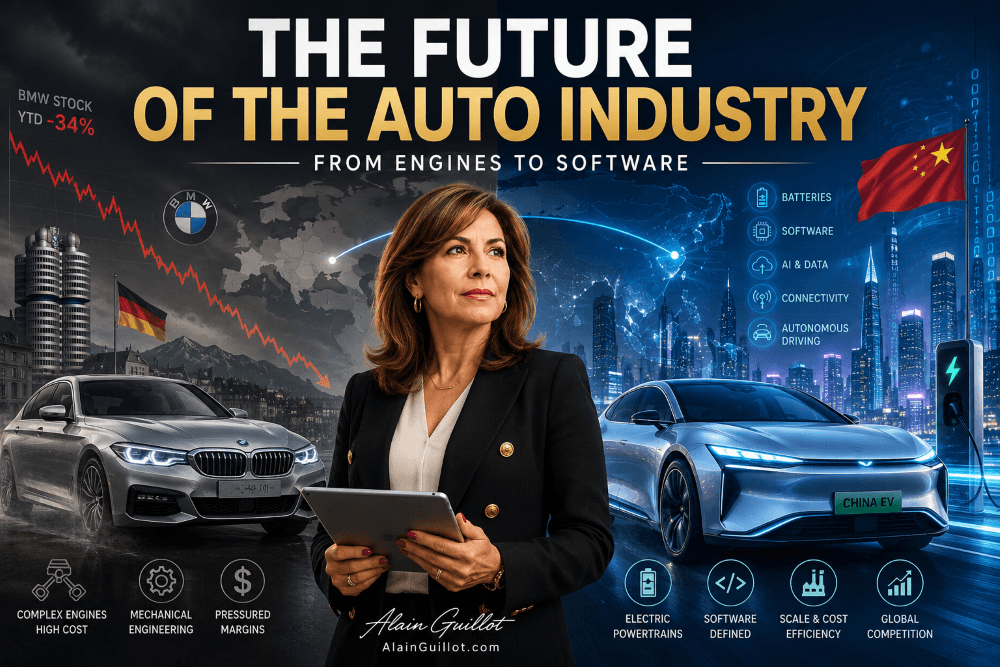
When investors think about the future of the auto industry, they often focus on quarterly earnings or temporary economic slowdowns. I think they’re missing the much bigger story.
BMW recently warned that profits would be lower than expected, sending its shares sharply lower. Management pointed to weakness in China as one of the primary reasons.
But I believe China isn’t the real problem.
China is the future.
And that future looks very different from the automobile industry we’ve known for the last hundred years.
The Future of the Auto Industry Is Being Written in China
For decades, Germany represented the gold standard in automobile manufacturing.
BMW.
Mercedes-Benz.
Volkswagen.
Audi.
Porsche.
They built some of the finest engineering masterpieces ever placed on four wheels.
Unfortunately for them, consumers increasingly care less about how beautifully an engine is engineered.
They care about software.
They care about battery range.
They care about charging speed.
They care about over-the-air updates.
They care about price.
These are entirely different competitive advantages.
My family in Colombia owns Chinese-made vehicles. Before they bought them, I was skeptical.
Today, they love them.
They’re reliable, packed with technology, comfortable, and—perhaps most importantly—far less expensive than many American or European alternatives.
North American consumers don’t yet have many opportunities to buy these vehicles because tariffs largely keep them out of the market.
That protection may delay competition.
It won’t eliminate it forever.
Why Electric Vehicles Change Everything
Traditional automakers built their reputations on internal combustion engines.
German engineers spent decades perfecting transmissions, fuel injection systems, turbochargers, suspension geometry, and precision manufacturing.
Those skills created enormous competitive advantages.
Electric vehicles dramatically reduce that advantage.
An electric motor contains far fewer moving parts than a gasoline engine.
The real competition shifts toward:
- Battery technology
- Manufacturing efficiency
- Software
- Artificial intelligence
- Autonomous driving
- User experience
- Supply chain management
In many ways, today’s cars are becoming smartphones on wheels.
Software updates increasingly matter as much as horsepower.
Future of the Auto Industry Means Lower Profit Margins
This is where investors should pay close attention.
History gives us a useful comparison.
Remember the Television Industry?
Several decades ago, American companies dominated television manufacturing.
Companies like RCA and Zenith were household names.
Then Japanese manufacturers entered the market.
Later, South Korean companies such as Samsung and LG raised the bar even further.
Televisions became:
- Better
- Larger
- More reliable
- Less expensive
Consumers won.
Manufacturers didn’t.
Televisions eventually became commodities with razor-thin profit margins.
Today, few people know—or care—where their television is manufactured as long as it offers good quality at a competitive price.
I believe automobiles are moving down the same path.
Can BMW, Mercedes, and Ford Adapt?
Of course they can.
These companies employ brilliant engineers and have tremendous financial resources.
The real question isn’t whether they can build excellent electric vehicles.
It’s whether they can earn the same profit margins doing so.
That’s a much harder challenge.
When dozens of manufacturers can produce excellent electric vehicles, competition naturally drives prices downward.
Consumers benefit.
Shareholders may not.
Tariffs Can Slow the Transition—but Not Stop It
Governments across North America and Europe have introduced tariffs designed to protect domestic automakers from Chinese competition.
These policies may buy traditional manufacturers additional time.
But history suggests that tariffs rarely reverse technological change.
They can delay it.
They cannot eliminate it.
Consumers ultimately gravitate toward products that deliver the best combination of quality, technology, and price.
If Chinese manufacturers continue improving while maintaining lower costs, competitive pressure will only intensify.
Investors Should Prepare for a Different Industry
I don’t believe the automobile business is disappearing.
People will always need transportation.
But the economics of building cars may be permanently changing.
Instead of a handful of manufacturers enjoying premium pricing because of mechanical engineering excellence, we may see an industry characterized by:
- Fierce price competition
- Rapid technological innovation
- Software becoming the primary differentiator
- Lower long-term profit margins
- Consolidation among manufacturers
The winners may not simply build the best cars.
They’ll build the best technology at the lowest cost.
Final Thoughts
The future of the auto industry won’t necessarily belong to the companies with the best engines.
It may belong to the companies with the best software, the strongest battery supply chains, and the most efficient manufacturing.
That’s a profound shift.
BMW’s recent struggles may be less about one disappointing quarter and more about a structural transformation taking place across the entire industry.
Just as televisions evolved from high-margin engineering marvels into highly competitive consumer electronics, automobiles may be heading down the same road.
For consumers, that’s likely good news.
For investors, it means looking beyond brand prestige and asking a more important question:
Who will be able to build great electric vehicles profitably ten years from now?
Frequently Asked Questions
Why are Chinese automakers becoming more competitive?
Chinese manufacturers have invested heavily in battery technology, software, supply chains, and large-scale manufacturing, allowing them to produce feature-rich electric vehicles at competitive prices.
Why are electric vehicles changing the auto industry?
Electric vehicles reduce the importance of complex engine engineering while increasing the value of software, batteries, artificial intelligence, and manufacturing efficiency.
Can European automakers remain competitive?
Yes, but maintaining historical profit margins may become increasingly difficult as global competition intensifies and electric vehicles become more commoditized.
Are tariffs enough to protect Western automakers?
Tariffs may slow foreign competition and provide time for domestic manufacturers to adapt, but they are unlikely to permanently prevent technological and competitive shifts in the global market.
Other Stock Market blog posts