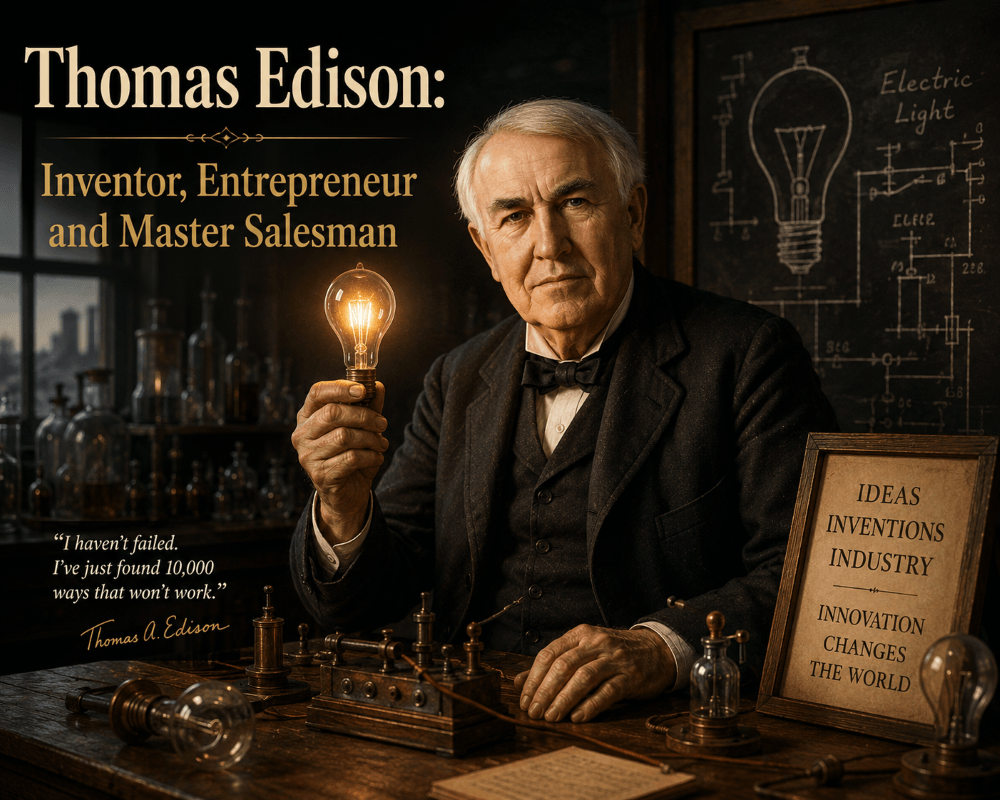
Thomas Edison is remembered as one of history’s greatest inventors. His name is associated with the electric light bulb, the phonograph, motion pictures and more than a thousand U.S. patents.
But focusing exclusively on Edison’s inventions misses what may be the most interesting part of his story.
Thomas Edison was also an entrepreneur, manufacturer, fundraiser, promoter and master salesman.
He understood something that innovators sometimes forget:
Inventing a product isn’t enough. You have to convince people to use it, finance it, manufacture it, distribute it and build the infrastructure that makes it useful.
Edison didn’t simply help develop a practical incandescent lamp.
He helped build an entire electrical industry around it.
That may be his greatest lesson for entrepreneurs today.
Who Was Thomas Edison?
Thomas Alva Edison was born in Milan, Ohio, in 1847 and grew up in Michigan.
He had relatively little formal schooling and spent much of his youth educating himself through reading, experimenting and working with technology.
As a teenager, Edison learned telegraphy and eventually worked professionally as a telegraph operator. Telegraph technology was expanding rapidly across America, putting young Edison at the center of one of the nineteenth century’s most important communications revolutions.
By the late 1860s, he was moving away from simply operating technology and toward inventing it.
His first patented invention was an electric vote recorder.
Commercially, it was a failure.
That failure taught Edison one of his most important entrepreneurial lessons.
According to the National Park Service, Edison subsequently resolved to concentrate on inventions he believed people would actually want.
That’s a surprisingly modern philosophy.
Don’t invent something merely because you can. Build something customers actually want.
Thomas Edison Wasn’t Just an Inventor
During his lifetime, Thomas Edison accumulated 1,093 U.S. patents.
His work contributed to technologies involving:
- Electric lighting
- Electrical power distribution
- Recorded sound
- Telegraphy
- Telephones
- Motion pictures
- Batteries
- Mining
- Manufacturing
The Library of Congress describes Edison not only as a prolific inventor but also as a successful manufacturer and businessman who marketed many of his inventions directly to the public.
That’s the Edison I’m most interested in.
There have been countless clever inventors throughout history.
Edison understood how to turn invention into commerce.
His First Important Business Lesson Came From Failure
Edison’s electric vote recorder seems like a good invention.
It was designed to allow legislative bodies to record votes more quickly.
The problem?
The intended customers apparently weren’t interested.
Politicians sometimes preferred slower voting procedures because delays gave them opportunities to negotiate, persuade colleagues and change outcomes.
Edison had solved a technological problem without adequately considering whether customers actually wanted it solved.
That’s a classic entrepreneurial mistake.
His next major commercial success came from improvements to stock-ticker technology. Edison reportedly received about $40,000 for his stock-printer inventions—an enormous amount for a young man in the nineteenth century.
He used that capital to establish a laboratory and manufacturing operation.
In modern startup language, Edison had found his first successful exit and reinvested the proceeds into his next ventures.
Menlo Park: Edison Invented the Innovation Factory
In 1876, Edison established a laboratory at Menlo Park, New Jersey.
This wasn’t simply a workshop where one man tinkered alone.
Edison assembled machinists, scientists, technicians and assistants who could repeatedly experiment, build prototypes, test ideas and turn successful concepts into products.
The National Park Service describes Menlo Park as the first research-and-development laboratory of its kind and a model for later industrial research facilities.
In that sense, one of Thomas Edison’s greatest inventions may have been:
the invention laboratory itself.
Instead of waiting for occasional flashes of inspiration, Edison attempted to create an organized system for innovation.
That idea eventually became standard throughout modern industry.
Bell Labs.
IBM Research.
Xerox PARC.
Apple.
Google.
Pharmaceutical research laboratories.
Technology companies with enormous R&D departments.
The modern corporation assumes innovation can be organized, financed and pursued systematically.
Edison was among the pioneers of that model.
Did Thomas Edison Really Invent the Light Bulb?
This is where Edison’s story often becomes oversimplified.
Thomas Edison did not invent the basic idea of electric light.
Inventors had experimented with electrical illumination and incandescent lamps before him.
Edison’s achievement was developing a commercially practical incandescent lighting system.
His team worked on much more than the bulb itself.
They needed:
- Durable filaments
- Generators
- Wiring
- Switches
- Fuses
- Meters
- Distribution systems
- Electrical sockets and fixtures
- Power stations
The National Park Service describes Edison’s accomplishment as the development of both a practical incandescent lamp and the complete system necessary to make electric lighting safe, economical and useful in homes and businesses.
That’s an important distinction.
Edison wasn’t merely selling a light bulb.
He was building an ecosystem.
The Light Bulb Was Useless Without Infrastructure
Imagine Edison had produced the world’s greatest light bulb in 1879.
Then he handed it to you.
What would you do with it?
Your house had no electrical wiring.
Your neighborhood had no electrical grid.
There was no nearby power station.
There wasn’t even a standardized socket in your ceiling.
The bulb by itself wasn’t particularly useful.
That’s why Edison’s entrepreneurship is arguably more interesting than the invention itself.
He realized he needed to build an entire system.
On September 4, 1882, Edison’s Pearl Street generating station began supplying electricity to customers in lower Manhattan.
The electricity business had moved from laboratory experiment to commercial infrastructure.
This is one of the great recurring themes in entrepreneurial history:
Breakthrough technologies often require entrepreneurs to build the ecosystem surrounding the product.
Thomas Edison Was Selling a New Future
Imagine trying to persuade investors to finance electrical infrastructure in the late nineteenth century.
Gas lighting already existed.
Cities had gas companies.
Homes and businesses already understood how gas lighting worked.
Edison wasn’t merely offering a slightly better lamp.
He was proposing an entirely different technological system.
That required storytelling.
Investors had to believe that electricity would become widespread enough to justify huge investments in generating stations, wires, factories and equipment.
Customers had to believe electricity was useful.
Cities had to tolerate new infrastructure.
Businesses had to be persuaded to switch from existing technologies.
In that respect, Edison had something in common with modern technology entrepreneurs.
The entrepreneur often has to sell the future before the future exists.
Electric Light Disrupted an Existing Industry
Whenever a revolutionary technology appears, an existing industry usually has something to lose.
Electric light threatened the enormous gas-lighting industry.
Gas companies already possessed infrastructure, customers, capital and political relationships.
They weren’t simply going to disappear.
Historian Ernest Freeberg explores this transformation in his book The Age of Edison: Electric Light and the Invention of Modern America.
Freeberg’s history isn’t merely about Edison as an individual.
It examines what happened when electrical illumination began spreading across American society—from major entertainment districts such as Broadway and Coney Island to much smaller communities.
Electricity didn’t simply replace one kind of lamp with another.
It changed how people worked, shopped, traveled and entertained themselves.
Ernest Freeberg and The Age of Edison

Several years ago, I interviewed historian Ernest Freeberg.
Our conversation focused primarily on another of his books, A Traitor to His Species, about nineteenth-century animal-rights reformer Henry Bergh.
But Freeberg also wrote a fascinating book about Thomas Edison and the electric revolution.
The Age of Edison examines the arrival of electric light and how something we now consider completely ordinary transformed American life.
That’s easy to forget.
We flip a switch today and don’t think about it.
But imagine living in a world where darkness dramatically constrained human activity.
Factories.
Restaurants.
Stores.
Offices.
Theaters.
Homes.
Streets.
Electric illumination changed all of them.
Freeberg’s book is particularly valuable because it looks beyond the inventor and asks a bigger question:
What happens to society when a revolutionary technology becomes ordinary?
That’s a question worth asking about every major technological revolution.
From Edison to General Electric
Building an electrical industry required enormous amounts of capital.
Edison therefore relied increasingly on investors and financiers.
His various electrical businesses were consolidated into Edison General Electric in 1889. Later corporate combinations eventually produced General Electric.
Interestingly, Edison himself did not retain control of the growing electrical empire bearing his name. The National Park Service notes that the enormous capital requirements of the electric-light industry necessitated involvement from powerful investment bankers.
There is another entrepreneurial lesson here.
The larger an enterprise becomes, the more likely founders are to confront questions of:
- Capital
- Ownership
- Control
- Governance
- Investors
- Professional management
Creating something and controlling it forever are not necessarily the same thing.
Edison Understood Manufacturing
Many inventors love prototypes.
Entrepreneurs have to think about production.
One perfect light bulb made in a laboratory isn’t commercially significant.
A company must manufacture thousands—and eventually millions—of them reliably and economically.
Edison’s later West Orange complex integrated research, testing and manufacturing on an extraordinary scale.
The National Park Service describes how Edison could develop a product, have his employees test it, manufacture it in nearby factories and then sell it around the world.
That’s vertical integration before anyone was using fashionable startup terminology to describe it.
Idea → Research → Prototype → Testing → Manufacturing → Distribution → Customer
Edison attempted to control the entire process.
Edison Was Also a Master of Publicity
Technology entrepreneurs sometimes behave as if public relations began with Steve Jobs.
It didn’t.
Edison understood publicity extremely well.
Newspapers loved him.
Journalists described him as the “Wizard of Menlo Park.”
Public demonstrations helped turn inventions into spectacles.
When Edison publicly demonstrated his electric lighting system at Menlo Park in 1879, people traveled to see something that seemed almost magical.
This wasn’t frivolous publicity.
It served a business purpose.
People needed to imagine a world illuminated by electricity before they would invest in it or purchase it.
Great entrepreneurs aren’t merely capable of creating something new.
They often become translators between technology and imagination.
Edison the Master Salesman
The word “salesman” can sometimes sound less glamorous than “inventor.”
I think that’s unfortunate.
Sales is essential to entrepreneurship.
You have to sell:
- Investors on financing you
- Employees on joining you
- Customers on buying
- Partners on cooperating
- Journalists on paying attention
- Society on accepting something unfamiliar
Edison did all of these.
His fame itself became an economic asset.
The Edison name suggested invention and technological progress.
In today’s language, he had built a personal brand.
The Wizard of Menlo Park wasn’t merely an individual.
He became a symbol of American technological optimism.
Edison Didn’t Work Alone
The mythology surrounding inventors often reduces complicated technological developments to one heroic individual.
Reality is rarely so simple.
Edison employed teams of skilled assistants—sometimes called his “muckers”—who participated extensively in experimentation and product development.
Menlo Park demonstrates that innovation is often collaborative.
Edison deserves enormous credit for organizing these efforts.
But understanding entrepreneurship requires recognizing the institution he built rather than imagining one genius sitting alone beside a light bulb.
His great talent may have included creating environments where many people’s knowledge could be directed toward commercially useful innovation.
What Thomas Edison Got Wrong
Successful entrepreneurs aren’t successful because every idea they have works.
Edison had plenty of failures.
His electric vote recorder failed commercially.
Some mining ventures consumed huge amounts of money without producing the expected results.
He pursued technologies that competitors ultimately defeated.
Perhaps the most famous example involved the War of the Currents.
Edison strongly promoted direct current, while alternating-current systems associated with George Westinghouse and Nikola Tesla ultimately proved better suited for transmitting electricity over long distances.
Edison could be brilliant.
He could also be stubborn.
That’s another valuable entrepreneurial lesson.
Past success doesn’t guarantee that your next idea is correct.
What Entrepreneurs Can Learn From Thomas Edison
Thomas Edison’s world looked completely different from ours.
The entrepreneurial principles behind his success look surprisingly familiar.
1. Build Something People Actually Want
Edison’s first patented invention failed commercially.
He learned from it.
Technical brilliance without customer demand doesn’t create a successful business.
2. Don’t Just Build the Product—Build the Ecosystem
The electric bulb needed generators, wires, power stations, switches and distribution.
Modern entrepreneurs face similar challenges.
An electric vehicle needs charging infrastructure.
AI applications need computing infrastructure.
Smartphones need applications and cellular networks.
Platforms need developers and users.
Sometimes the ecosystem becomes more valuable than the original product.
3. Distribution Matters as Much as Invention
A product sitting inside a laboratory doesn’t change the world.
Someone has to manufacture it.
Distribute it.
Install it.
Market it.
Service it.
Edison understood this.
4. Learn to Sell the Future
Revolutionary companies frequently need capital long before their vision becomes obvious.
Entrepreneurs have to explain:
Here is where the world is going, and here is why our company will matter when it gets there.
Edison was selling electric light before America had an electrical grid.
That’s entrepreneurial storytelling.
5. Create a System for Innovation
Menlo Park represented an attempt to make invention repeatable.
Modern entrepreneurs should think similarly.
Don’t rely entirely on flashes of inspiration.
Create processes for:
- Experimentation
- Customer feedback
- Product development
- Testing
- Learning
- Improvement
Innovation can be organized.
6. Capital Changes Everything
Great ideas often require money.
The electrical revolution required enormous investment.
Factories, generators and electrical networks were capital-intensive.
Entrepreneurs therefore have to understand not only products but also capital allocation and finance.
7. Be Persistent—but Don’t Become Blind
Edison performed enormous numbers of experiments.
That may be the ultimate sign of entrepreneurial success.
That persistence became legendary.
But persistence isn’t the same as refusing to recognize evidence.
Entrepreneurs need both determination and intellectual flexibility.
Keep pursuing the goal.
Be willing to change the method.
Thomas Edison and the Modern Entrepreneur
Edison died in 1931.
Yet much about his business model feels contemporary.
He operated research laboratories.
Built technological platforms.
Raised outside capital.
Managed intellectual property.
Created consumer products.
Built manufacturing operations.
Cultivated his personal brand.
Used media strategically.
Sold investors a vision of the future.
Built infrastructure around his products.
And competed in rapidly changing technological markets.
Replace electricity with artificial intelligence, semiconductors, biotechnology, renewable energy or robotics, and many of the entrepreneurial challenges look remarkably familiar.
The technology changes.
Entrepreneurship doesn’t change nearly as much.
Edison Didn’t Merely Invent a Light Bulb
If we remember Thomas Edison only as the inventor of the light bulb, we miss the most valuable part of his story.
Electric illumination existed before Edison.
What Edison and his team helped create was something much larger:
a commercially viable electrical system.
He helped take an emerging technology and connect it with capital, manufacturing, infrastructure, publicity and customers.
That’s what entrepreneurs do.
They stand between an idea and the world.
And they somehow persuade enough investors, workers, customers and partners to help turn something that doesn’t yet exist into something everyone eventually takes for granted.
Ernest Freeberg’s The Age of Edison captures that transformation beautifully.
Today, turning on a light requires almost no thought.
A revolutionary technology eventually becomes so useful, so widespread and so ordinary that we forget there was ever a world without it.
Thomas Edison wasn’t simply an inventor.
He was one of the entrepreneurs who helped build that new world.
Frequently Asked Questions About Thomas Edison
What did Thomas Edison invent?
Thomas Edison and his laboratories contributed to numerous technologies, including practical incandescent lighting systems, the phonograph, motion-picture technology, telegraph improvements and batteries. During his lifetime, Edison received 1,093 U.S. patents.
Did Thomas Edison invent the light bulb?
Edison did not originate the basic concept of incandescent electric lighting. Earlier inventors had developed forms of electric light. Edison’s important achievement was helping develop a commercially practical incandescent lamp along with the generating and distribution system necessary to make electric lighting widely useful.
Was Thomas Edison an entrepreneur?
Yes. In addition to inventing, Edison created laboratories, manufacturing operations and numerous companies. He raised capital, marketed inventions, built electrical infrastructure and helped establish a commercial electric-power industry.
What is The Age of Edison by Ernest Freeberg about?
Ernest Freeberg’s The Age of Edison: Electric Light and the Invention of Modern America is a social history of the electric-light revolution. It examines how electric illumination spread through America and transformed work, entertainment, cities and daily life.
Other Self Made Posts