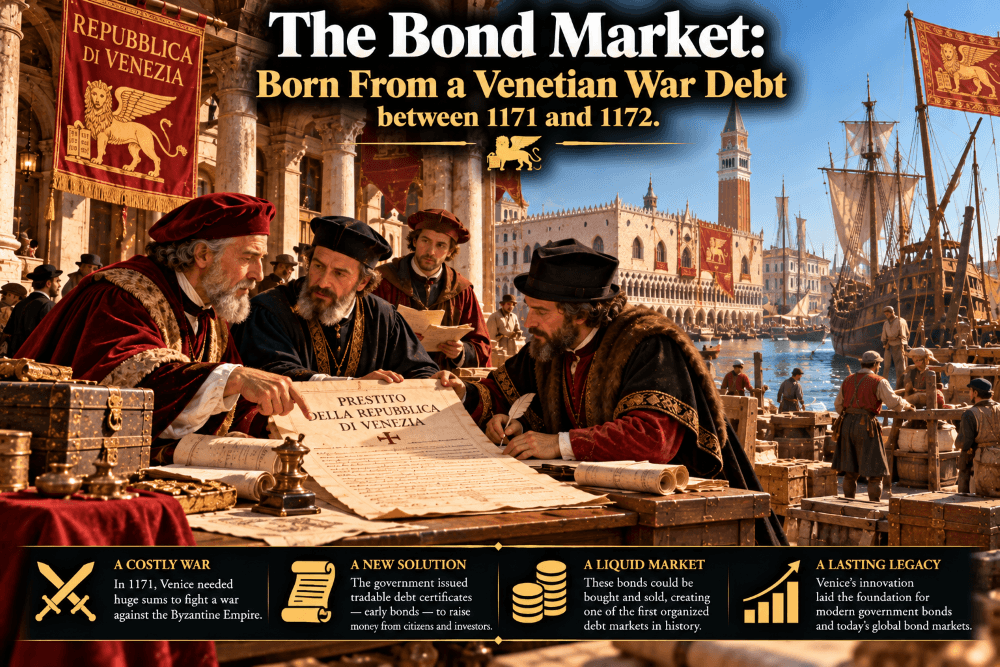
The bond market as we understand it today, tradable debt with a fixed interest rate and a fluctuating price, didn’t emerge from a boardroom or a stock exchange. It emerged from a geopolitical crisis, a desperate war loan, a catastrophic military failure, and the murder of a Venetian head of state. The full story, examined in detail in Mike Wigglesworth’s A Fabulous Debt, traces back to 12th-century Venice and reveals just how much political upheaval shaped one of finance’s most foundational instruments.
What Is a Bond?
Before tracing the bond market’s origins, it helps to understand the basic mechanics that have remained remarkably consistent for roughly 850 years.
- A bond is essentially a tradable loan carrying a fixed interest rate, known as its coupon, paid to whoever currently holds it.
- While that coupon rate remains fixed, a bond’s market price fluctuates based on investor demand and broader economic conditions.
- This creates an inverse relationship between price and yield: as a bond’s price rises, its effective yield falls, and vice versa.
This basic structure, a tradable claim on fixed future payments, is precisely what Venice accidentally invented while trying to solve a very different problem.
The Geopolitical Crisis That Started It All
Venice Without Resources
By the 12th century, Venice had become a thriving trade hub despite possessing remarkably few natural resources of its own.
- The city’s prosperity depended almost entirely on commerce, shipping, and its extensive trading relationships throughout the Mediterranean.
- This trade-dependent economy made Venice particularly vulnerable to political conflicts that disrupted its commercial relationships.
- Tensions with the Byzantine Empire, a crucial trading partner, were building toward a serious breaking point.
Manuel I Comnenus and Mass Arrests
In 1171, Byzantine Emperor Manuel I Comnenus took a drastic and provocative action against Venice’s commercial interests.
- He ordered the mass arrest and property seizure of more than 20,000 Venetians living and trading across the Byzantine Empire.
- This action represented a devastating blow to Venice’s commercial network and a direct assault on its citizens and their property.
- Venice’s government faced immediate pressure to respond forcefully, despite lacking the readily available funds needed to mount a significant military response.
The Birth of the Prestiti
Financing a War Fleet
To fund a retaliatory fleet of 120 warships, Doge Vitale II Michiel instituted a mandatory war loan imposed on Venice’s wealthy citizens between 1171 and 1172.
- This mandatory levy, known as the prestiti, required wealthy Venetians to lend money directly to the state to finance the military campaign.
- Venice needed to structure this loan carefully, both to make the forced contribution politically palatable and to navigate Catholic Church prohibitions against usury.
- The resulting structure became something genuinely new in financial history.
Designing Around Religious Restrictions
Venice’s solution to the usury problem proved remarkably clever, and remarkably consequential.
- The prestiti paid a 5 percent annual return to lenders, technically structured in a way intended to navigate around strict religious prohibitions on charging interest.
- Critically, receipts for these loans could be registered and sold to third parties, allowing investors to exit their position by selling to someone else rather than waiting for full repayment.
- This tradability, conducted at Venice’s Rialto, is widely considered the origin of the world’s first formal bond market.
This combination, a fixed return paired with the ability to trade one’s claim to that return, created the essential mechanics that still define bond markets today.
Catastrophe and Political Transformation
A Military Disaster
Venice’s expensively financed war fleet did not deliver the victory the mandatory loan had been designed to fund.
- The military campaign collapsed when plague struck the fleet, devastating its forces before any meaningful victory could be achieved.
- The surviving fleet returned to Venice having accomplished essentially nothing, despite the enormous financial sacrifice demanded of the city’s wealthy citizens.
- This catastrophic outcome triggered intense public anger throughout Venice.
The Doge’s Murder and Government Reform
Venice’s enraged population responded to this military failure with shocking political violence.
- An angry mob murdered Doge Vitale II Michiel in 1172, holding him directly responsible for the disastrous and costly campaign.
- This crisis forced Venice to fundamentally reform its system of government, moving toward a more representative structure intended to prevent any single leader from accumulating this level of unchecked authority again.
- Venice also established greater fiscal transparency practices, specifically intended to reassure the bondholders whose capital the state now depended upon.
This connection matters enormously: Venice’s bondholders, holding tradable claims on government debt, effectively demanded more accountable governance as the price of their continued financial trust.
Why the Birth of the Bond Market Still Matters
Debt as a Check on Power
The prestiti’s legacy extends well beyond financial mechanics into genuine political history.
- Once a government depends on investors willing to buy and hold its debt, maintaining investor confidence becomes a genuine political constraint.
- Venice’s shift toward transparency and representative governance directly reflects this dynamic: bondholders needed reassurance that their capital was being managed responsibly.
- This relationship between sovereign borrowing and government accountability represents one of the bond market’s most significant and lasting historical contributions.
A Modern Parallel
This dynamic between government borrowing and investor-driven accountability remains directly visible in modern financial markets.
- Modern sovereign bonds, including U.S. Treasury securities, continue to function as a meaningful check on government fiscal policy through the collective judgment of bond investors.
- Governments pursuing policies perceived as fiscally irresponsible often face rising borrowing costs as investors demand higher yields to compensate for increased perceived risk.
- This feedback mechanism, first visible in 12th-century Venice, continues operating as a genuine constraint on government behavior today.
Lessons from the Bond Market’s Origins
- Crisis often drives financial innovation. Venice’s bond market emerged directly from the urgent pressure of funding an unplanned war.
- Tradability transforms an obligation into an asset. The ability to sell prestiti receipts to third parties is what distinguished Venice’s innovation from a simple forced loan.
- Creditor confidence can reshape governance itself. Venice’s political reforms were driven partly by the practical need to maintain bondholder trust.
Frequently Asked Questions
What were the prestiti? The prestiti were mandatory war loans imposed on wealthy Venetian citizens in 1171 and 1172, paying 5 percent annual interest and structured to be tradable, forming the basis of the first formal bond market.
Why did Venice create the first bond market? Venice needed to finance a war fleet after Byzantine Emperor Manuel I Comnenus ordered the mass arrest of Venetian citizens, and structuring the mandatory loan as a tradable instrument helped navigate religious usury restrictions while raising needed capital.
What happened to Doge Vitale II Michiel? He was murdered by an angry Venetian mob in 1172 after the war fleet he financed through the prestiti failed catastrophically due to plague, triggering major governmental reforms in Venice.
How does the origin of the bond market relate to modern finance? Just as Venice’s bondholders pushed for greater government transparency and accountability, modern sovereign bond investors, including those holding U.S. Treasuries, continue to influence government fiscal policy through their collective lending decisions.