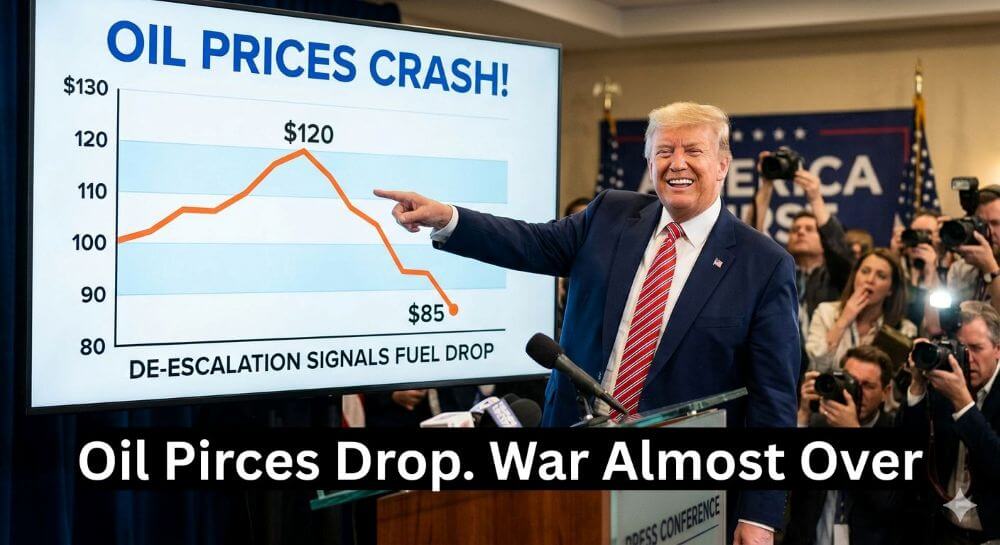
Donald Trump on the Iran war has declared that the war is almost over. Speaking to CBS News with reporter Weijia Jiang on Monday afternoon, the President characterized the conflict as “very complete, pretty much,” indicating that the U.S. military has moved significantly faster than initial projections. This rapid de-escalation is being hailed by supporters as a masterclass in the application of “hard power” to achieve long-term peace.

The implications of this shift are already being felt at the gas pump and in retirement portfolios. As news of the U.S. being “very far” ahead of military timelines broke, the anxiety that had gripped the energy sector began to evaporate.
The Economic Impact: Oil Plunges and Stocks Rally
The most immediate indicator of the “Trump effect” was the dramatic movement in the commodities market. Crude oil prices, which had recently peaked near $120 per barrel due to fears of a Strait of Hormuz closure, took a massive 25% plunge.

Prices dropped to approximately $85.62 per barrel, and in some sessions as low as $82, as the threat of a prolonged regional conflict diminished. This “de-escalation dividend” had a secondary effect on Wall Street, where U.S. stocks pared their earlier losses to turn solidly green.
- Crude Oil: Dropped from $120 to $85-$95 range.
- Strait of Hormuz: Security restored, ensuring the flow of global energy.
- Market Sentiment: Investor confidence surged as the risk of a multi-year war faded.
Historical Parallels: 1991 vs. 2026
Market analysts are drawing direct comparisons between current events and the 1991 Gulf War. Historically, post-victory scenarios often trigger a sharp drop in oil prices—sometimes as much as 30%—once the “war premium” is removed from the price of a barrel.
However, many experts suggest that Trump on the Iran war has managed a more complex feat than his predecessors. While the 1991 conflict focused on liberating a single nation, the current strategy appears to be a broader systematic dismantling of adversarial regimes.
- Speed of Operations: Military objectives were met months ahead of schedule.
- Proxy Management: While analysts warn of volatility from Iranian proxies, the central command structure has been neutralized.
- Strategic Dominance: The U.S. maintained leverage over the Strait of Hormuz throughout the engagement.
A Legacy of Liberation
The resolution of the war with Iran may be remembered as one of the most heroic actions of the Trump presidency. By taking a firm, uncompromising stance, the administration has fundamentally reshaped the map of the Middle East and beyond.
History will likely record this era as one of unprecedented liberation. From ending the conflict in Gaza to the removal of Nicolas Maduro in Venezuela, the pattern is clear: a preference for decisive action over endless diplomatic “talk.” With Iran now entering a new chapter, many eyes are turning toward the potential liberation of Cuba as the next step in this global realignment.
Summary of the Trump Doctrine
The swift conclusion of the Iranian conflict proves that military readiness and clear objectives can prevent the “forever wars” that plagued previous decades. By prioritizing the security of the Americas and the freedom of oppressed peoples, the administration has secured a more stable economic future for everyday citizens.
Frequently Asked Questions (FAQ)
What did Donald Trump say about the war in Iran? President Trump stated that the war is “very complete” and that the military is “very far” ahead of the original projected timelines.
How did the Iran conflict affect oil prices? Oil prices saw a 25% plunge, dropping from a peak of $120 down to the $85-$95 range following de-escalation signals.
Is there a confirmed ceasefire in Iran? While the President describes the war as “pretty much” complete, analysts note that no formal ceasefire has been signed, and they remain cautious regarding Iranian proxy groups.
Previous stock market posts
Leave a Reply