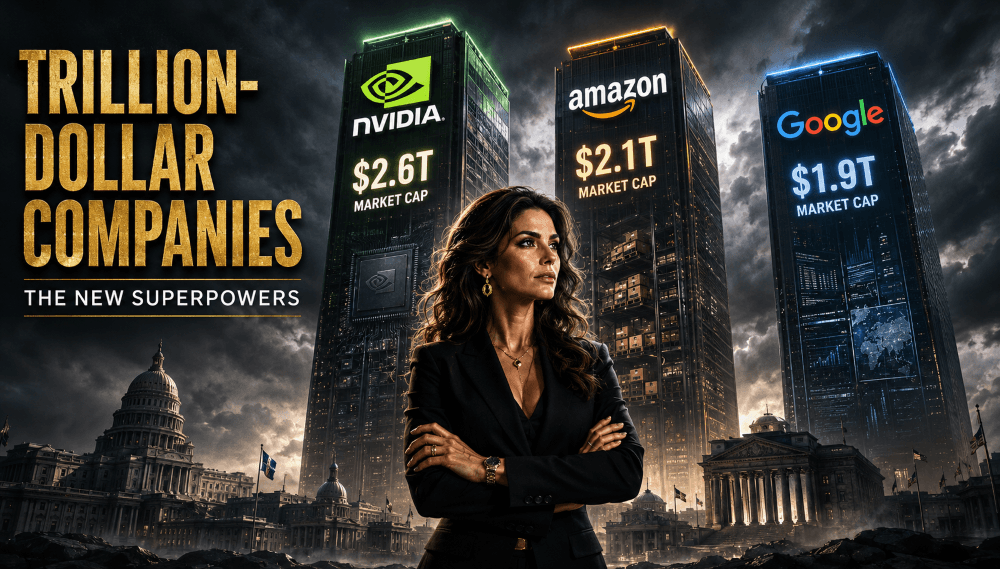
There was a time when a company worth one trillion dollars sounded absurd. Today, the trillion-dollar club keeps growing, and these corporations are becoming more powerful than many governments.
The rise of trillion-dollar companies is not just a financial story. It is a story about technology, artificial intelligence, military influence, political leverage, and control over the future of humanity.
Yesterday, Micron Technology became the latest member of the trillion-dollar club. Only a handful of corporations in history have reached this level. That alone tells us something profound about where the global economy is heading.
The Rise of the Trillion-Dollar Companies
The first trillion-dollar companies were mostly American technology firms that built digital infrastructure used by billions of people.
Among the most influential are:
- Apple
- Microsoft
- Amazon
- Alphabet
- Nvidia
- Meta
- Saudi Aramco
- Tesla
- Micron Technology
At first glance, these companies appear to belong to different industries.
But they all share one thing in common:
They control critical infrastructure.
Apple controls devices.
Microsoft controls enterprise software and cloud computing.
Amazon controls logistics and cloud infrastructure.
Nvidia and Micron control the chips powering artificial intelligence.
Meta controls attention and social influence.
These companies are no longer simply businesses. They are platforms upon which entire economies operate.
Why AI Changed Everything
Artificial intelligence accelerated the concentration of power.
AI systems require enormous amounts of:
- Computing power
- Advanced semiconductors
- Energy
- Data centers
- Cloud infrastructure
- Capital
Very few countries can provide all of those ingredients.
Right now, the global AI race is primarily dominated by the United States and China.
That creates an uncomfortable question:
What Happens to the Rest of the World?
Countries without advanced AI infrastructure may become dependent on the nations and corporations that own it.
In the industrial era, countries needed oil.
In the AI era, countries need computing power.
That changes geopolitics completely.
Imagine a developing nation needing access to American AI systems to:
- Monitor elections
- Fight organized crime
- Analyze intelligence
- Protect financial systems
- Defend against cyberattacks
What happens if those systems become unavailable?
What happens if a foreign corporation decides who gets access and who does not?
We already have examples of private companies influencing military and political outcomes.
When Elon Musk controls satellite internet infrastructure through SpaceX and its Starlink network, the decisions of one executive can affect wars, communications, and national security.
That would have sounded impossible twenty years ago.
Today, it is reality.
The New Form of Colonialism
Historically, powerful nations controlled weaker countries through military force or economic pressure.
The next version may happen through technological dependence.
A country that lacks AI infrastructure may eventually depend on foreign corporations for:
- Communication
- Banking systems
- Security
- Healthcare analysis
- Election integrity
- Transportation systems
This creates a new hierarchy of nations.
Countries that control AI infrastructure become dominant.
Countries that do not may become technologically subordinate.
That possibility should concern everyone.
Why Investors Keep Buying These Companies
Investors understand that these corporations are becoming essential infrastructure providers.
The stock market no longer values companies only based on current profits.
It values future dominance.
That is why investors continue pouring money into AI-related firms like Nvidia and Micron.
The logic is simple:
If AI transforms the global economy, then the companies supplying the chips, servers, data centers, and software become the toll booths of the future economy.
And toll booths are incredibly profitable.
Are Trillion-Dollar Companies Too Powerful?
This may be the defining economic question of the next decade.
When a corporation becomes worth more than the GDP of many nations, traditional ideas about capitalism start to break down.
Governments move slowly.
Corporations move quickly.
Governments are constrained by elections.
Corporations are constrained only by competition and regulation.
But what happens when competition disappears?
What happens when only a few companies control:
- Artificial intelligence
- Cloud infrastructure
- Semiconductors
- Global communications
- Social influence
The trillion-dollar club is no longer just a milestone for investors.
It is a map of who may control the future.
FAQ
What is a trillion-dollar company?
A trillion-dollar company is a corporation whose market capitalization exceeds one trillion dollars.
Which companies are part of the trillion-dollar club?
Major members include Apple, Microsoft, Nvidia, Amazon, Alphabet, Meta, Tesla, Saudi Aramco, and Micron Technology.
Why are AI companies reaching trillion-dollar valuations?
Investors believe AI infrastructure companies will dominate future economic growth by controlling chips, cloud computing, and data systems.
Could AI increase inequality between countries?
Yes. Countries without AI infrastructure may become dependent on nations and corporations that control advanced computing systems.
Other Stock Market blog posts