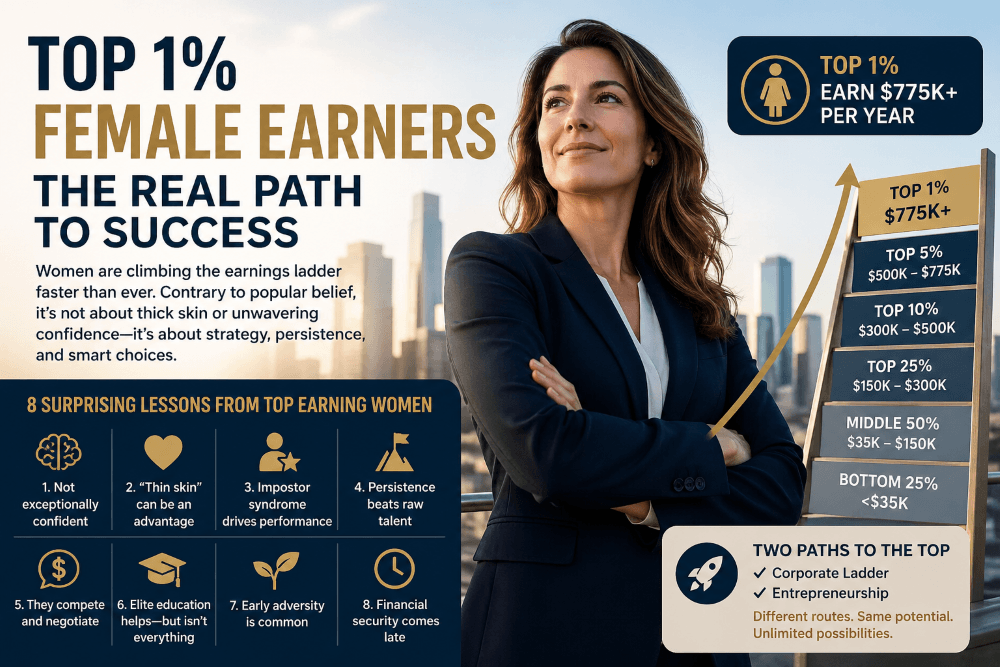
Top 1% Female Earners Are Redefining Success
The rise of top 1% female earners is quietly reshaping the professional landscape. Contrary to popular belief, women are not only catching up—they are increasingly climbing into the highest income brackets, earning $775,000+ per year.
Yet the narrative around how they get there is deeply flawed.
According to research by Emily Riley, reported in The Wall Street Journal by Callum Borchers, many of the commonly held beliefs about success at this level are either incomplete or outright wrong.
For years, we’ve been told that women need thick skin, extreme confidence, or near-perfect assertiveness to succeed at the highest levels. But recent insights suggest something very different—and far more accessible.
The 8 Real Traits of Top 1% Female Earners
Research into high-earning women reveals patterns that challenge conventional wisdom.
1. They’re Not Exceptionally Confident
Many top earners admit they don’t feel extraordinary.
Self-doubt is common—even at the top.
2. “Thin Skin” Can Be an Advantage
Instead of brushing off criticism, they feel it—and use it as fuel to improve.
3. Impostor Syndrome Drives Performance
Rather than holding them back, it pushes them to:
- Prepare more
- Work harder
- Continuously prove their value
4. Persistence Beats Raw Talent
Success isn’t about brilliance.
It’s about:
- Staying in the game
- Adapting when blocked
- Outlasting competition
5. They Compete—and Negotiate
Top earners don’t wait to be rewarded.
They:
- Ask for raises
- Push for promotions
- Strategically change roles when needed
6. Elite Education Helps—but Isn’t Everything
Many attended top schools, but education alone doesn’t explain their success.
7. Early Adversity Is Common
A surprising number experienced:
- Financial hardship
- Immigration challenges
- Unstable beginnings
These experiences often create urgency and ambition.
8. Financial Security Comes Late
Even at high incomes, many don’t feel secure until much later in life.
This creates a constant drive to keep progressing.
How Everyday Women Can Become Top 1% Female Earners
You don’t need to be born exceptional to reach elite income levels. But you do need to act differently.
1. Play the Long Game
- Choose careers with high income ceilings (tech, finance, law, medicine)
- Stay committed long enough to reach senior levels
2. Get Comfortable With Discomfort
- Apply before you feel ready
- Speak up even when unsure
- Take on visible, high-stakes projects
3. Master Negotiation
- Negotiate every salary offer
- Ask for performance-based raises
- Tie compensation to measurable outcomes
4. Build Strategic Visibility
- Work on projects that leadership notices
- Communicate results clearly
- Advocate for your contributions
5. Use Self-Doubt as Fuel
Instead of waiting for confidence:
- Act first
- Improve through feedback
- Let discomfort drive growth
Examples of High-Earning Women
While many top earners are not publicly known due to private compensation structures, a few high-profile leaders clearly operate at or above the top 1% income level.
- Gwynne Shotwell – President and COO of SpaceX
One of the most powerful executives in aerospace, she runs day-to-day operations of a company valued in the hundreds of billions. While her exact compensation is not public, executives at this level typically receive multi-million-dollar packages including equity, placing her firmly within or above top 1% earners. - Jane Fraser – CEO of Citigroup
One of the most influential leaders in global banking, overseeing a major multinational financial institution. - Lisa Su – CEO of AMD
A leading figure in the semiconductor industry, heading one of the most valuable chip companies in the world.
These women climbed the corporate ladder—but they’re not the only path.
The Entrepreneurship Route to the Top 1%
Corporate careers are one route. Entrepreneurship is another—often faster but riskier.
Why entrepreneurship works:
- Unlimited income ceiling
- Equity ownership
- Scalable business models
Examples:
- Luana Lopes Lara – The youngest self-made female billionaire, co founder of Kalshi, a predition market platform.
- Sara Blakely – Founder of Spanx, built a billion-dollar brand
- Whitney Wolfe Herd – Founder of Bumble, became one of the youngest female billionaires
Corporate vs. Entrepreneurship: Which Path Is Better?
Both paths can lead to top 1% income.
Corporate path:
- More stable
- Clear progression
- High compensation at executive levels
Entrepreneurship:
- Higher risk
- Higher upside
- Greater control
The key is choosing the path aligned with your tolerance for risk and ambition.
Final Thought
The myth of the ultra-confident, fearless high achiever is just that—a myth.
Top 1% female earners are not defined by perfection.
They are defined by persistence, adaptability, and the willingness to keep going despite doubt.
That’s a far more attainable blueprint than most people realize.
U.S. Income Brackets (Individual Earners)
🟢 Lower income
~$0 – $35,000
- Part-time workers, entry-level roles, service jobs
- Often below full-time median income
🟡 Lower-middle class
~$35,000 – $75,000
- Many entry-to-mid career workers
- Typical roles:
- administrative jobs
- teachers (early career in many states)
- trades at entry level
🔵 Middle class (core band)
~$75,000 – $150,000
Characteristics:
- Professional salaries (engineering, IT, nursing, government, skilled trades)
- Comfortable lifestyle in many regions
- Ability to save, but not necessarily accumulate wealth quickly in high-cost cities
In percentile terms:
- Roughly 60th to 85th percentile (varies by year and state)
🟣 Upper-middle class
~$150,000 – $300,000
- Senior professionals, dual-income households (sometimes single high earners)
- Managers, physicians early-mid career, senior engineers
- Strong financial stability and significant savings potential
🟠 High income (top ~10%)
~$300,000 – $500,000
- Executives, top specialists, successful business owners
- Start of “financially elite” category in most economic studies
🔴 Very high income (top ~5% to 2%)
~$500,000 – $775,000
- Senior executives, partners in law/finance, top surgeons
- Significant wealth accumulation potential
🟣 Elite income (top 1%)
~$775,000+
- CEOs, top investment professionals, elite entrepreneurs
- Very small fraction of population (~1 in 100 households or fewer)
🧠 Key insight (important nuance)
Income brackets can be misleading because:
- Geography matters (e.g., $120K feels very different in Montreal vs. San Francisco)
- Household income ≠ individual income
- Wealth (net worth) often diverges from income
For example:
- A $120K earner saving aggressively can outperform a $300K earner with high spending
- A $775K earner may still be “new rich” without accumulated wealth
📊 Simple summary
- $120K/year → Middle class (upper-middle in some regions)
- $300K/year → Top ~10% territory
- $775K+/year → Top 1% elite earners
U.S. Wealth Ladder
Key insight: Wealth is far more unequal than income
1. The “middle class” is mostly asset-light
- Most households sit between $50K and $1M net worth
- Much of this is tied to:
- home equity
- retirement accounts
- pensions
2. The real jump happens after $1M
- Wealth becomes increasingly investment-driven
- Capital begins to matter more than salary
3. The top 1% is a different financial universe
- Starts around $13 million+ net worth in the U.S.
- Wealth is driven by:
- equity ownership
- private businesses
- real estate portfolios
- capital gains
4. Net worth accelerates non-linearly
- The gap between $250K → $3M is large
- The gap between $5M → $25M is where wealth becomes exponential
Takeaway
Income creates stability.
Net worth creates freedom.
Most people focus on income, but the wealth ladder shows the real divide:
- Earners trade time for money
- Wealth builders convert income into assets
- The top 1% primarily own capital, not just salaries
FAQ
What income qualifies as a top 1% earner?
In the U.S., top 1% earners typically make $775,000 or more annually.
Do women need confidence to succeed at high levels?
Not necessarily. Many top earners report self-doubt and use it as motivation.
What careers lead to top 1% income?
Common paths include finance, technology, law, medicine, and executive leadership roles.
Is entrepreneurship a faster path to high income?
It can be, but it comes with higher risk compared to corporate careers.