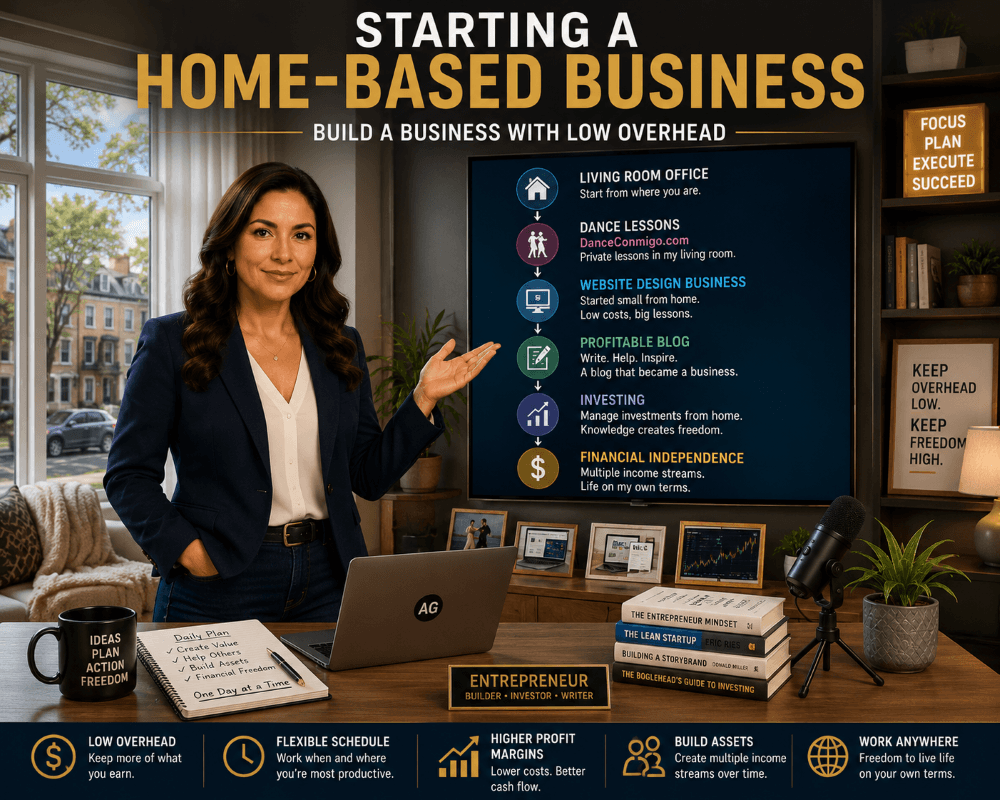
Starting a home-based business is one of the smartest ways to become an entrepreneur. By keeping your overhead low, you reduce financial risk, preserve cash flow, and give yourself more time to learn, adapt, and build a profitable business.
Many people dream of opening an office, renting commercial space, or hiring employees from day one. In reality, some of the world’s most successful businesses started in garages, spare bedrooms, basements, and living rooms.
A home office isn’t a sign that your business is small.
It’s often a sign that you’re managing your resources wisely.
Why Starting a Home-Based Business Makes Sense
Every dollar you don’t spend on unnecessary overhead is a dollar you can invest in growing your business.
When you eliminate expenses such as:
- Office rent
- Furniture
- Utilities
- Commuting
- Parking
- Commercial insurance
- Reception staff
you give your business more time to succeed.
Many businesses fail not because they lack customers, but because their fixed expenses become too high too quickly.
Low overhead gives entrepreneurs flexibility.
Flexibility creates opportunity.
The Biggest Advantage Isn’t Saving Rent
Most people think the biggest benefit of working from home is avoiding office rent.
I disagree.
The greatest advantage is keeping your fixed costs low while proving that your business works.
A business with very few monthly expenses can survive slow periods much longer than one burdened by high overhead.
Before signing a commercial lease, ask yourself:
“Do I really need this expense today?”
Growing slowly is often healthier than growing too quickly.
My Own Experience Building Businesses from Home
Nearly every business I’ve started began in my home.
When I launched Dance Conmigo, my dance school, I didn’t immediately rent a professional dance studio.
Instead, I began by teaching private dance lessons in my living room.
Only after building a steady clientele did I move into a dedicated studio.
That decision kept my expenses low and allowed the business to grow naturally.
I also started a website design business from home.
Although that business ultimately failed, it cost very little to operate because I wasn’t paying for commercial office space. One of the hidden advantages of starting from home is that even unsuccessful ventures become valuable learning experiences instead of expensive financial mistakes.
Today, I continue writing my blog from home.
What began as a passion project has grown into a profitable business that reaches readers around the world.
I also manage my investment portfolio from the same home office.
When I look back over the years, I realize that I have built most of my personal wealth from a small corner desk in my living room, overlooking the street from my second-floor apartment.
That simple workspace has been the headquarters for several businesses, countless interviews, thousands of articles, and many investment decisions.
You don’t always need a large office to build something meaningful.
Sometimes all you need is a laptop, a reliable internet connection, and the discipline to keep showing up every day.
Choose the Right Business
Not every business is well suited for operating from home.
Some of the best options include:
- Consulting
- Coaching
- Freelancing
- Graphic design
- Writing
- Online education
- Bookkeeping
- Software development
- Content creation
- Digital marketing
The ideal home-based business has low startup costs and serves a genuine customer need.
Create a Productive Workspace
Your home office doesn’t need to be large.
It simply needs to help you focus.
Consider:
- A comfortable chair
- Good lighting
- Reliable internet
- Minimal distractions
- Organized storage
A dedicated workspace also creates an important psychological boundary between work and personal life.
Separate Business and Personal Finances
One of the first habits every entrepreneur should develop is separating personal and business finances.
Open a dedicated business bank account if appropriate for your business.
Track income and expenses carefully.
Maintain organized financial records.
These simple habits make tax season easier and provide a clearer picture of your business’s performance.
Finding Your First Customers
Many entrepreneurs spend months perfecting their website before speaking with a single customer.
Instead, focus on solving problems for real people.
Some effective ways to attract early clients include:
- Asking for referrals.
- Building a professional website.
- Creating useful content.
- Networking locally.
- Sharing expertise online.
- Requesting testimonials.
Customers—not office space—are what make a business successful.
Know When It’s Time to Expand
Starting from home doesn’t mean staying there forever.
Eventually, your business may outgrow your living room.
You might consider commercial space when:
- You’re consistently turning away customers.
- You need employees working together.
- Clients regularly visit your office.
- Equipment no longer fits comfortably at home.
Expansion should follow business growth—not precede it.
I gave privave dance classes from my living room for a little over a year before I found a studio where to give dance classes.
Common Mistakes Home-Based Entrepreneurs Make
Many problems are avoidable.
Some of the most common mistakes include:
- Renting office space too early.
- Mixing personal and business finances.
- Buying expensive equipment before it’s needed.
- Underpricing services.
- Ignoring marketing.
- Trying to do everything alone.
- Failing to create a daily work routine.
Starting lean gives you more opportunities to learn and adjust.
Build a Business Before You Build an Office
One lesson I’ve learned through entrepreneurship is that customers don’t care where you work.
They care whether you solve their problem.
Too many entrepreneurs spend time designing the perfect office while neglecting sales, marketing, and customer service.
Focus first on building a great business.
The office can come later.
Famous Businesses That Started at Home
If you think a home office limits your potential, history tells a very different story. Some of the world’s most influential companies began in garages, spare bedrooms, and living rooms before growing into global brands.
Here are just a few examples:
- Apple was founded by Steve Jobs and Steve Wozniak in 1976, with the first Apple computers assembled in Jobs’ parents’ garage in Los Altos, California.
- Amazon began in Jeff Bezos’ rented house and garage in Bellevue, Washington, in 1994. What started as an online bookstore grew into one of the world’s largest companies.
- Disney traces its origins to a small garage behind the home of Walt Disney’s uncle in Los Angeles, where Disney and his brother Roy launched their first animation studio.
- Hewlett-Packard (HP) was founded by Bill Hewlett and David Packard in a one-car garage in Palo Alto, California. That modest workspace is now recognized as the birthplace of Silicon Valley.
- Google started in 1998 in the garage of Susan Wojcicki’s home in Menlo Park, where founders Larry Page and Sergey Brin built the search engine that transformed the internet.
These entrepreneurs didn’t wait until they had impressive offices or unlimited funding. They focused on creating valuable products, serving customers, and growing their businesses one step at a time.
Their stories remind us that success doesn’t depend on where you work—it depends on the value you create, the discipline you maintain, and your willingness to start before everything feels perfect.
Final Thoughts
Starting a home-based business isn’t about thinking small.
It’s about thinking smart.
Keeping overhead low gives you freedom.
Freedom to experiment.
Freedom to learn.
Freedom to survive setbacks.
Freedom to fail.
And ultimately, freedom to grow on your own terms.
Whether you’re launching your first business or your fifth, remember that success isn’t determined by the size of your office.
It’s determined by the value you create for your customers.
While my home office may not become the birthplace of the next Apple or Amazon, it has become the headquarters of my entrepreneurial life. From teaching dance lessons to writing articles, conducting interviews, managing investments, and building online businesses, it has proven to me that a small workspace can be the foundation for big ideas and it has provided a nice confortable life for myself.
Frequently Asked Questions
What is the biggest advantage of starting a home-based business?
The biggest advantage is keeping overhead low, allowing you to invest more money into growing your business while reducing financial risk.
What businesses work well from home?
Consulting, freelancing, coaching, writing, online education, software development, bookkeeping, digital marketing, and content creation are all excellent home-based businesses.
Should I rent office space immediately?
Usually not. Many entrepreneurs benefit from working from home until their customer base and revenue justify the additional expense.
Can a successful business really start from home?
Absolutely. Many successful companies and solo businesses began in homes, garages, or spare bedrooms before expanding into commercial spaces.
Other Personal Finance Posts