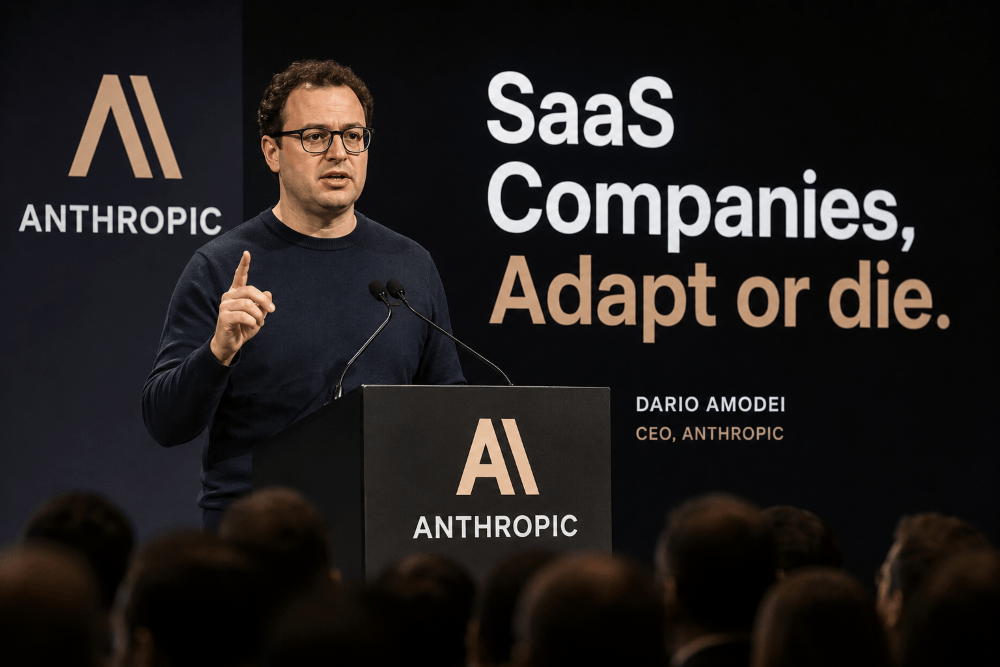
The SaaS-ocalypse has arrived—and this time, it’s not hype. When Dario Amodei says software companies must adapt or die, he’s not speculating. He’s describing a shift already underway, where artificial intelligence is tearing down the one moat SaaS companies relied on for decades: complexity.
For years, SaaS winners thrived by building tools that were hard to replicate and even harder to replace. Today, AI is flipping that equation. What once required massive engineering teams can now be built faster, cheaper, and—most importantly—good enough to steal customers.
The Death of Complexity as a Moat
According to Dario Amodei:
“If your moat is ‘our software is complex and difficult to write,’ that’s going away.”
AI is flattening the playing field.
What used to take:
- Large engineering teams
- Years of development
- Massive capital
…can now be replicated faster and cheaper with AI tools.
That changes everything.
Why the SaaS-ocalypse Is Real
AI doesn’t just improve software—it commoditizes it.
Here’s what’s happening:
1. Faster Competition
Startups can now build competing products in months, not years.
2. Lower Switching Costs
Customers are more willing to leave expensive platforms for cheaper AI-native alternatives.
3. Pricing Pressure
If AI reduces the cost of building software, customers expect lower prices.
👉 The result: margins shrink, and weak players get exposed.
SaaS Companies at Risk
Let’s be clear: not every SaaS company will fail. But some are clearly more vulnerable if they don’t evolve fast enough.
1. ServiceNow
ServiceNow wants to lead in AI—but investors aren’t convinced.
- Stock down ~53% over 12 months
- Heavy enterprise exposure
- Questions about real AI monetization
If it fails to prove ROI from AI, the downside could continue.
2. Snowflake
Snowflake sits at the center of data—but AI could bypass traditional data layers.
- Stock down ~16%
- Facing competition from AI-native data stacks
- Risk of becoming infrastructure instead of a premium platform
3. Thomson Reuters
A classic example of a company built on proprietary data and complex tools.
- Stock down ~49%
- Legal and research workflows now being challenged by AI
If AI can deliver answers instantly, why pay a premium?
4. Shopify
Not a traditional SaaS casualty—but under pressure.
- Up only ~9.4%
- Recently dropped 15.62% after weak outlook
- Merchants facing margin pressure
If AI simplifies e-commerce tools, differentiation becomes harder.
The Winners Are Already Moving
Some companies understand the shift.
- Microsoft integrates AI with Copilot across its ecosystem
- Google embeds Gemini into Workspace
These companies are not defending their moat—they’re rebuilding it with AI.
Adapt or Get Blindsided
Dario Amodei makes one thing clear:
Some companies will pivot and come out stronger. Others will ignore the shift and get blindsided.
This is where investors need to be brutally honest.
Ask yourself:
- Is this company truly integrating AI into its core product?
- Or is it just adding AI as a marketing feature?
Because the difference will determine survival.
My Take: The SaaS Reckoning Is Just Starting
The SaaS-ocalypse won’t happen overnight. But the trend is already visible in stock prices.
- Slower growth
- Multiple compression
- Investor skepticism
Some companies will adapt and thrive.
Others will:
- Lose market share
- See valuations collapse
- Or disappear entirely
The biggest mistake investors can make right now is assuming that yesterday’s winners will automatically survive tomorrow.
They won’t.
FAQ: SaaS-ocalypse and AI
1. What is the SaaS-ocalypse?
The SaaS-ocalypse refers to the potential collapse or decline of SaaS companies that fail to adapt to AI-driven disruption.
2. Why is AI a threat to SaaS companies?
AI reduces the cost and complexity of building software, making it easier for competitors to enter the market and undercut existing players.
3. Which SaaS companies are most at risk?
Companies relying on complexity as a moat or those slow to integrate AI—such as ServiceNow, Snowflake, and Thomson Reuters—may face higher risks.
4. Will all SaaS companies fail?
No. Companies that successfully integrate AI into their core offerings—like Microsoft and Google—are more likely to thrive.
Other personal finance blog posts