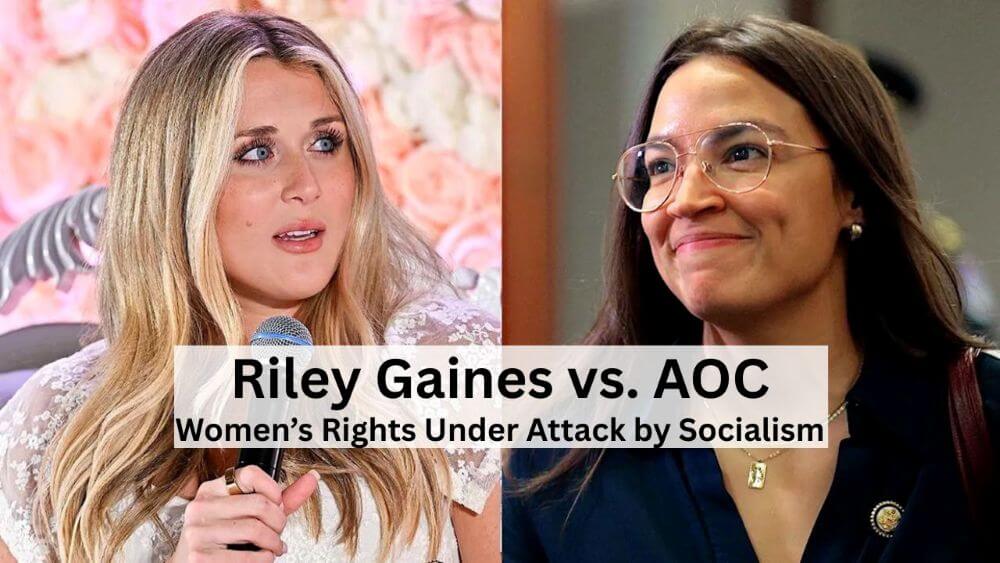
When former All-American swimmer Riley Gaines publicly criticized radical left-wing policies, she probably expected debate — not personal attacks from a sitting member of Congress. But that’s exactly what happened when Rep. Alexandria Ocasio-Cortez decided to target Gaines on social media. What started as a discussion about socialism and women’s rights quickly devolved into petty insults about swimming rankings and career choices.
Gaines, however, refused to play that game. While AOC relied on snark and ad-hominem attacks, Gaines addressed the substance of the debate. On her podcast Gaines for Girls, she called out the socialist agenda she believes is undermining America, pointing to countries like Venezuela, Cuba, and North Korea as cautionary examples of a system that prioritizes ideology over individual achievement.
AOC’s Petty Attacks on Achievement
It all began when Gaines posted a photo of AOC, Bernie Sanders, and Zohran Mamdani at a campaign event with the caption: “We are being destroyed from within.” Instead of responding to the critique, AOC went after Gaines personally, mocking her swimming career:
“Maybe if you channeled all this anger into swimming faster you wouldn’t have come in fifth.”
Gaines didn’t retaliate with insults. She highlighted the absurdity of the comment: being fifth in NCAA Division I swimming is a phenomenal achievement. She contrasted it with Lia Thomas’ previous ranking among male swimmers — 462nd — emphasizing the unfairness and the reality that biological differences matter.
Fighting Back With Substance
Rather than stoop to snark, Gaines challenged the ideas behind AOC’s politics. She explained on her podcast how socialism undermines opportunity and merit, saying:
“Democrats have made it very, very clear that they are not fighting for the American dream anymore. They’re fighting for that socialist fantasy. And it’s a losing battle every single time.”
Her critique was clear, fact-based, and principled — a stark contrast to AOC’s approach, which relied on personal attacks rather than engaging the argument.
“Get a Real Job” — The Left’s Misogynistic Double Standard
AOC didn’t stop at athletic insults. She suggested Gaines “get a real job,” implying her activism and advocacy weren’t legitimate work. Gaines responded with clarity and conviction: she has multiple jobs, all dedicated to protecting women’s rights and fighting for her daughter’s future.
“When I think of our daughter and the future that I want her to inherit… that’s precisely why I fight,” Gaines said.
This exchange revealed something larger: AOC’s self-proclaimed feminism often fails to protect women and instead silences those who do. Gaines called her opponent “a self-absorbed, misogynistic socialist,” pointing out the contradiction between AOC’s public image and her policies.
A Message to Young Women
Gaines used the opportunity to speak directly to the next generation. She urged young women to resist blindly following the Democratic Party’s anti-woman agenda and to seek fulfillment in meaningful, enduring pursuits: motherhood, service, marriage, and faith.
“True fulfillment comes through things like motherhood, service, a strong and loving marriage, and, most importantly, a relationship with Jesus Christ, our Lord and Savior.”
It’s a reminder that real empowerment doesn’t come from political hashtags or virtue signaling; it comes from courage, conviction, and the willingness to stand for what is right.
The Real Battle
The confrontation between Riley Gaines and AOC is more than a personal feud. It’s a clash of principles: merit, fairness, and accountability versus ideology, performative politics, and celebrity culture. Gaines represents courage, grounded in reality and purpose. AOC represents a politics that often values image over substance.
In this battle, the stakes are high. Women’s rights, fairness in sports, and the future of America’s values are all on the line. And as Riley Gaines continues to stand firm, she shows that real leadership isn’t about who can tweet the wittiest insult — it’s about standing up for truth, even when the opposition is powerful.