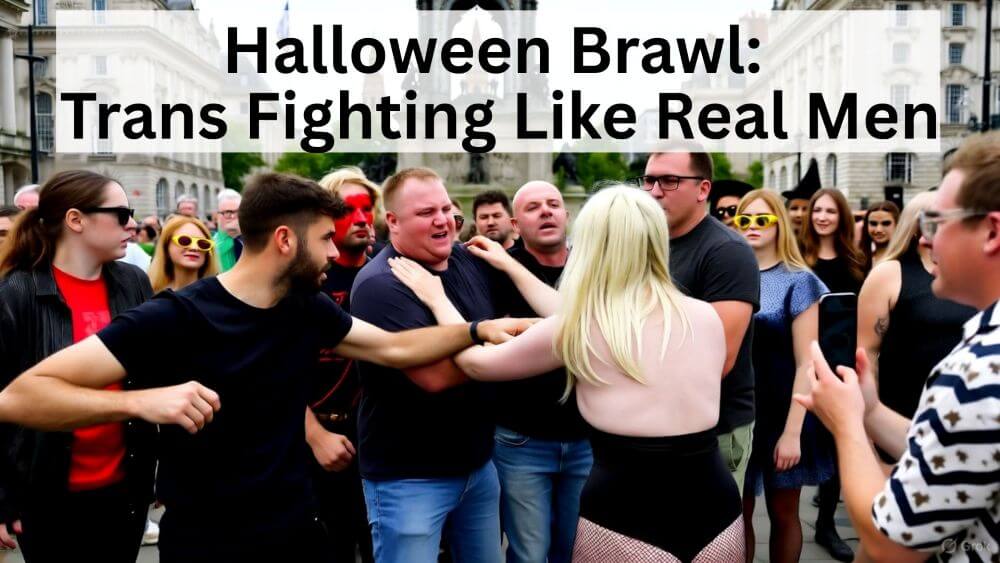
On Halloween night, in the middle of Manchester’s Piccadilly Gardens, a fight broke out — not just between people, but between two worlds. The viral video that exploded across social media shows a brawl between people identified as “illegal migrants” and others dressed in drag, presumably transgender individuals. The video spread like wildfire — 1.8 million views, tens of thousands of comments — each one trying to explain, justify, or condemn what they thought they saw.
The Viral Halloween Fight That Shook Manchester
The truth? Nobody really knows yet. As of November 1, 2025, the police haven’t confirmed what actually happened. But that doesn’t matter on the internet. Once the algorithm gets a taste of outrage, the facts become optional.
Still, this incident reveals something real — something uncomfortable. It’s not just about Manchester or Halloween. It’s about the increasingly fragile coexistence between people whose values are not just different, but fundamentally incompatible.
When Cultural Values Collide in the Same City
On one side, we have communities whose sense of morality is rooted in traditional, often religious worldviews — where gender roles are fixed and deviation is seen as defiance. On the other, we have people who believe self-expression, including gender identity, is a basic human right. These are not minor disagreements. They are two moral universes that operate by entirely different rules.
And when those universes occupy the same city block, the tension becomes explosive.
We’ve seen this before. A week earlier, in Tower Hamlets, Muslim demonstrators clashed with far-right groups, and even with leftists who were supposedly their political allies. The language used — “stupid,” “brainwashed” — shows that these alliances of convenience are breaking apart. The idea of a unified “multicultural harmony” feels increasingly like a myth we tell ourselves to avoid facing the depth of our divisions.
The real challenge is this: how do we live together when our values are not just different, but mutually exclusive?
The Real Challenge of Multicultural Coexistence
Diversity sounds good on paper — until it reaches the point where beliefs collide head-on. And then, what? Tolerance is easy when we agree on the fundamentals. It’s much harder when one person’s freedom feels like another’s moral corruption.
Data from the Home Office shows hate crimes against transgender individuals are at record highs. That’s not an accident. It’s a symptom of something deeper — a cultural cold war playing out in the streets, online, and in people’s minds.
But before we start pointing fingers, we have to acknowledge the role of social media in all this. Outrage is profitable. Nuance is not. A shaky 20-second clip can ignite millions of angry comments before a single fact is verified. It’s digital gasoline poured over every cultural spark.
So where do we go from here?
Building Bridges Between Radical Differences
First, we stop pretending that coexistence is automatic. It’s not. Living peacefully with people who see the world completely differently requires effort, patience, and — above all — honesty about the depth of our disagreements.
Second, we invest in dialogue — real dialogue, not performative debates where everyone just waits for their turn to be offended.
And third, we need institutions — schools, community centers, media platforms — that help us engage across those divides without demonizing each other. Because if we don’t, the vacuum will be filled by mobs with smartphones.
The fight in Piccadilly Gardens wasn’t just a Halloween brawl. It was a mirror. It showed us how fragile our social fabric has become — and how urgently we need to learn to live with radical difference before it tears us apart.
Coexistence is not just about sharing space. It’s about building a shared vision — one that allows for disagreement, dignity, and even discomfort. Because the alternative — endless cultural warfare — is a future none of us can afford.