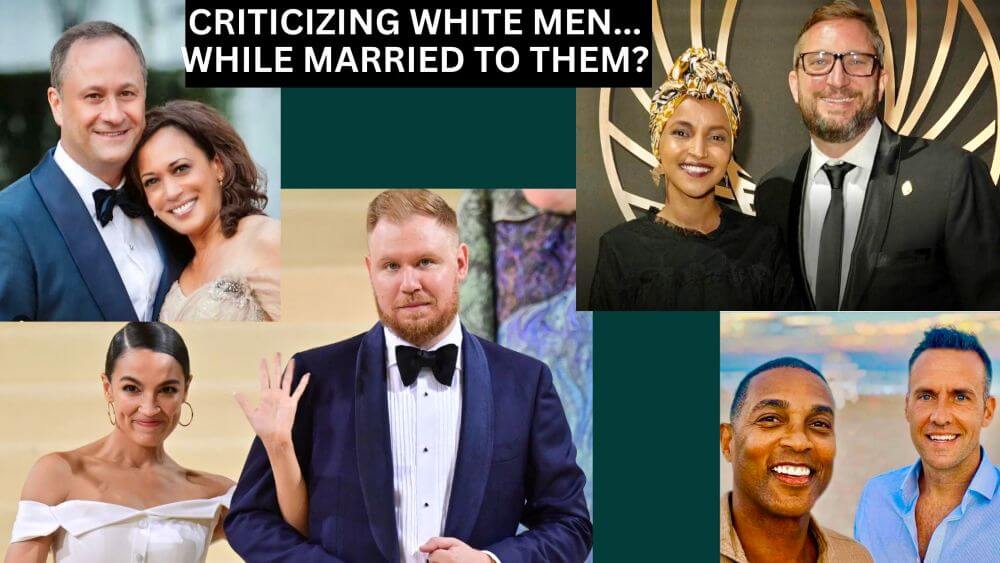
In the world of political branding, “consistency” is often the first casualty of “strategy.” For many high-profile figures on the left, a specific narrative has become a staple of their platform: the idea that systemic racism, driven largely by white men, is the primary obstacle to progress in America.
However, a curious pattern emerges when we look past the podium and into the personal lives of the very people delivering these messages. It raises a provocative question: If the rhetoric is as dire as they claim, why do their personal choices seem to tell a completely different story?
The Contrast in the Public Eye
Critics often point to several high-profile examples where public denunciations of “whiteness” or “patriarchy” seem to clash with private partnerships.
- Ilhan Omar: While frequently criticizing the American “system” and the role of white male influence within it, Omar’s personal life includes a marriage to Tim Mynett, a white man.
- Kamala Harris: As Vice President, she has often spoken about the deep-seated “systemic racism” inherent in American institutions. Yet, her husband, Doug Emhoff, is a white man.
- Don Lemon: The former CNN anchor has spent years highlighting the “danger” posed by certain demographics of white men in America, yet he is married to real estate agent Tim Malone, a white man.
- Alexandria Ocasio-Cortez (AOC) and Riley Roberts, a white man.
This isn’t to say that people cannot love whoever they choose—they absolutely can and should. The irony lies in the disconnection. If one believes that a specific group is inherently bigoted or a threat to society, it is logically inconsistent to choose a member of that group as your most trusted life partner.
Is It Advocacy or Performance?
For many observers, this gap suggests that the rhetoric isn’t based on a lived reality, but is instead a calculated tool for attention. In the attention economy, polarizing statements generate clicks, votes, and donations.
By framing “white men” as a monolith of oppression, these figures can mobilize a base. However, their personal lives suggest they know the truth: that character is an individual trait, not a racial one. This suggests a level of hypocrisy where politicians seek to “fire up” the masses with grievances they themselves don’t appear to feel in their private homes.
America: A Global Perspective on Tolerance
When we zoom out and look at the world stage, the narrative of “systemic American racism” becomes even harder to sustain. While no country is perfect, the United States remains one of the most diverse and welcoming nations on Earth.
In many parts of the world, tribalism and ethnic conflict are not just social issues—they are matters of state policy. In countries like Somalia, Sudan, or Yemen, tribal and ethnic divisions often lead to open conflict. In parts of the Middle East and Asia, legal systems and social hierarchies are explicitly built on ethnic or religious preferences.
| Region | Primary Social Friction | Legal Standing |
| United States | Individual interactions | Equal protection under the law |
| Middle East | Religious/Sectarian | Often codified in law |
| East Africa | Tribal/Clan-based | Major driver of civil unrest |
By comparison, the “systemic” issues in America are often vastly overshadowed by the level of freedom and integration available to everyone, regardless of their background.
Final Thoughts
Authenticity is the currency of leadership. When politicians preach a gospel of division while living a life of integration, it’s fair for the public to question their motives. If white Americans were truly the “bigots” portrayed in stump speeches, the personal lives of these politicians would look very different.
The fact that they choose white partners is perhaps the ultimate, unintentional compliment to the American spirit of integration—even if they won’t admit it on the microphone.