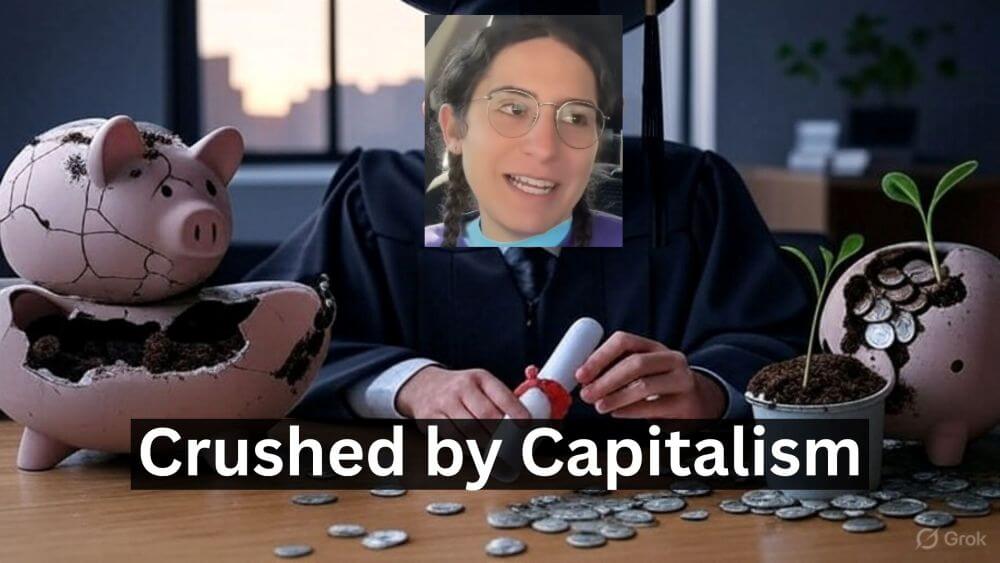
A few days ago, I came across a TikTok video by Bonnie Leigh, a young woman with a PhD in Soil Biology from Berkeley. She shared her frustrations about not being able to find work in her field. Here’s part of what she said:
“Getting crushed by capitalism is so cringe, but it’s happening to me. I got a PhD from Berkeley, and I can’t get a job to save my life. I have a soil biology PhD, and now I’m a tutor, a babysitter, and a dog sitter. Part of that is because I don’t want to move to some random place in the middle of nowhere. The other half is that they cut all the funding for science, and the biotech market has absolutely cratered. I also have long COVID, so it’s difficult for me to work a full-time job. I just got on here to rant a little bit. Oh my God, what do we do? I just have to keep working while getting crushed by all this.”
Her video went viral because many people relate to the frustration: working hard, getting an advanced degree, and still struggling to find meaningful work.
But here’s my take.
The Economics of a PhD
If you earned a PhD from Berkeley, you’re clearly smart. You spent 5–6 years after your bachelor’s degree studying one of the most specialized sciences imaginable. That’s an impressive intellectual achievement.
But here’s the problem: the median salary for someone with a PhD in soil biology is only about $65,000 a year. That’s not bad, but it’s far from the life-changing financial return that people imagine when they think “doctorate.”
Why? Because soil biology is a niche field. Jobs often exist in agricultural towns, research labs, or government agencies—not in San Francisco or Los Angeles. If you’re unwilling to move to where the jobs are, opportunities shrink dramatically.
This isn’t a secret. It’s something anyone pursuing a PhD in a specialized field has to consider before committing.
Side Jobs Aren’t Failure—They’re Opportunities
Bonnie says she’s now working as a tutor, babysitter, and dog sitter. None of these jobs require a PhD, true. But if you treat them seriously—as a business—they can be surprisingly lucrative.
- Tutoring online can pay $50–$100 an hour with the right marketing.
- Dog walkers and pet sitters in large cities can earn six figures (yes, really) if they build a loyal clientele.
- Childcare services are always in demand, especially in wealthy urban neighborhoods.
What feels like “failure” could actually be the foundation of a sustainable business—if approached with an entrepreneurial mindset.
Is Capitalism the Problem?
Bonnie blames capitalism for her struggles. But let’s be real: what’s the alternative? Communism? In many communist countries, people don’t get to choose their careers at all. They are told what to study, where to live, and what job to take. And often, they work just as hard for much less.
Capitalism isn’t perfect, but it does offer countless opportunities. The truth is, many of us don’t want to pay the price success requires: moving to where the jobs are, starting with grunt work, putting in the years before moving up the ladder.
That’s how careers work in most industries. You start small, prove yourself, and then—over time—you earn prestige and better positions in the city of your choice.
My Own Story
When I immigrated to Canada, I didn’t walk into a dream job. I started as a janitor, cleaning toilets at 3:00 a.m. That was my reality.
Twenty years later, I live as a blogger, writing articles like this one from the comfort of my living room. How did that happen? Through persistence, adaptability, and taking responsibility for my choices.
Capitalism worked for me—not because it’s flawless, but because I embraced its opportunities instead of resenting its challenges.
Final Thoughts
I sympathize with Bonnie. Long COVID, student debt, and a collapsing biotech market make her struggle real and painful. But blaming capitalism won’t solve her problems.
The real question is: how do we adapt when the path we chose doesn’t pan out?
Sometimes that means moving to where the jobs are. Sometimes it means reinventing yourself with the skills you already have. And sometimes it means building a business out of “side jobs” until they become your main job.
That’s not being crushed by capitalism. That’s being challenged by it—and rising to the occasion.
Previous opinion posts
- Mathematics is racist according to DEI proponents
- God Bless America vs. Death to America: A Campus Divide
- D.C. Homeless Could Go To Jail if They Refuse to Leave Encampments, Says Trump