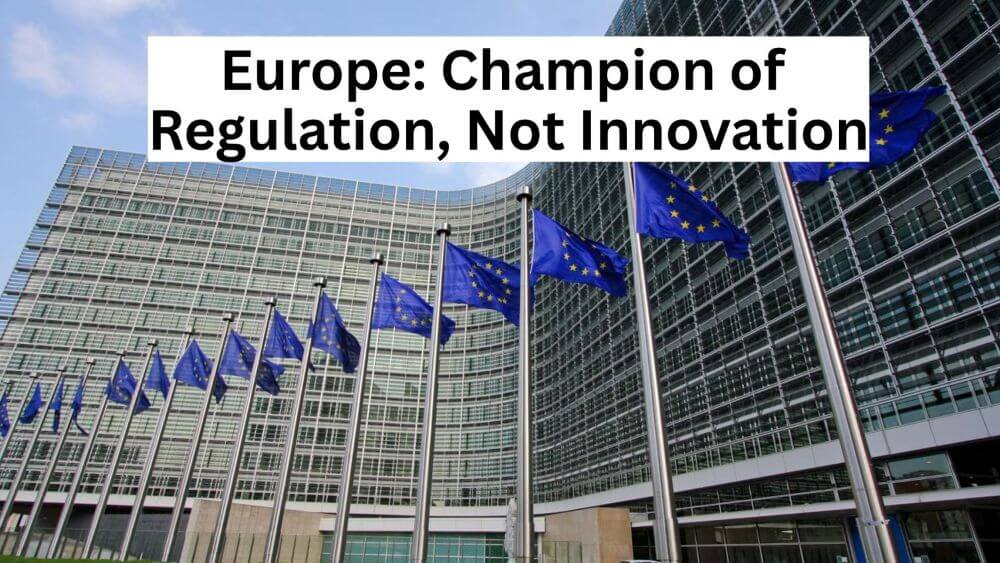
Europe, once a global economic powerhouse, is increasingly viewed as falling behind in the competitive war against the United States and China. This shift is not due to a lack of talent or capital but rather to self-imposed limitations. Recent high-profile statements from influential figures have laid bare the core of the issue: an overwhelming regulatory burden and an entrenched aversion to risk.
Former European Central Bank President Mario Draghi has explicitly identified this situation as an “existential challenge” for the EU. In late 2024 and through 2025, his landmark report on European competitiveness confirmed that while Europe maintains strengths in traditional industrial quality, it is dramatically losing ground in crucial “new world” sectors like artificial intelligence, cloud computing, and semiconductors. Draghi’s analysis points to fragmented markets and a systemic lack of growth capital, particularly compared to the U.S. venture capital ecosystem.
Europe: Champion of Regulation, Not Innovation?
This sentiment was forcefully echoed at the 2026 World Economic Forum in Davos by German Chancellor Friedrich Merz. In a refreshingly blunt assessment, Merz attributed Europe’s competitiveness decline directly to internal over-regulation and bureaucratic hurdles. He argued that the EU’s single market, originally designed for economic dynamism, has instead morphed into a “world champion of over-regulation” that is actively stifling growth.
Merz’s comments highlight a deeply frustrating paradox:
- The Single Market Ideal: Intended to allow businesses to scale easily across 27 nations.
- The Reality: Startups must navigate a maze of 27 different legal, tax, and labor systems, even within this “single market.”
- Reactive vs. Proactive: EU regulation, such as the AI Act or GDPR, often prioritizes protection over building. It sets global standards (the “Brussels Effect”) but imposes heavy compliance costs that can crush smaller innovators.
Merz didn’t mince words about the consequences, stating, “Germany and the EU kneecapped their own growth with endless rules, delayed reforms, and a reflex to regulate first and think later.” He concluded, “The single market was meant to beat everyone. Instead it became a museum of forms, permits, and compliance departments. In the end: Europe didn’t lose competitiveness to China or the U.S. It buried it under paperwork.”
Understanding the Competitive Divide
The widely repeated adage, “America innovates, China imitates, Europe regulates,” neatly encapsulates the perception, though the reality is more nuanced. China has advanced far beyond pure imitation, particularly in fields like electric vehicles and 5G. However, the fundamental models of growth show clear distinctions:
- United States: Driven by private capital, robust venture markets, and a “fail-fast” high-risk culture. Innovation is fast and market-led.
- China: Fueled by state strategy and massive government subsidies, allowing for rapid deployment and scale in prioritized sectors.
- European Union: Relies on setting standards and regulation, driven by the precautionary principle and heavy reliance on risk-averse bank financing rather than deep equity markets.
Merz’s call is to reverse this dynamic, prioritizing entrepreneurial freedom over excessive rules to revive the bloc’s potential. Yet, the challenge is complex. Even as he decries over-regulation, Merz continues to advance green agendas, illustrating the ongoing political balancing act Europe faces. Frustrations also run high over other unaddressed and contentious issues, such as migration and a cohesive long-term energy policy.
The Proposed Path Forward
To prevent further decline, substantial shifts are being debated within European leadership, largely inspired by the Draghi report’s recommendations:
- A Capital Markets Union (CMU): This long-discussed goal aims to deepen and unify European stock and bond markets. This would unlock vast internal savings, directing them towards innovative European firms rather than letting that capital flow to Wall Street.
- The “28th Regime”: A proposal for a simplified legal framework specifically for startups, allowing them to operate across borders under a single set of EU-wide rules, bypassing national bureaucracies.
- Massive Joint Investment: Draghi called for an astonishing €800 billion in annual joint investment. This level of funding, however, is met with significant political resistance, particularly from states wary of shared debt.
The coming years will be decisive. Whether Europe can shed its self-imposed regulatory straightjacket and foster a culture that embraces risk will determine its standing in the 21st-century global economy.
Frequently Asked Questions (FAQ)
Why is Europe losing competitiveness compared to the US and China?
According to recent analysis by Mario Draghi and German Chancellor Friedrich Merz, Europe’s competitive lag is largely due to excessive regulation (over-regulation), fragmented internal markets, and an investment ecosystem that is too risk-averse compared to the dynamic venture capital models of the US and the state-driven strategy of China.
What did Mario Draghi’s report on European competitiveness say?
Draghi’s 2025 report termed the competitiveness gap an “existential challenge.” It highlighted that while Europe is strong in traditional manufacturing, it is falling behind in critical future technologies like AI and semiconductors due to market fragmentation and a lack of scalable “growth capital” for innovative firms.
What were Friedrich Merz’s comments at Davos 2026?
Chancellor Merz stated that Germany and the EU have “kneecapped” their own growth. He described the EU’s single market as a “museum of forms, permits, and compliance departments,” arguing that “Europe didn’t lose competitiveness… It buried it under paperwork.” He called for a shift prioritizing entrepreneurial freedom over excessive rules.
What are the main proposed solutions to Europe’s competitiveness issues?
Key proposals include creating a true Capital Markets Union to unlock investment, introducing a “28th Regime” for a single set of cross-border startup rules, and massive joint public-private investments (as much as €800 billion annually) in key technology sectors.
Leave a Reply