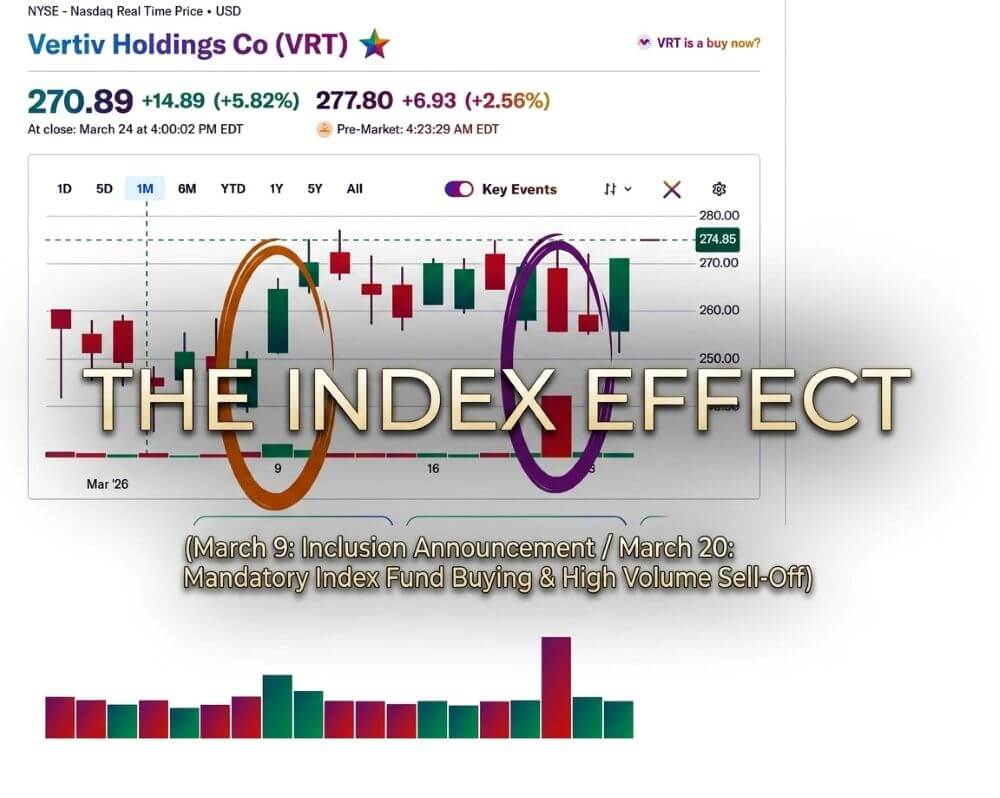
The index effect is a phenomenon many investors try to capitalize on, hoping for a quick win. The theory is simple: when a stock is added to a major benchmark like the S&P 500, passive funds must buy millions of shares, driving the price up.
However, my recent experience with Vertiv Holdings Co (VRT) served as a stark reminder that the market is rarely that predictable. What looked like a “sure thing” turned into a lesson in market efficiency and the dangers of short-term speculation.
The Strategy: Front-Running the S&P 500 Inclusion
On March 9, the news broke that Vertiv Holdings Co (VRT) would be officially added to the S&P 500. Knowing the mechanics of the index effect, I decided to move quickly. My logic was twofold:
- Technical Catalyst: The massive demand from ETFs would create a price “pop.”
- Fundamental Backup: Vertiv is a solid company involved in data center infrastructure. I figured that even if the trade didn’t work immediately, holding a “good company” would eventually lead to a profit.
I executed my buy on March 10 at a price of $271 per share. I was positioned and ready for the surge.

When the Index Effect Goes South
To my dismay, the expected rally never materialized. Almost immediately after I bought in, the stock began to drift downward. At one point, my position was down nearly 10%.
This is the “dark side” of the index effect. By the time the news is public, professional traders and high-frequency algorithms have often already priced in the move. As a retail investor, buying the day after the announcement often means buying the peak of the hype.
The Peak Volume Disappointment
March 20 arrived—the final trading day before VRT officially joined the index. This is typically the day of maximum impact. The volume was staggering, roughly 10 times the typical daily average.
Yet, instead of a triumphant price spike, the stock price actually declined. The massive “buy” orders from passive funds were met with equally massive “sell” orders from speculators who were “selling the news.”
A Slow Return to Break-even
It is now March 25, and the price has finally crawled back to approximately $271—the exact price where I started. After two weeks of volatility and stress, my return is 0%. While I didn’t lose capital, I lost the opportunity to have that money working elsewhere.
Lessons Learned from the VRT Trade
This experience highlighted several reasons why chasing the index effect is a risky gambit for individual investors.
1. The Market is Forward-Looking
Institutional investors often predict index additions months in advance. By the time you hear the news on March 9, the “easy money” has already been made.
2. Arbitrage and “Selling the News”
For every passive fund forced to buy, there is an arbitrageur waiting to sell them the shares they bought weeks earlier. This creates a ceiling on the price.
3. High Volatility Risk
Speculative trades based on technical events are prone to “mean reversion.” As I saw, the price often settles back to its fundamental value shortly after the inclusion event.
Why Fundamentals Trump Speculation
My biggest takeaway is that there is very little to gain from trying to outsmart the index effect. If you want to build long-term wealth, your strategy should look like this:
- Focus on Valuation: Buy companies when they are undervalued, not when they are in the headlines.
- Long-Term Horizon: Avoid the stress of “day-to-day” price movements.
- Diversification: Don’t let a single speculative event dictate your portfolio’s health.
Summary and FAQ
In conclusion, while Vertiv Holdings is a strong company, my attempt to play the S&P 500 inclusion was a failure. Speculation is not a substitute for a disciplined investment plan.
Frequently Asked Questions
What is the index effect? The index effect is the price change that occurs when a stock is added to or removed from a major index, driven by passive fund rebalancing.
Why did Vertiv stock go down after the S&P 500 announcement? This often happens due to “selling the news,” where speculators who bought early sell their shares to passive funds on the inclusion day, neutralizing the upward pressure.
Is it worth trading index inclusions? For most retail investors, no. The potential gains are often offset by high volatility and the efficiency of institutional traders who move before the general public.
What is the best way to invest in new S&P 500 stocks? Focus on the company’s long-term earnings potential and fundamentals rather than the technicality of joining an index.
Previous stock market posts