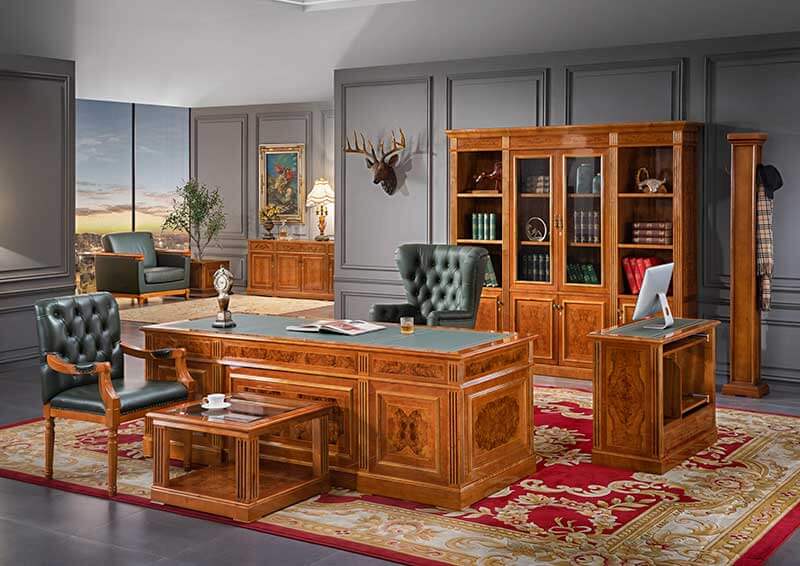
Every trend cycle eventually produces a backlash against itself, and right now that backlash is aimed at the glass-topped, all-white executive suite. A classic office isn’t about nostalgia. It’s a deliberate set of choices about materials, proportion, and symmetry that happen to outlast whatever’s trending on office design boards this year. Done right, it also does something the sterile version rarely manages: it makes people want to be in the room.
What “Classic” Actually Means Here
Many people may have a misconception about what a “classic executive office” looks like. They may imagine something from a historical drama with heavy drapes, a globe, and a hunting print. However, that’s not the case. In design terms, classic means being based on traditional proportions and quality materials rather than what is trendy at the time. Think about classical architecture: symmetry, clean molding, and a feeling that everything in the room was intentionally put there rather than being selected from a catalog at the last minute.
This is important because “classic” and “dated” are often used interchangeably, but the difference between them is the level of craftsmanship, not the era. A well-built wood desk will look appropriate in 2005, 2025, and 2045. A piece that follows a trend, such as stark white lacquer, exposed hairpin legs, etc., will only be popular for a few years, or sometimes just a few months. The classic philosophy is not about having an old appearance. It is about investing in furniture that is timeless.
The Desk Is The Anchor, Not Just A Surface
An organizing principle is essential in every room and in an executive office, that’s the desk. It’s what a visitor sees first coming through the door, the part of the room you touch most often, and the one item that reveals to the world everything else in the room. A flimsy, undersized desk will undercut an impressively decorated office. A solid one will anchor a room that’s relatively spare otherwise.
This is why it’s a good idea to design the rest of the room around an anchoring purchase like a classic mahogany desk, for no other item in an office commands the majority of visual attention and actual interaction. Mahogany has the right warm reddish tones and depth to it that make details pop on video calls, it ages well and adds a certain dignity, and the size and heft of it give the unspoken assurance of capability. Walnut is the same idea, just slightly darker and less formal.
A desk needs to be the biggest, most expensive item in the office if the rest of the office is serious. Everything else needs to fit around that. Do not be surprised if a grown-up desk costs more than your computer. They’re a relative bargain compared to a couch.
No piece of furniture is used more and photographed less than the typical run-of-the-mill office desk. People spend years at a desk that’s cramped, cluttered, and centralized in their room taking up all the space. This should not be your fate. You want a real desk that you will want to sit at for a whole workday. We are almost scared to say it, but the desk you like is the correct one. If you look at it and feel you’d rather work from this desk with nothing on it, other furniture should not get in your way of making it happen. Most people sense this and come to peace with reality. They buy less than they ever hoped for and more than they expected to spend. It’s the wise choice.
Building The Supporting Cast: Credenza, Bookcases, Seating
A desk by itself in a large room appears contrived, as a showroom present rather than somewhere effort happens. The classic office solves this with a series of case goods that match the desk’s material and finish. A credenza behind or beside the desk gives you storage but doesn’t interfere with the desktop itself. It also balances the room visually – a lone desk in the center of a space can feel oddly exposed without a weighty piece nearby to anchor the composition.
Bookcases or built-ins serve double duty. They occupy wall space that would otherwise be blank, and they signal something relating to the person who works there. A shelf with actual books, a few framed items, and maybe a clock communicates permanence in a way a bare wall never will. The mistake here is over-styling it – a shelf that looks overly arranged reads as false. Leave a little visual noise. Real offices have some.
Guest seating should get the same treatment. Two button-tufted leather chairs facing the desk, arranged symmetrically, do more for the room’s authority than almost anything else you could add. If space allows, a small Chesterfield sofa along a side wall gives you a second, less formal meeting spot for conversations that don’t need a desk between two people. A wool rug underneath the seating area adds warmth and cuts down on the echo that hard floors and hard furniture tend to create together.
Palette: Discipline Over Decoration
A classic office feels right with a tight, intentional palette – leather, wood, brass, and a few quiet neutrals like deep green, burgundy, navy, or warm tan. That’s all you need. The discipline is the appeal. Every material choice should be pushing warmth and longevity, not begging for your attention.
Which means no glaring whites. No glass or chrome pushing sterile – it looks great in some fancy architecture magazine and feels like you’re spinning through your workday in a lab. No repurposed barn wood and mason jar pens pulling you somewhere the office isn’t trying to go. Stick with materials that wear, age, and deepen the color of the world around you.
Making The Technology Disappear
What many classic-style offices don’t account for is that current work requires monitors, cables, webcams, and charging stations, and none of that works with the aesthetic if it’s all just plopped on top of a beautiful desk. The solution isn’t to sidestep technology. It’s to make its messiness invisible.
Buy a desk with cable-routing built in, or have a discreet grommet added. Hide power strips inside the credenza rather than having cords trailing across the floor. Design the placement of your monitor and camera so that the wall of bookcases or wood paneling is what’s visible behind you on video calls, not a blank wall or a haphazard tangle of cords. None of this is hard, but you have to think of it before you buy the furniture, not after.
Lighting In Three Layers
Only using overhead lighting will make every room seem flat and institutional, and an office needs to avoid that at all costs. The standard three-layer approach calls for ambient light (standard overheads or a room’s main light source), task light (for reading and writing), and accent light (often low-level, indirect light that eases shadows and adds depth).
Ambient light can come from a ceiling fixture or, better, from wall sconces in an aged brass finish that fit the room’s material palette. Task lighting is where a banker’s lamp earns its reputation, the green glass shade and brass base aren’t just decorative, they cast a pool of warm, focused light exactly where you need it for reading or writing without glare on a screen. Accent lighting, often a floor lamp near the seating area or a small picture light above a framed print, fills in shadows and keeps the room from feeling like it’s lit for an office rather than lived in. Layer these three and even a small room reads as considered rather than underlit.
Why This Is A Productivity Decision, Not Just An Aesthetic One
There’s a reasonable argument that all this attention to materials and symmetry is vanity dressed up as design philosophy. The research says otherwise. A University of Exeter study found that employees given control over designing and personalizing their own workspace were up to 32% more productive than those working in stripped-down, sterile environments. The mechanism isn’t mysterious – people focus better and report higher well-being in spaces that feel intentional and personally suited to them, rather than generic.
A classic executive office, built around materials that feel warm and permanent, is a direct application of that finding. It’s not about impressing visitors, though it does that too. It’s about creating a workplace environment where the person using it daily actually wants to sit down and work. Comfort and authority aren’t in tension here. They reinforce each other.
There’s also a sustainability argument that gets overlooked. Buying one well-made desk, chair, and set of case goods built to be serviced and refinished for decades is a smaller long-term footprint than replacing trend furniture every five to seven years as tastes shift. Quality joinery costs more upfront and less over time.
Living With It: Maintenance and Psychology
None of this is self-maintaining. Wood surfaces will need their oil to keep the grain from drying and the finish from crackling. Leather will need its conditioning to keep from stiffening and cracking at the seams. Brass can be left alone to tarnish or be polished, as you prefer. Budget for this like you’d budget for any maintenance: it’s small, regular, and it’s what keeps the room looking cared for, rather than merely old.
The payoff for that maintenance is more than visual. There’s a well-documented psychological effect that a well-composed, stable-feeling office has on the people who aren’t in it; that is, how the person behind the desk strikes the visitor. Whether you’re hosting a client negotiation, a performance review, or a new hire’s first day, the room is doing work before anybody says anything. A classic office signals competence and staying power – not because it’s trying to send that message, but because it just looks like someone thought about it and then sat down to work.
That’s the real case for this style. It’s not a costume from another era. It’s a workplace built on materials and proportions that don’t need replacing every fashion cycle, in a room that makes the actual work of sitting there, day after day, a little more pleasant.