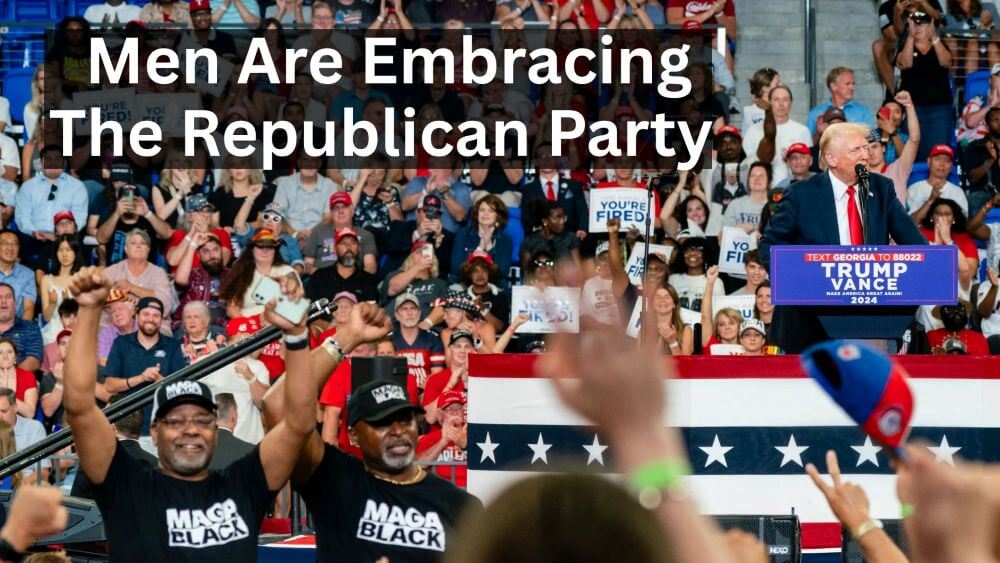
There’s a growing crisis within the Democratic Party that no one seems to want to talk about: the exodus of young men. Not just white men. Not just rural men. Men of all backgrounds are quietly — and not-so-quietly — walking away from the Democratic Party. And while party strategists are scrambling to “study” the phenomenon with a $20 million campaign, the reasons for this shift are already painfully clear to anyone willing to listen.
Let’s break this down.
Men Don’t Want to Be Demonized
On The Big Money Show, panelists pointed out the obvious: Donald Trump didn’t win men over with policies or charisma. He simply acknowledged their existence. He didn’t shame them for being men. He didn’t treat masculinity as a pathology. He offered basic respect — and then promised to leave them alone.
That resonated. Because increasingly, mainstream Democratic rhetoric has painted masculinity itself as inherently toxic, as if every man is a ticking time bomb of misogyny or privilege. The message from the left has often been: “You’re the problem.”
And now they’re shocked when those same men stop voting for them?
Identity Politics Has Its Limits
April Chapman said it plainly: masculine men don’t want to be lumped into a culture that celebrates confusion while demonizing clarity. Men are being told that a bearded man in stilettos is the new ideal of beauty and bravery — and if you question that, you’re a bigot. That’s not inclusion. That’s erasure.
Jason Miller, a senior Trump advisor, cut through the noise: men want to be told the truth. They know men can’t get pregnant. They know men shouldn’t compete in women’s sports. They like football and UFC. They believe in fairness, meritocracy, and being left alone to chase their version of the American Dream. Is that so radical?
Culture Over Policy
CNN commentator Scott Jennings noted that the Democrats are for something — but what they’re for is increasingly alien to most men: open borders, boys in girls’ locker rooms, and a relentless obsession with identity over unity. These aren’t just cultural disagreements. They’re signs to men that their values don’t matter anymore.
And this disconnect is painfully obvious during political events like the Democratic National Convention. Scott Galloway, a professor and public intellectual, put it bluntly: there was a “parade of special interest groups,” but no one acknowledged the struggles of men. Suicide. Addiction. Incarceration. The disintegration of purpose. The economic and emotional stagnation many young men feel. Crickets.
According to Axios reporter Alex Thompson, the party knows it has a “young man” problem. They just don’t know what to do about it — because acknowledging male struggle would break the ideological purity test the left has built for itself.
The Personal is Political — And the Political is Petty
Jake Tapper, CNN anchor and a liberal by any measure, recently shared how his 15-year-old son — a football player and aspiring police officer — was mocked by left-wing podcasters simply for saying he wanted to help people as a cop. The joke? That he must be racist.
Think about that.
A teenage boy who dreams of serving his community is publicly smeared because of his ambition — all in the name of “justice.” If that’s how the Democratic base talks about a kid, imagine how they treat adult men who dare to step outside the ideological line.
This is how the party alienates not just men, but families. It sends a message to fathers, brothers, and sons: your dreams and values don’t belong here.
The Political Cost of Ignoring Men
For a party that claims to champion working-class Americans, the Democrats are bleeding support from the very demographic that makes up a large portion of that class. Men are no longer seen as part of the progressive coalition — unless they renounce their own identity and conform to an increasingly rigid ideology of guilt, shame, and self-censorship.
Conclusion: Stop Studying, Start Listening
The Democratic Party doesn’t need a $20 million study to figure out why men are leaving. They need to stop preaching at men, stop shaming them, and start listening to what they’re saying:
- “Don’t call me toxic just because I’m a man.”
- “Don’t ignore my struggles.”
- “Don’t mock my values.”
- “Don’t lecture me on identity. Talk to me about opportunity.”
Until the Democratic Party finds the courage to say, “We see you, and we respect you,” they will continue to lose not just elections, but the hearts and minds of the men who once considered them allies.
And no amount of funding or focus groups will fix that.
Subscribe to my weekly newsletter at AlainGuillot.com where I explore culture, politics, money, and identity — one uncomfortable truth at a time.
Previous Politics posts