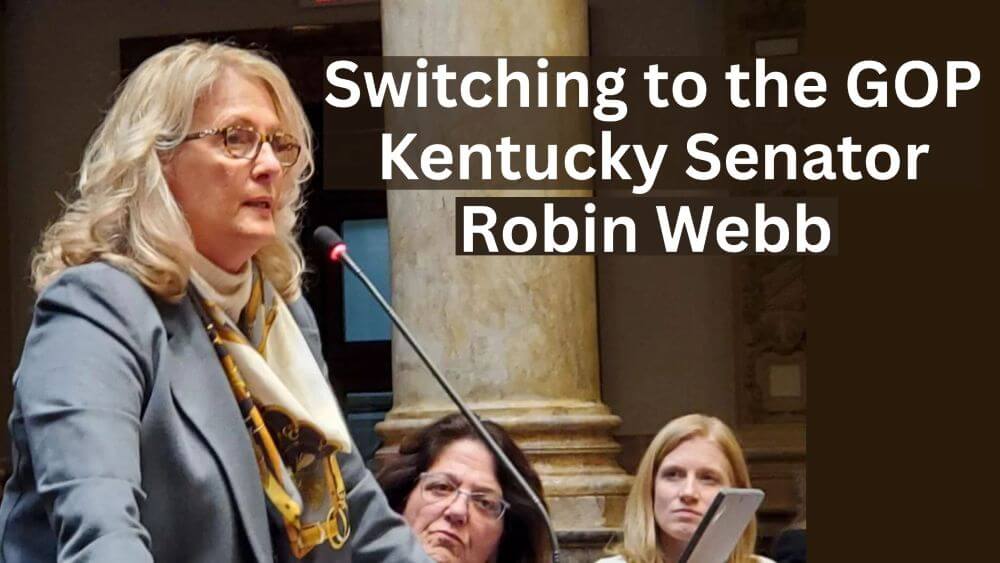
In a trend that’s becoming increasingly difficult to ignore, a number of prominent individuals—and now even elected officials—are walking away from the Democratic Party, citing cultural, ideological, and political shifts that no longer align with their values. The latest figure to make headlines is Kentucky State Senator Robin Webb, who announced her decision to leave the Democratic Party and join the Republican ranks.
This move is more than symbolic. Webb was one of the last remaining rural Democrats in the Kentucky legislature. Her departure not only underscores the Democratic Party’s shrinking rural presence, but also signals a broader dissatisfaction that transcends geography and background.
“It has become untenable and counterproductive to the best interests of my constituents for me to remain a Democrat,” Webb said.
“I will continue to be a fearless advocate for rural Kentucky and for the residents of eastern Kentucky who have been so good to me and my family.”
A Cultural and Political Shift
Webb’s personal identity—a hunter, horse enthusiast, and former coal miner—is deeply embedded in Kentucky’s traditional values. Her values and those of her constituents, she argues, no longer align with a party she says has “lurched to the left.”
This sentiment is echoed by many Americans who feel alienated by the Democratic Party’s focus on identity politics, gender theory, and top-down cultural reforms that seem out of step with everyday reality. Critics argue that the party’s messaging on issues like gender has gone from inclusive to exclusionary—particularly toward those who hold traditional views.
Some of the most common points of contention include:
- The assertion that men can become women through self-identification alone.
- The claim that men can get pregnant, despite biological contradictions.
- The push to allow men to compete in women’s sports, raising concerns over fairness and safety.
- The rise of narratives suggesting masculinity is inherently toxic, alienating many men who feel marginalized.
For Webb and many others, these stances are not only confusing but are seen as detached from the lived experiences of most Americans.
Not an Isolated Case
Robin Webb is not alone. Her defection joins a longer timeline of high-profile political shifts:
- Ronald Reagan, once a Democrat, famously said, “I didn’t leave the Democratic Party. The party left me.” He became a central figure in the conservative movement and ultimately the 40th President of the United States.
- Donald Trump, while perhaps the most polarizing figure in modern politics, was a registered Democrat from 2001 to 2009. His switch to the GOP helped crystallize a brand of populist conservatism that energized millions of working-class voters.
- Joe Rogan, a podcasting powerhouse with millions of listeners, endorsed Trump in 2020, citing concerns over censorship and elite overreach within Democratic leadership.
- Elon Musk, once a donor to Barack Obama and Hillary Clinton, has now emerged as a Republican mega-donor. He’s criticized the Democrats for promoting overregulation and cultural extremism. In 2024, he donated more than $250 million to support Trump’s reelection bid.
- Robert F. Kennedy Jr., a lifelong Democrat and member of the Kennedy dynasty, shocked the political world when he endorsed Donald Trump in 2024—citing free speech, vaccine transparency, and overreach by federal agencies.
What’s Next for the Democratic Party?
These high-profile exits and endorsements are not just political anomalies—they’re symptoms of a party grappling with its identity.
If Democrats continue to alienate rural voters, working-class men, and moderates who feel left behind by culture wars, they risk becoming a party of the coastal elite and urban technocrats—disconnected from the everyday realities of most Americans.
The Democratic Party must confront hard truths:
- Biology is not bigotry.
- Tradition is not oppression.
- Masculinity is not toxicity.
If it hopes to retain a broad base, the party may need to return to its working-class roots and embrace common-sense policies that resonate beyond academia, X, and cable news talking points.
Until then, the exodus may continue—one voter, one podcaster, one billionaire, and one lawmaker at a time.
📬 Sign up for my weekly newsletter at AlainGuillot.com for more commentary on politics, personal finance, and society.
Previous Politics posts