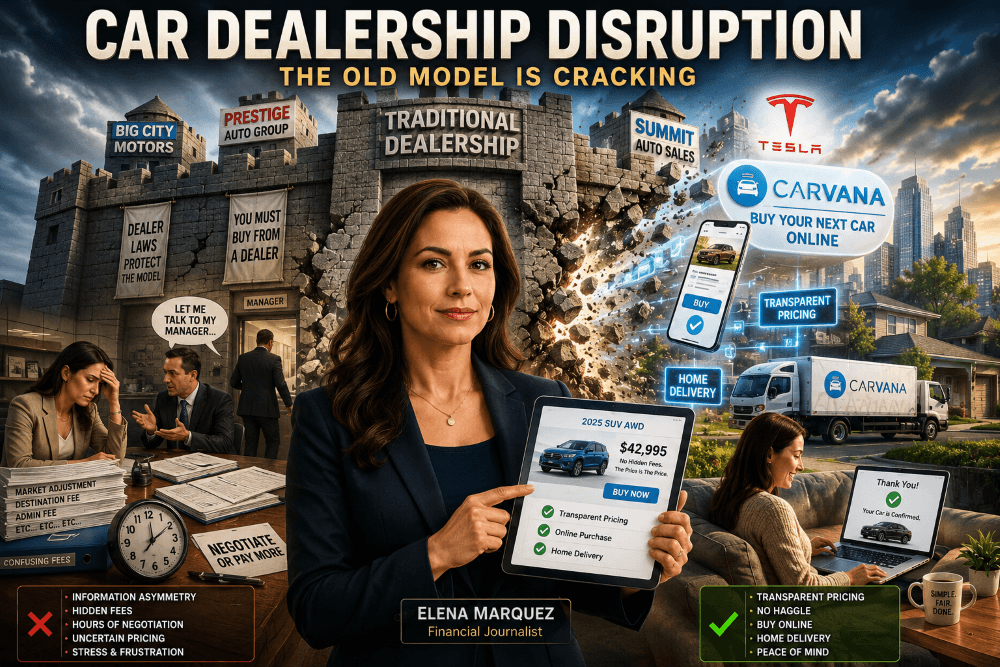
For decades, buying a car has been one of the most unpleasant consumer experiences in North America. The car dealership disruption now underway is not just about technology—it is about fixing a process that millions of customers have disliked for generations.
Personally, I hate buying cars from dealerships.
The information asymmetry is impossible to ignore. The dealer knows the invoice price, financing incentives, manufacturer rebates, inventory levels, and sales targets. The buyer knows almost none of that.
As a result, customers often feel that the price they pay depends less on the value of the vehicle and more on how many hours they spent preparing for negotiations.
Did you get a good deal?
Who knows.
Maybe the person who walked in after you negotiated a better price simply because they spent more time researching. Maybe you paid thousands too much because you didn’t.
Most people don’t want to spend hours haggling over a price. They just want to know “the price” and decide whether they want to buy the car or not.
Many women have long reported feeling especially disadvantaged in dealership negotiations, often believing they receive less favorable treatment than male buyers.
Fortunately, new business models are beginning to challenge this system.
Car Dealership Disruption Is Finally Arriving
The traditional dealership model was created during the mid-20th century.
At the time, lawmakers worried that giant manufacturers such as Ford, General Motors, and Chrysler would overpower small local dealerships. To protect these family-owned businesses, states passed franchise laws requiring consumers to buy new vehicles through independent dealers rather than directly from manufacturers.
For decades, the system worked.
Dealerships became pillars of their communities. They sponsored local sports teams, supported charities, and created generational wealth for many families.
But the world has changed.
Today’s dealerships are often large corporate groups rather than small family businesses. Yet the laws protecting them remain largely intact.
Meanwhile, consumers have become accustomed to buying everything online—from groceries to homes.
Cars are increasingly becoming the next frontier.
Tesla Showed That Direct Sales Can Work
The biggest challenge to the traditional model came from Tesla.
Rather than building a dealer network, Tesla chose to sell directly to consumers.
The company spent years fighting legal battles across the United States, state by state, to gain the right to bypass dealerships.
Many industry observers doubted the strategy would work.
They were wrong.
Today, buying a Tesla is remarkably straightforward:
- Visit the website.
- Configure your vehicle.
- See the price.
- Buy the car.
No negotiation.
No sales manager.
No endless back-and-forth discussions.
The process resembles buying an iPhone more than buying a traditional automobile.
Tesla proved something important: consumers are perfectly willing to purchase vehicles directly from manufacturers.
Now newer electric vehicle companies such as Rivian and Lucid Motors are following the same path.
Carvana Is Reinventing the Dealership Experience
If Tesla challenged dealerships from the manufacturer side, Carvana is challenging them from the retail side.
For years, Carvana focused on used cars.
Its mission was simple: become the Amazon of automobiles.
Customers browse inventory online, receive transparent pricing, arrange financing digitally, and complete transactions with minimal human interaction.
The approach has proven incredibly popular.
A striking example comes from Casa Grande, Arizona.
A dealership acquired by Carvana reportedly increased sales from only a few dozen vehicles per month to roughly 350 monthly sales after adopting the company’s online-first approach.
What’s remarkable is that those sales are not happening because hundreds of people are walking through the showroom.
They’re happening because customers are shopping from their couches.
The process appeals to modern consumers because it removes many of the most frustrating aspects of traditional car buying:
- Fixed pricing
- Minimal negotiation
- Online financing
- Home delivery
- Reduced sales pressure
- Faster transactions
For many consumers, especially younger generations, this is exactly what they want.
It’s the introvert’s dream.
Why Dealers Are Nervous
The car dealership disruption isn’t merely about one company succeeding.
It’s about proving alternatives exist.
Carvana has now expanded into new-car sales through partnerships with automakers such as Stellantis.
At the same time, companies like Scout Motors, backed by Volkswagen, are attempting direct-to-consumer sales models that bypass traditional dealers entirely.
Dealers recognize the risk.
If consumers discover they can buy vehicles online with transparent pricing and minimal hassle, the traditional dealership’s negotiating advantage begins to disappear.
The dealership model has often functioned like a fortress protected by regulation.
Digital commerce is now testing the walls.
Why Consumers Want Transparent Pricing
Imagine buying groceries where every customer pays a different price depending on negotiation skills.
Imagine purchasing a laptop where the final cost depends on how long you’re willing to sit in a conference room arguing with a salesperson.
Consumers would never tolerate that.
Yet this remains normal in automotive retail.
My view is simple:
People should be allowed to buy directly from manufacturers if they choose.
The process should be transparent.
The listed price should be the price.
Customers should not need advanced negotiation skills to avoid being overcharged.
Markets work best when information is widely available and prices are easy to understand.
Will Traditional Dealerships Become Obsolete?
Probably not.
Many customers still want to test drive vehicles, inspect them in person, and speak with knowledgeable staff before making a purchase.
Dealerships also provide valuable services:
- Vehicle maintenance
- Warranty repairs
- Trade-in evaluations
- Local inventory access
However, the role of dealerships is likely to change dramatically.
Instead of acting primarily as sales organizations, they may increasingly become service and delivery centers.
The winners will be those that embrace transparency rather than resist it.
The Future of Car Buying
The future probably won’t be entirely online or entirely dealership-based.
Instead, consumers will demand flexibility.
Some buyers will want a traditional showroom experience.
Others will want to complete the entire transaction from their smartphones.
The crucial difference is that consumers are finally getting choices.
Tesla demonstrated that direct sales can succeed.
Carvana showed that digital-first retailing can scale.
The fortress protecting traditional dealerships is still standing, but the walls are no longer impenetrable.
The next decade may fundamentally change how we buy automobiles—and for many consumers, that change can’t come soon enough.
Frequently Asked Questions
What is car dealership disruption?
Car dealership disruption refers to the transformation of the traditional dealership model through direct-to-consumer sales, online purchasing platforms, transparent pricing, and digital retail technologies.
Why do consumers dislike traditional car dealerships?
Many consumers dislike the negotiation process, lack of price transparency, sales pressure, hidden fees, and information asymmetry between buyers and dealers.
How does Tesla sell cars differently?
Tesla sells directly to consumers through its website and company-owned stores, eliminating the traditional dealership network and fixed-price negotiations.
Can online car sales replace dealerships completely?
Probably not. Many buyers still want test drives, vehicle inspections, and local service centers. However, dealerships may evolve into service and delivery hubs rather than sales-focused businesses.