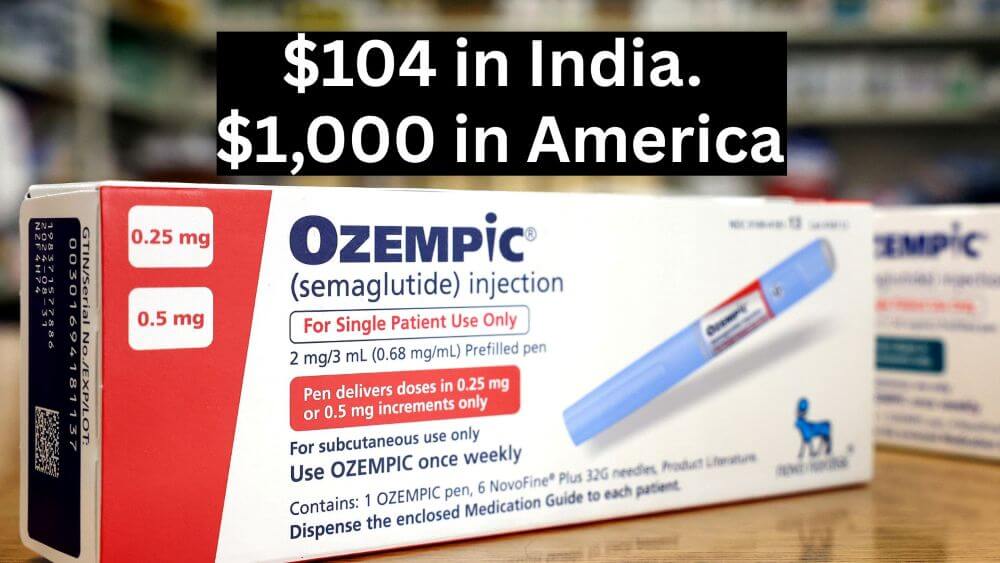
Novo Nordisk just launched Ozempic in India at $104 per month.
In the United States?
$997.58 for the same pen. Or $349–$499 per month if you’re lucky enough to qualify for a “discount.”
Same company.
Same drug.
Same molecule.
Yet Americans pay up to ten times more.
Even with insurance, many U.S. patients still fork over $200–$400 per month in copays for the exact same medication.
This isn’t complicated.
It’s not mysterious.
And it’s definitely not inevitable.
It’s a system where every middleman gets greased, and the consumer gets stiffed.
The Convenient Lies Americans Are Told
When confronted with this absurdity, the industry reaches for a familiar script.
“Research and development costs money”
True — but irrelevant here.
Ozempic was approved in 2017. Its development costs have long since been recovered. In fact, it’s one of the most profitable drugs on Earth. The R&D excuse only works if we pretend pharmaceutical companies are charities instead of publicly traded profit machines.
India proves the point: Novo Nordisk can sell Ozempic for $104–$132 per month, build supply-chain infrastructure, ensure quality, expand distribution, and still make money.
R&D didn’t suddenly get cheaper in Mumbai.
“Insurance negotiations lower prices”
This one accidentally tells the truth.
Yes, the U.S. system inflates list prices on purpose so insurers and pharmacy benefit managers (PBMs) can “negotiate” rebates behind closed doors. Those savings rarely reach patients.
Instead, Americans get:
- Artificially high list prices
- Copays tied to those inflated prices
- A rebate shell game no consumer can see
Negotiation only looks good if you ignore the patient being crushed at the pharmacy counter.
“Patent protection!”
Also misleading.
Novo Nordisk holds patents globally — not just in the U.S. And the main Ozempic patent expired in September 2024. India didn’t magically lose patent law enforcement.
Yet somehow, Novo can sell Ozempic there for a fraction of the price.
Patents explain monopoly power, not 10× price differences.
What the India Launch Actually Proves
India has 89.8 million diabetics — nearly three times the U.S. diabetic population.
Novo Nordisk chose to enter that market at $104–$132 per month, while:
- Investing in infrastructure
- Ensuring quality control
- Expanding access
- And — crucially — turning a profit
Meanwhile, Americans pay $250+ per week for the same drug.
That tells us everything we need to know.
U.S. prices are not about necessity.
They’re about exploitation.
The Real Reasons Americans Pay More
Let’s stop pretending.
Americans pay more because:
- Insurance hides real prices, shielding outrage
- PBMs insert profit layers without adding value
- Drug imports are effectively banned, eliminating competition
- Medicare is forbidden from real negotiation for most drugs
- And because pharmaceutical companies can get away with it
That’s it. No mystery. No economic law of nature.
Just policy choices.
The Human Cost of These “Choices”
While Novo Nordisk demonstrates in India that reasonable prices work just fine, Americans are:
- Rationing diabetes medication
- Skipping doses to stretch supply
- Flying abroad for affordable prescriptions
- Going into medical debt for a chronic condition
- Choosing between rent and insulin
This is not a system malfunction.
This is the system working exactly as designed.
The Solution (It’s Not Radical)
Fixing this doesn’t require reinventing capitalism.
It requires political will.
- Allow drug imports from countries with equivalent safety standards
- Cap international price differentials — no more 10× markups
- Break PBM monopolies that add cost without value
- Real Medicare negotiation for all drugs
- Full price transparency — end the fake “list price” theater
Novo Nordisk’s own executives have admitted they are investing in India at these prices.
They’re expanding.
They’re building.
They’re profiting.
So when they tell Americans they need to charge $1,000 instead of $100, there’s only one honest response:
No, you don’t. You just want to.
The Bottom Line
A cure isn’t worth much if only select Americans can afford it.
Diabetes medication that costs $100 in Mumbai and $1,000 in Miami isn’t healthcare.
It’s extortion with a prescription pad.
Stop accepting “that’s just how it works.”
These prices are a choice, not a necessity.
Americans taking the same drug deserve the same price as everyone else.
Period.