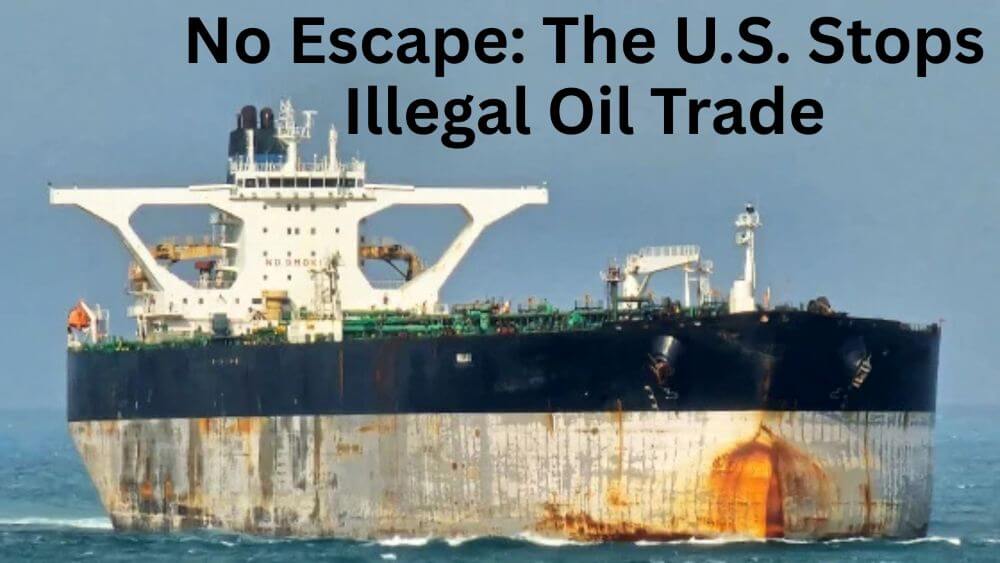
In a decisive display of maritime enforcement, the U.S. Coast Guard has once again demonstrated its unwavering commitment to upholding international law and ensuring transparency in the global oil trade. Recent operations, particularly the interdiction of the Motor Tanker Bella 1 (recently renamed the Marinera) and the Motor Tanker Sophia, highlight the critical role of these brave men and women in stabilizing a volatile market and countering illicit finance.
These aren’t mere isolated incidents; they are calculated, strategic actions against a “shadow fleet” that thrives on opacity. The vessels targeted were either last documented in Venezuela or actively en route to its shores, deeply implicated in schemes to circumvent sanctions. By relentlessly pursuing these dark operations across the high seas, the U.S. Coast Guard is not just making headlines—it’s reshaping the geopolitical landscape.
A Masterstroke of Maritime Strength
The seizure of the Marinera (formerly Bella 1) was a particularly impressive feat of coordination. After fleeing a U.S. blockade in the Caribbean and attempting to hide under a freshly painted Russian flag, the vessel was pursued 325km into the North Atlantic, near Iceland.
According to reports, the operation was shadowed by Russian military assets, including at least one submarine and several warships. However, in a clear testament to American maritime superiority and the precision of the U.S. Coast Guard and Special Forces, these Russian assets did not intervene and were unable to affect the mission. The interception proceeded smoothly, proving that no amount of posturing can shield those engaging in illegal commerce from the reach of justice.
The Weakness of the “Shadow Fleet”
The Russian Ministry of Foreign Affairs was left with little recourse but to issue defensive statements to mask its inability to protect its “shadow” assets. In a formal demand that barely disguised their lack of leverage, the Ministry stated:
“Russia demands that the United States ensure humane and dignified treatment of Russian citizens on board the ship ‘Marinera,’ and also respect their rights and interests… The United States must not hinder the swift return of Russian citizens from the ship ‘Marinera’ to their homeland.”
This rhetorical retreat highlights a significant victory: the “shadow fleet” is no longer a safe haven for illicit trade.
The “Night Stalker” Precision: A Masterclass in Maritime Interdiction
The seizure of the Marinera was not a routine boarding; it was a high-risk “non-compliant” operation executed under the cover of darkness. When the crew refused to stop in the Caribbean, the U.S. responded by moving elite assets into the United Kingdom and Iceland. The operation saw the deployment of the 160th Special Operations Aviation Regiment (SOAR), famously known as the “Night Stalkers.” Using highly modified MH-6 Little Bird and MH-60M Black Hawk helicopters, these world-class aviators—the same unit that participated in the raid on Osama bin Laden and the recent capture of Nicolás Maduro—hovered over the moving tanker in choppy North Atlantic seas. While AC-130J Ghostrider gunships provided lethal overwatch from above, specialized Maritime Security Response Teams (MSRT) fast-roped onto the deck. The speed and intensity of the raid completely overwhelmed the crew, allowing U.S. forces to secure the bridge and engine room before the nearby Russian submarine or warships could even attempt a maneuver. This “Night Stalker” precision sent a clear message: in the effort to stop illegal oil, no vessel is out of reach.Bella 1
Did You Know? The “Naphtha-for-Oil” Swap
You might wonder why Russia—a massive oil exporter—is sending tankers to Venezuela. It’s all about a “technical barter.” Venezuelan crude is too thick to flow through pipes on its own. It requires a diluent called naphtha. Russia provides this chemical (Leg 1), picks up heavy Venezuelan crude in exchange (Leg 2), and then sells it to markets like China (Leg 3). By seizing these ships, the U.S. breaks this “triangular trade” that keeps rogue regimes afloat.
A Win for Legitimate Commerce and Global Consumers
The impact of these seizures—both the Marinera and the Sophia—reverberates far beyond the high seas. For Venezuela, these actions significantly tighten the screws on illicit oil trade, forcing a choice: engage with legitimate businesses and cooperative governments or face increasing economic isolation.
Meanwhile, China, which has benefited from the influx of cheap, illicit oil, will find its supply lines disrupted. This creates a level playing field for all participants in the global market, free from the distortions of illegal trade.
Perhaps most significantly, the persistent enforcement of sanctions strikes a direct blow to the heart of regimes like Iran. Every barrel of illicit oil intercepted is a dollar less for the IRGC-QF and its proxies. As the financial lifeblood of these oppressive regimes is choked off, the possibility of the Iranian regime tumbling under the weight of biting economic sanctions and a discontented population becomes a more tangible prospect.
The global community owes a debt of gratitude to the U.S. Coast Guard. Their vigilance is about more than seizing ships; it is about safeguarding the integrity of international commerce and delivering a powerful message: The free and open seas will not be a haven for illicit activities. This is a resounding victory for transparency and the global consumers who benefit from a stable, rules-based trading system.
Previous Politics posts