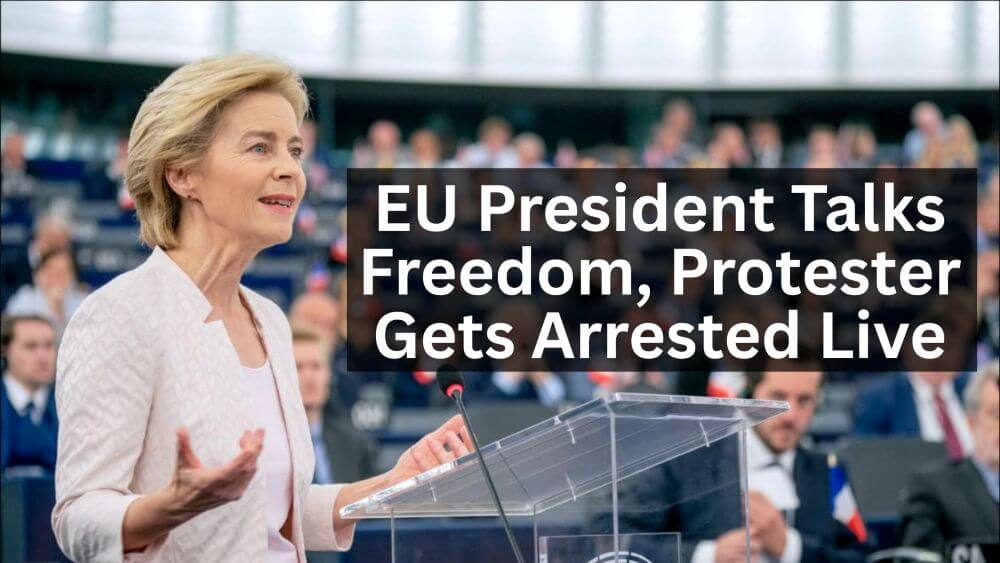
On August 22, 2025, at a European People’s Party rally in Helsinki, European Commission President Ursula von der Leyen stood before a crowd and delivered a line that will go down as one of the most unintentionally ironic moments in modern European politics.
“First of all, to those of you who are shouting so loudly, you can be happy that you live in a free country like Finland. Here, there is freedom of speech and no restrictions. If they were in Moscow, they would be in prison in two minutes,” she said confidently.
Seconds later—almost as if on cue—a man was arrested.
That man was Armando Mema, an Albanian-Finnish activist who had been shouting in protest of the EU’s policies toward Israel. As von der Leyen praised Finland’s freedom of expression, police officers escorted Mema out of the rally. Later, he was fined €110 by a Helsinki court—not for his opinions, but for “violating assembly rules” by shouting and ignoring police instructions.
Technically, yes, Mema wasn’t imprisoned for his words. But the symbolism of that moment was inescapable: the EU’s top official celebrating freedom while a protester was physically removed for exercising it.
The Optics of Hypocrisy
The viral video of the event, which resurfaced in November 2025, has reignited debate about the limits of “European freedom.” Supporters of von der Leyen and Finnish authorities claim that Mema wasn’t silenced for his speech, but for disrupting a public event—a matter of crowd control, not censorship.
But let’s be honest: when a leader declares “you should be grateful for free speech” while police drag out a heckler, the nuance is lost. The message becomes self-parody.
Freedom of speech isn’t tested when everyone agrees—it’s tested when someone dares to disagree, loudly and inconveniently.
Europe’s Growing Culture of “Managed Dissent”
Incidents like this highlight a broader trend in Western democracies: managed dissent.
Citizens are told they can speak freely—but only if they do it quietly, politely, and at the designated time and place. Step outside those parameters, and you’re fined, detained, or socially ostracized.
Europe prides itself on being the bastion of liberty in contrast to authoritarian states like Russia or China. And in many respects, it still is. But freedom that exists only within bureaucratic boundaries is not freedom in spirit—it’s permission.
Von der Leyen’s words in Helsinki were not malicious, but they revealed an underlying truth about the EU’s elite mindset: freedom is something they grant, not something citizens inherently possess.
The Real Lesson
This episode should serve as a reminder to all of us—Europeans, Canadians, Americans, anyone living in a so-called “free society”—that freedom of expression is not a slogan to be repeated at rallies. It’s a principle to be defended in uncomfortable, messy, and sometimes noisy moments.
Armando Mema’s brief protest may have been disruptive. But in a truly free society, the right to disrupt power is sacred.
The irony of Ursula von der Leyen’s speech is not just that a man was arrested mid-sentence—it’s that so many of us have grown used to such contradictions. We still call it freedom, even when it comes with conditions.
Freedom doesn’t need permission. It needs courage.