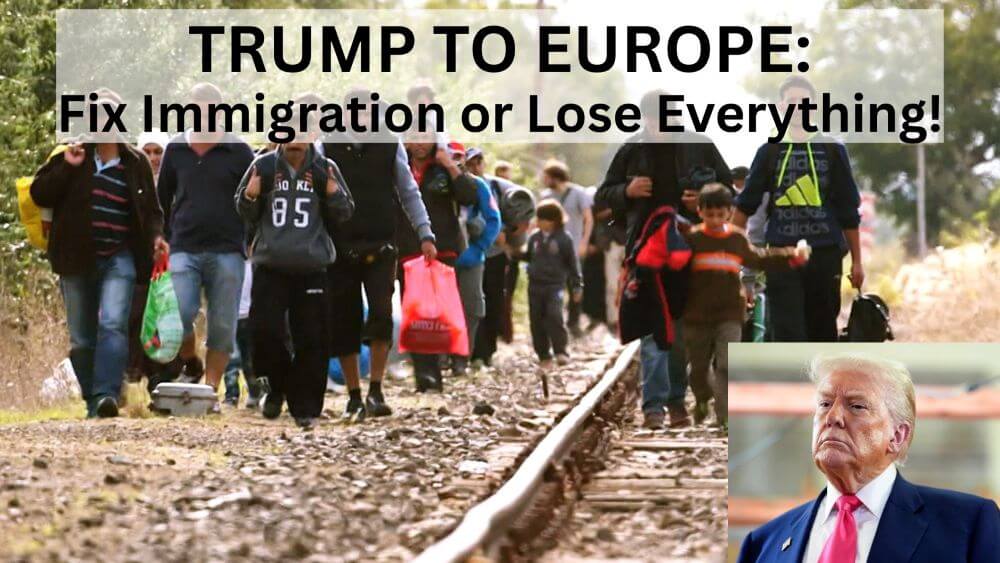
Today, July 25, 2025, former U.S. President Donald Trump arrived in Scotland, sparking global headlines once again—not for his business ventures or golf courses, but for his truthful commentary on Europe’s immigration policies.
Speaking to a group of reporters, Trump issued a stark warning:
On immigration, you better get your act together—you’re not gonna have Europe anymore.”
Donald Trump is right, his underlying message taps into a growing concern shared by many across Europe and beyond: the future of national identity in the face of rising migration.
Immigration is good, but immigrants have to integrate in the community. They can not be committing crimes and raping women.
A Consistent—and Global—Message
Trump’s remarks in Scotland are not new. During his presidency, he pushed hardline immigration policies like the U.S.-Mexico border wall, travel bans, and increased deportations of undocumented immigrants. His message was clear: a country without borders isn’t a country at all.
Trump’s ideas have had a ripple effect. Institutions like Spain’s Real Instituto Elcano have noted a “contagion effect,” where Trump-style immigration rhetoric has influenced policy decisions in countries far beyond the U.S.
Today, several European governments are taking a page from Trump’s playbook. Germany, long known for its openness to refugees, has adopted stricter asylum policies. The United Kingdom, post-Brexit, is clamping down on economic migration. In Eastern Europe, Poland and Hungary have gone even further, instituting near zero-tolerance policies for illegal immigration.
The result? According to government crime statistics and third-party analyses, crime rates remain relatively low, and social cohesion appears strong in those countries—though these claims remain the subject of ongoing debate among academics and activists.
Is Trump Right?
Let’s be clear: immigration is a complex issue. It’s about more than just borders—it involves human rights, economics, demographics, and values. But Donald Trump is right to highlight the consequences of unchecked immigration.
If countries fail to define their national boundaries and expectations for integration, the result can be cultural fragmentation, overwhelmed public services, and political instability. We’ve seen examples of this in urban centers where parallel communities develop with limited assimilation, creating tension instead of unity.
In contrast, countries that maintain clear immigration policies—enforcing their laws while encouraging lawful, values-based migration—tend to experience greater internal stability.
Europe’s Crossroads
Europe stands at a crossroads. The continent is grappling with war-driven refugees from Ukraine, economic migrants from Africa, and asylum seekers from the Middle East and South Asia. These movements are not slowing down—and governments must make difficult choices.
Trump’s statement, however provocative, is a wake-up call. If Europe fails to “get its act together,” as he put it, the continent may indeed lose touch with the values and cohesion that once defined it.
Final Thoughts
I do believe that Europe must take firmer control over its immigration policies—not out of hatred or fear, but out of necessity. Without decisive action, Europe risks losing the very essence of what makes it Europe: its cultural identity, its social cohesion, and its foundational values.
The examples of Poland and Hungary offer a model worth examining. These countries have taken a no-nonsense approach to illegal immigration, prioritizing national sovereignty and community stability. The result? Lower crime rates, fewer internal tensions, and a clearer sense of collective identity.
This doesn’t mean slamming the door shut on those in need. It means creating clear rules, secure borders, and well-managed integration systems. Compassion and order are not mutually exclusive—they must coexist.
If Europe wants to preserve what it is, it must act—before it becomes something unrecognizable.
Previous Politics posts